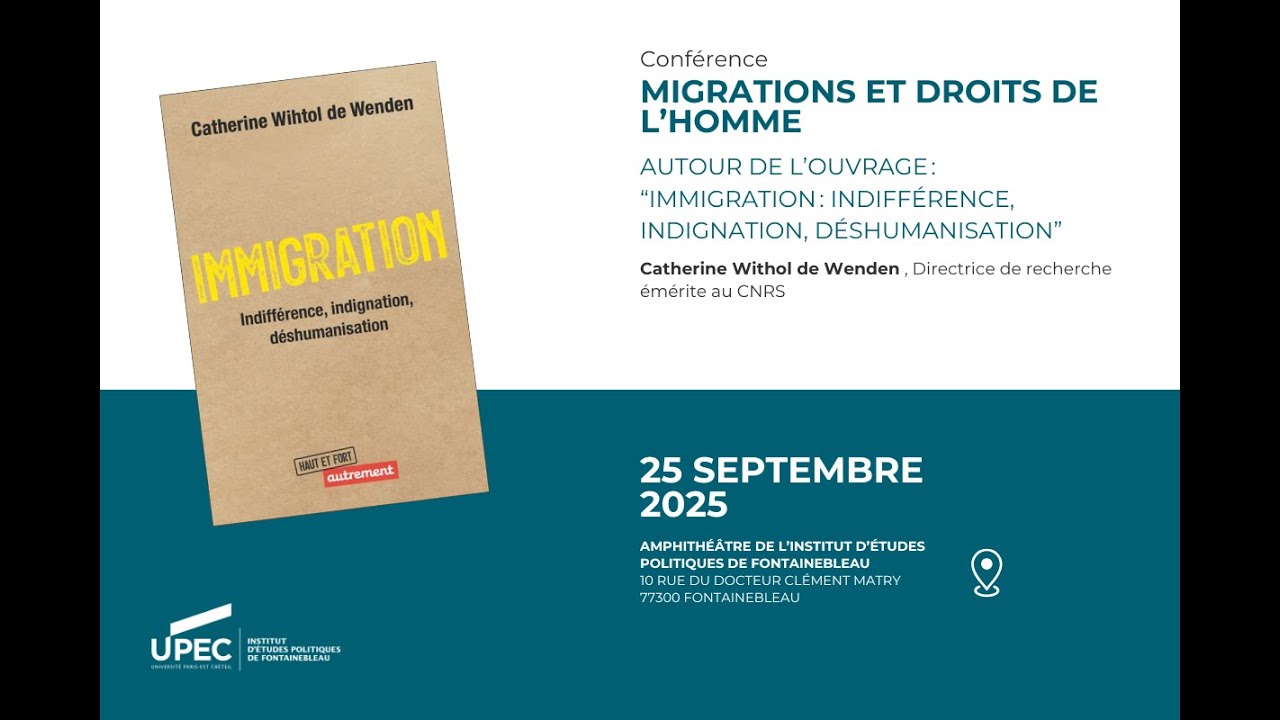
Conférence - Catherine Whitol de Wenden "Migrations et droits de l'homme"
Keywords
Summary
175 words
Critical Evaluation
Value of the Information & Strength of the Argument
The talk provides valuable insights into the legal and ethical dimensions of migration, drawing on the speaker’s extensive expertise. The argumentation is coherent and well-structured, moving from foundational principles to contemporary challenges. The speaker effectively uses data to counter common misconceptions, such as the belief that most migration is from South to North, when in fact most migration is intra-regional. She also highlights the paradox of increased border controls alongside persistent migration flows. The value lies in its comprehensive overview and the authority of the speaker, though it remains an opinion-based lecture rather than a systematic review.
Scientific Rigor, Source Quality, Title Accuracy
The speaker demonstrates scientific rigor by referencing international legal instruments and UN data, though specific citations are not provided during the talk. The title accurately reflects the content, which is a lecture on migration and human rights. The talk is based on the speaker’s published work and expertise, lending credibility. However, the lack of explicit source citations in the video limits the ability to verify all claims. The title is appropriate and not misleading.
186 words
Title / Content Match
The title accurately reflects the content, which focuses on the intersection of migration and human rights.
Quality & Reliability
8/10
The speaker is a recognized expert (CNRS emeritus research director) and the content is based on established international data and legal frameworks. However, the talk is an opinion/expert lecture without systematic citation of sources, and some figures are approximate.
Key Moments
Markers derived by PSI from the transcript: the creator did not define chapters.
- Introduction and presentation of the speaker by the host.
- Discussion of the legal foundations of migration and human rights, including the 1951 Geneva Convention and the Universal Declaration of Human Rights.
- Overview of global migration statistics, emphasizing that most migration is intra-regional.
- Analysis of the shift from difficult exit to difficult entry, and the visa hierarchy.
- Critique of securitization and populist influences on migration policies.
- Discussion of the role of civil society and legal advocacy in defending migrants' rights.
- Conclusion and call to recognize migration as a permanent phenomenon.
Cited Sources
- Convention relating to the Status of Refugees (1951) — Referenced as the foundation of the right to asylum.
- Universal Declaration of Human Rights (1948) — Cited for Article 13 on the right to leave any country.
- Treaty of Maastricht (1992) — Mentioned as establishing European citizenship and freedom of movement.
- Kant's Perpetual Peace (1795) — Referenced for the concept of universal citizenship.
- GISTI (Groupe d'information et de soutien des immigré·e·s) — Mentioned as an example of legal advocacy for migrants.
Concurring Sources
- UNHCR Global Trends Report — Provides data on refugee movements that align with the speaker's claims about regional displacement.
- IOM World Migration Report — Offers comprehensive migration statistics that support the speaker's overview.
Dissenting Sources
- Academic critique of securitization of migration — Some scholars argue that securitization is necessary for national security, contrasting with the speaker's human rights perspective.
Contribution & Novelties
The talk provides a comprehensive and accessible overview of the intersection between migration and human rights, drawing on the speaker’s extensive research and expertise. It challenges common misconceptions about migration patterns and highlights the legal and ethical tensions inherent in state sovereignty versus individual rights. The speaker’s emphasis on the role of civil society and legal advocacy offers a unique perspective on how to address human rights violations in migration governance.
Pour aller plus loin :
- International Migration Report 2020 — Provides up-to-date global migration statistics.
- The Global Compact for Safe, Orderly and Regular Migration — An international framework for migration governance.
- Hannah Arendt’s concept of ‘right to have rights’ — Philosophical foundation for human rights of migrants.
- Zygmunt Bauman’s ‘Liquid Modernity’ — Discusses the paradox of mobility in the modern world.
132 words
Radar Profile
The radar profile shows high scores in quantity and quality of information, reflecting the speaker's expertise and comprehensive coverage. The technical level is moderate, suitable for a general academic audience. The overall reliability is high, though the lack of explicit citations slightly reduces the score.
💬 No comments were provided for analysis.