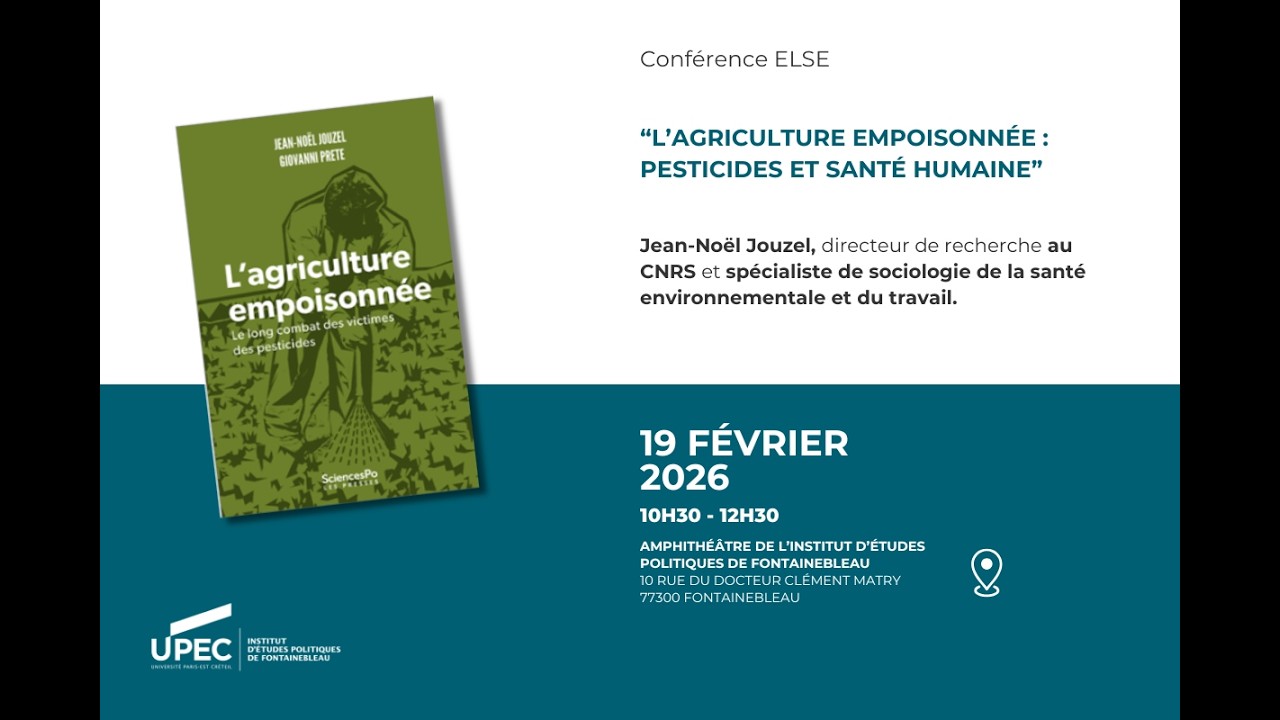
Conférence de l'IEP : Jean-Noël Jouzel "L’agriculture empoisonnée : pesticides et santé humaine"
Keywords
Summary
128 words
Critical Evaluation
Value of the Information & Strength of the Argument
The talk provides valuable insights into the social construction of occupational health issues, drawing on extensive qualitative research. The argumentation is solid, based on a long-term ethnographic study and supported by references to epidemiological literature and institutional reports. The speaker effectively demonstrates the paradox of farmers as both users and victims of pesticides, and the complex processes of recognition and mobilization.
Scientific Rigor, Source Quality, Title Accuracy
The speaker is a recognized expert, and the content is grounded in rigorous academic research. He cites INSERM collective expertise reports and his own published works. The title accurately reflects the content, focusing on the health impacts of pesticides on farmers. The presentation is well-structured and scientifically sound.
124 words
Title / Content Match
The title accurately reflects the content, which focuses on the health impacts of pesticides on farmers and the social dynamics of recognizing them as victims.
Quality & Reliability
8/10
The speaker is a CNRS research director and sociologist, presenting findings from a long-term study. The talk is based on peer-reviewed research and published books, but it is a conference presentation, not a peer-reviewed article itself.
Key Moments
Markers derived by PSI from the transcript: the creator did not define chapters.
- Introduction by the host and presentation of the speaker.
- Start of the talk: presentation of the book and the investigation on Phytovictims.
- Overview of the evolution of French agriculture and the role of pesticides.
- Discussion of the regulatory framework for pesticides and the concept of 'safe use'.
- Presentation of epidemiological evidence linking pesticides to chronic diseases.
- Analysis of the social and political challenges for farmers to be recognized as victims.
- Discussion of the intergenerational effects and the role of family in these mobilizations.
Cited Sources
- Pesticides : comment ignorer ce que l'on sait — Previous book by the speaker, mentioned as a reference for the issue of 'safe use'.
- L'agriculture empoisonnée — The book presented in the talk, co-authored with Giovanni Prete.
- Expertise collective INSERM 2013 — Cited as the first INSERM collective expertise establishing links between pesticides and Parkinson's disease.
- Expertise collective INSERM 2021 — Cited as the updated expertise adding further evidence on pesticides and health.
Concurring Sources
- Pesticides et santé - Expertise collective INSERM 2021 — Confirms the epidemiological links between pesticides and various diseases.
Contribution & Novelties
The talk offers a sociological perspective on the recognition of farmers as victims of pesticides, a topic often treated from a biomedical or epidemiological angle. It highlights the social processes, alliances, and legitimation work required for this recognition. The investigation is original in its focus on the collective mobilization of farmers and the intergenerational dimension.
Pour aller plus loin :
- Pesticides et santé - Expertise collective INSERM 2021 — Comprehensive review of scientific evidence.
- Sociologie des problèmes publics — Theoretical framework for understanding how issues become public problems.
- Maladie professionnelle — Overview of the legal and social recognition of occupational diseases.
101 words
Radar Profile
The radar profile shows high scores in information quantity, quality, and reliability, with a moderate technical level. This indicates a well-informed and credible presentation, accessible to a general audience but with solid scientific grounding.