Le SOC Autonome de Bell : La Prochaine Évolution en Cybersécurité
Keywords
Summary
181 words
Critical Evaluation
Value of the Information & Strength of the Argument
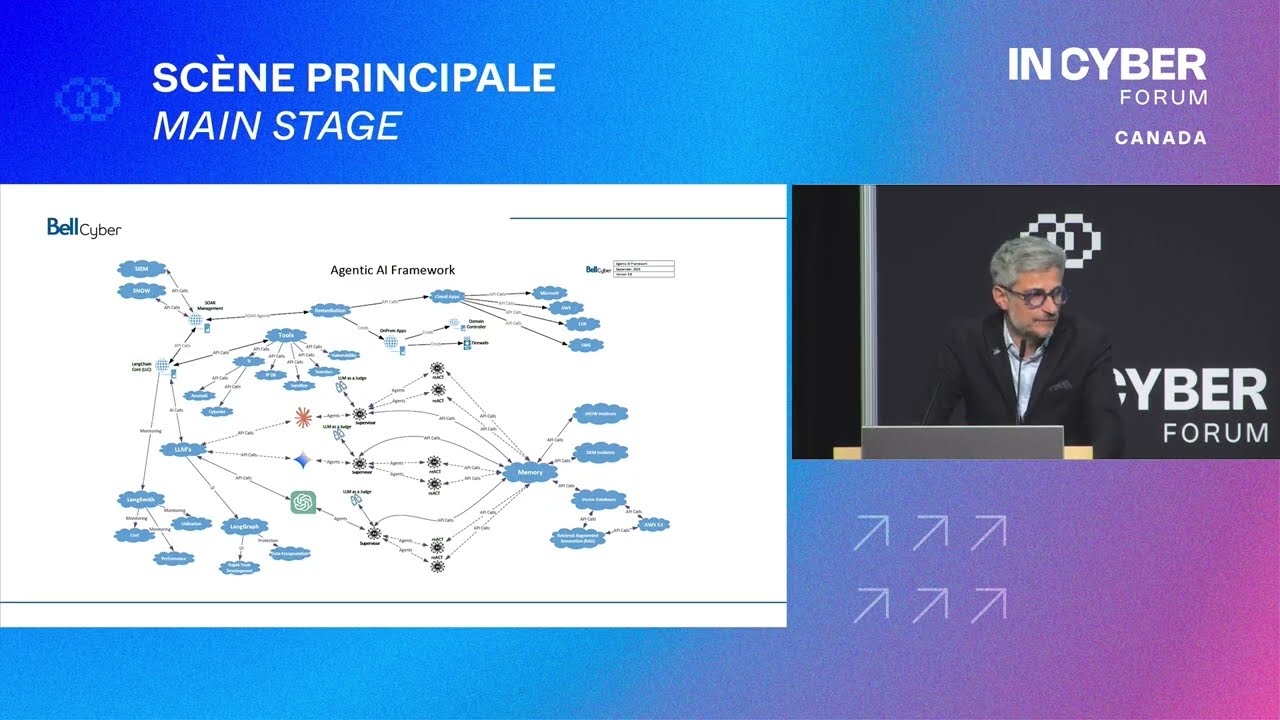
The talk provides valuable insights into the practical implementation of AI in a SOC, detailing the architecture and components of Bell’s autonomous SOC. The argumentation is based on the speaker’s direct experience and specific examples, such as the use of ReAct agents and the ‘LLM as a judge’ concept. However, the talk is largely promotional, lacking independent validation or comparative analysis with other solutions. The speaker does not provide quantitative metrics beyond error rates, and the claims about effectiveness are not backed by external data.
Scientific Rigor, Source Quality, Title Accuracy
The talk is scientifically rigorous in terms of technical detail, but it relies solely on the speaker’s expertise and Bell’s internal practices. No external sources are cited, and the only references are to Bell’s own initiatives and partnerships. The title accurately reflects the content, focusing on the autonomous SOC as the next evolution in cybersecurity. The talk does not address potential limitations or alternative approaches, which could be seen as a lack of critical perspective.
175 words
Title / Content Match
The title accurately reflects the content, focusing on Bell's autonomous SOC and its evolution.
Quality & Reliability
7/10
The speaker is a Director of Cybersecurity at Bell Canada, providing an insider perspective on their autonomous SOC. The talk is based on practical experience and specific technical details, but lacks external citations or verifiable data, and is promotional in nature.
Key Moments
Markers derived by PSI from the transcript: the creator did not define chapters.
- Introduction to Bell Cyber's history and acquisition of Strategemme.
- Explanation of the evolution of Bell's SOC, including cloud migration and mesh architecture.
- Discussion on the need for automation due to AI-powered attacks.
- Overview of the AI framework components: agents, automation, and threat intelligence.
- Description of the mesh architecture and the addition of the autonomous SOC layer.
- Explanation of the 'LLM as a judge' mechanism to reduce errors.
- Details on the use of LangChain and ReAct agents in the framework.
- Mention of the partnership with Cohere for sovereign LLMs and conclusion.
Cited Sources
- INCYBER Forum Canada — Mentioned as the event where this talk was given.
- INCYBER Forum Canada LinkedIn — Mentioned as a way to follow the forum.
Concurring Sources
- Gartner on Predictive Security — The speaker references Gartner's concept of predictive security, which aligns with the proactive approach described.
Dissenting Sources
- Potential limitations of AI in SOC — The talk does not discuss potential drawbacks or challenges of AI-driven SOCs, such as adversarial attacks on AI models or over-reliance on automation.
Contribution & Novelties
The talk provides a detailed case study of Bell Canada’s autonomous SOC, offering insights into the practical integration of AI and LLMs in a real-world cybersecurity operations center. It highlights the use of a ‘LLM as a judge’ to improve accuracy and the importance of threat intelligence in predictive security. The talk also touches on the development of sovereign AI models, which is a forward-looking aspect.
Pour aller plus loin :
- ReAct: Synergizing Reasoning and Acting in Language Models — This paper introduces the ReAct pattern used in the agents described.
- LangChain — The framework used to build the AI agents.
- LLM as a Judge — A paper discussing the use of LLMs to evaluate other LLMs, relevant to the ‘LLM as a judge’ concept.
125 words
Radar Profile
The radar profile shows a balanced performance across all dimensions, with slightly higher scores in information quantity and quality, reflecting the detailed technical content. The lower score in technical level suggests the talk is accessible to a broad audience, while the reliability score is moderate due to the lack of external validation.
💬 No comments were provided for analysis.