(DT10) (CFI) Cybersécurité et Digitalisation, Sécuriser la Data pour Maximiser la Valeur à l'ère de l'IA
Keywords
Summary
158 words
Critical Evaluation
Value of the Information & Strength of the Argument
The talk provides valuable insights into the practical application of cybersecurity in industrial digital transformation, drawing on Schneider Electric’s experience. The argumentation is coherent, emphasizing that cybersecurity is a key enabler rather than a burden. However, the claims about specific benefits (e.g., 7% production increase) are not backed by detailed evidence or case studies, and the presentation remains at a high level without diving into technical specifics. The speaker’s authority and real-world examples add credibility, but the lack of quantifiable data weakens the overall argument.
Scientific Rigor, Source Quality, Title Accuracy
The talk does not cite external sources or academic references, relying solely on the speaker’s professional experience. The title accurately reflects the content, which focuses on securing data to maximize value in the AI era. The presentation is consistent with the title, though it could have delved deeper into AI-specific security challenges. No comments were provided for analysis.
158 words
Title / Content Match
The title accurately reflects the content, which discusses cybersecurity and digitalization in the context of securing data for value creation in the AI era.
Quality & Reliability
6/10
The speaker is a cybersecurity architect at Schneider Electric, providing practical insights from industrial experience. However, the talk is largely anecdotal, lacks detailed technical depth, and does not cite specific studies or standards. Claims about ROI and production increases are not substantiated with data.
Key Moments
Markers derived by PSI from the transcript: the creator did not define chapters.
- Introduction of speaker and topic
- Overview of threat landscape and need for cybersecurity
- Schneider Electric's digital transformation journey and three pillars
- Maturity model for industrial sites (standard, smart, advanced)
- Data collection and contextualization architecture
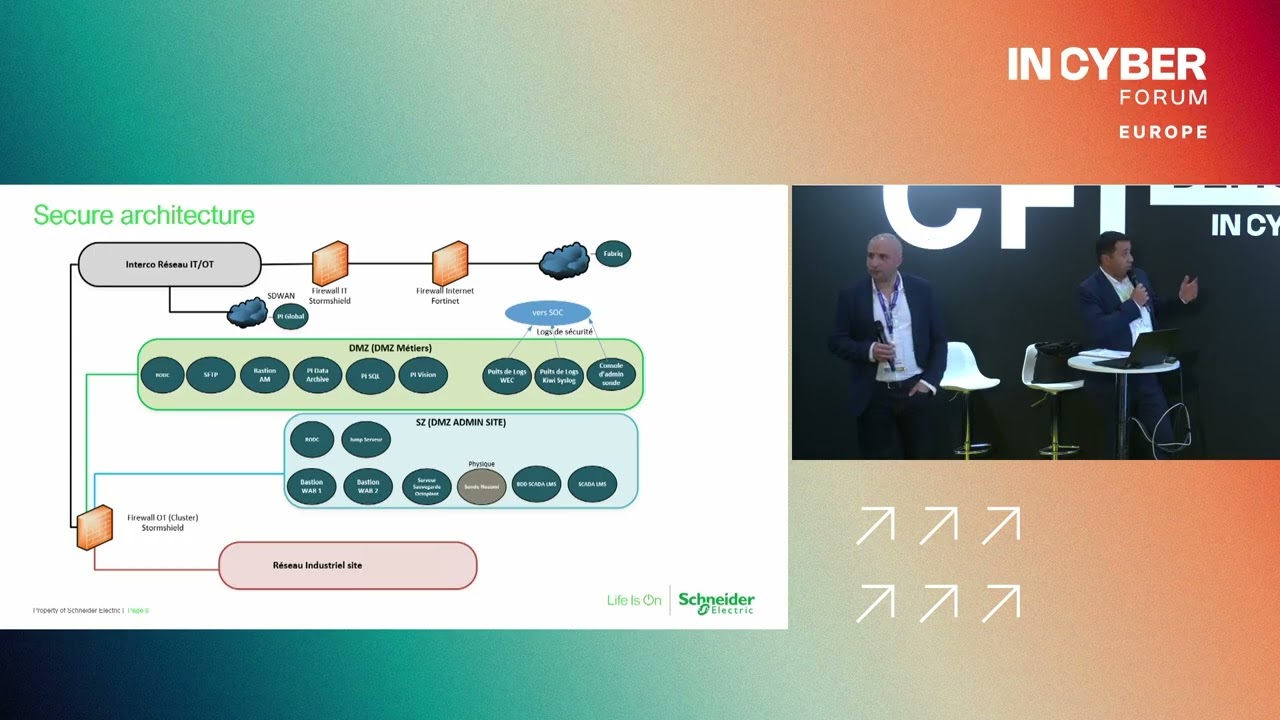
- Security architecture: segmentation, control, supervision
- Deployment framework and SOC services
- Benefits and ROI of digital transformation with cybersecurity
- Conclusion and invitation for questions
Cited Sources
- Forum INCYBER Europe — Event website for the forum where this talk was presented.
- Forum INCYBER Europe LinkedIn — LinkedIn page of the forum, providing additional context.
Concurring Sources
- IEC 62443 — Standards for industrial automation and control systems security, aligning with the speaker's emphasis on segmentation and defense-in-depth.
- NIST Cybersecurity Framework — Framework for improving cybersecurity, supporting the approach of integrating security into digital transformation.
Dissenting Sources
- No specific discordant sources identified — The talk does not present controversial claims that would contradict established literature.
Contribution & Novelties
The talk offers a practitioner’s perspective on integrating cybersecurity into industrial digital transformation, emphasizing the importance of data security for maximizing value. It provides a framework for assessing site maturity and highlights the need for a unified data platform. While not groundbreaking, it reinforces the message that cybersecurity is a business enabler.
Pour aller plus loin :
- IEC 62443 — International standards for industrial cybersecurity, relevant to the security architecture discussed.
- NIST Cybersecurity Framework — A widely adopted framework for improving cybersecurity, applicable to the segmentation and control strategies.
- Digital Twin — Concept related to the digital simulation use case mentioned, enabling real-time monitoring and optimization.
106 words
Radar Profile
The radar profile shows moderate scores across all dimensions, indicating a balanced but not exceptional presentation. The talk provides practical insights but lacks depth and rigorous sourcing, resulting in a moderate overall assessment.