(DT30) (INCYBER) De quelques jours à quelques secondes : L'évolution de l'intelligence Real-Time DNS
Keywords
Summary
173 words
Critical Evaluation
Value of the Information & Strength of the Argument
The presentation provides valuable insights into the practical application of DNS data for cybersecurity. The speaker demonstrates the importance of real-time monitoring and the use of risk scores to prioritize threats. The argumentation is solid, based on the company’s extensive experience and data coverage. However, the talk is largely a product demonstration, so the value is more in showcasing capabilities than in providing independent analysis. The speaker effectively argues that DNS data is a rich source of threat intelligence, and the live demos illustrate the speed and utility of their tools.
Scientific Rigor, Source Quality, Title Accuracy
The presentation is scientifically rigorous in the sense that it relies on DomainTools’ proprietary data, which is a legitimate source for DNS intelligence. However, no external sources are cited, and the claims are not independently verified. The title accurately reflects the content, focusing on the evolution of real-time DNS intelligence. The talk is well-structured and the demos are convincing, but the lack of citations and the promotional nature of the content slightly reduce its scientific credibility.
182 words
Title / Content Match
The title accurately reflects the content, focusing on the evolution of real-time DNS intelligence and the speed of DomainTools' services.
Quality & Reliability
7/10
The speaker is a representative of DomainTools, a well-established company in DNS intelligence. The presentation is based on their proprietary data and tools, but lacks independent verification. The claims about real-time DNS monitoring and risk scoring are plausible but not backed by external studies.
Key Moments
Markers derived by PSI from the transcript: the creator did not define chapters.
- Introduction and presentation of DomainTools' history and mission.
- Explanation of DNS mapping and the concept of domain lifecycle.
- Introduction of the risk score and its components (phishing, malware, spam, proximity).
- Demo of Iris Detect for brand protection and phishing detection.
- Demonstration of escalating suspicious domains and integration with Google Web Risk.
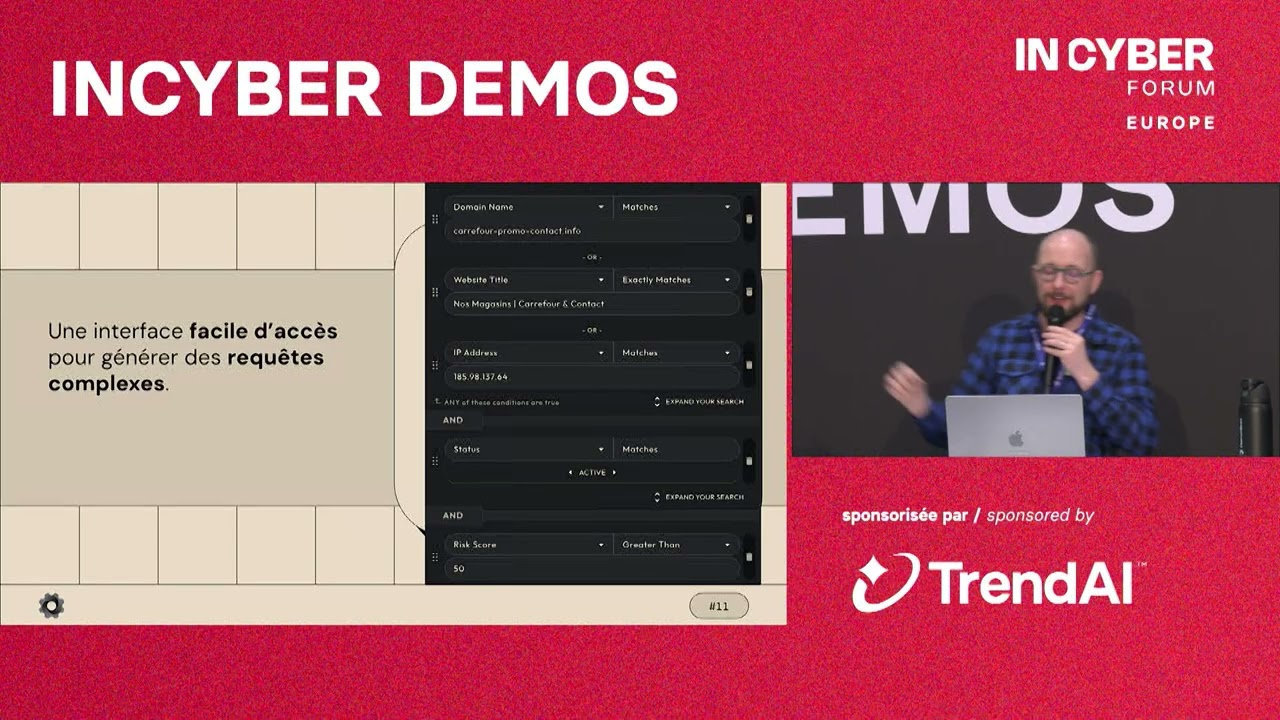
- Transition to Iris Investigate and introduction of IRISQL query language.
- Live investigation of a Carrefour phishing domain, pivoting on website title and IP address.
- Expansion of the investigation to 451 domains associated with a malicious IP.
- Conclusion and mention of MCP integration for AI.
Cited Sources
- INCYBER Forum Europe — Event website for the INCYBER Forum where the presentation took place.
- INCYBER Forum Europe LinkedIn — LinkedIn page of the INCYBER Forum Europe.
Concurring Sources
- DomainTools — Official website of DomainTools, the company behind the presented tools.
Contribution & Novelties
The presentation highlights DomainTools’ real-time DNS intelligence, which is a significant advancement in threat detection. The introduction of IRISQL is a novel approach to querying DNS data, making it more accessible and shareable. The risk score based on proximity to malicious infrastructure is a unique feature that allows proactive blocking. The talk also emphasizes the speed of detection, reducing response times from days to seconds.
Pour aller plus loin :
- DomainTools — Official website of the company, providing more details on their products and services.
- DNS-based threat intelligence — Wikipedia article on DNS-based threat intelligence, offering background on the concept.
- IRISQL documentation — Blog post introducing IRISQL, though the URL is not verified; if uncertain, consider searching for ‘DomainTools IRISQL’ on their site.
123 words
Radar Profile
The radar profile shows high scores in information quantity and quality, reflecting the detailed and practical content. The technical level is moderate, suitable for a professional audience. The reliability score is slightly lower due to the promotional nature and lack of external verification.