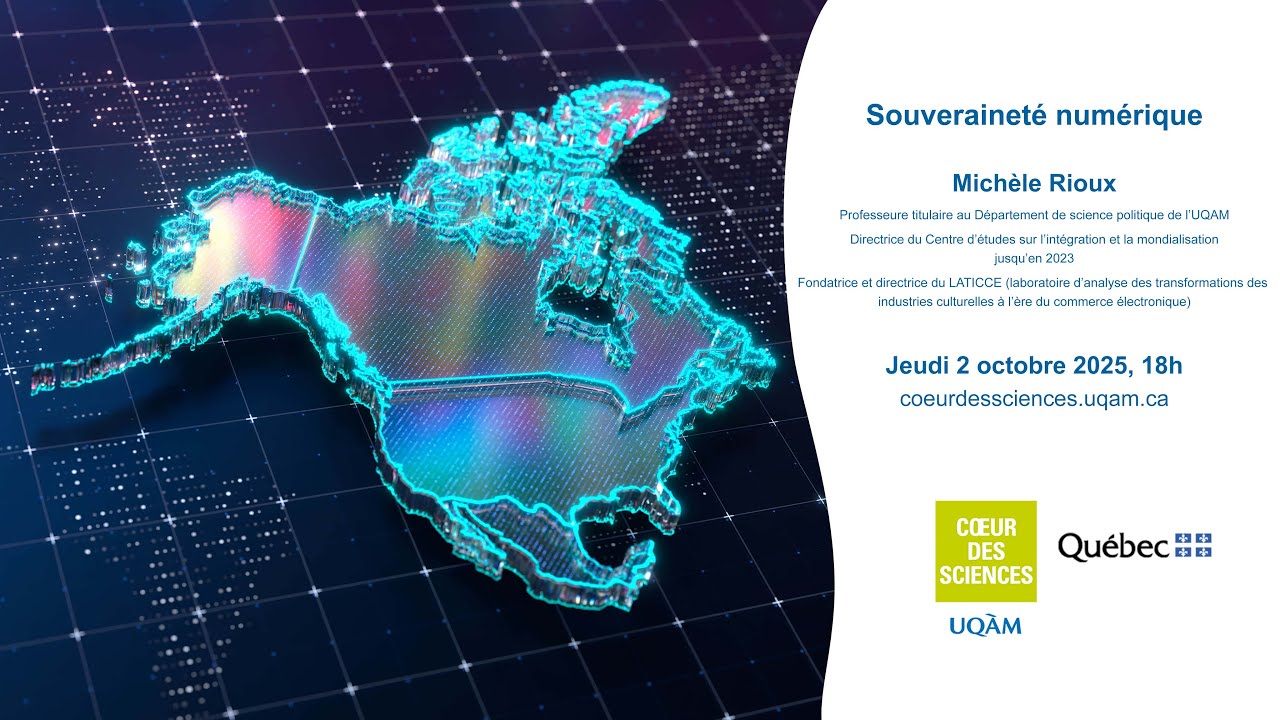
Conférence - Souveraineté numérique - Mardi 2 octobre 2025
Keywords
Summary
160 words
Critical Evaluation
Value of the Information & Strength of the Argument
The talk provides a valuable overview of digital sovereignty, synthesizing various dimensions and comparing international approaches. Rioux’s argumentation is coherent, drawing on her extensive research and experience. She effectively illustrates the shift from multi-stakeholder governance to state-centric control and highlights the role of corporations. However, the argumentation is more descriptive than analytical, with limited critical depth on specific policies or data. The discussion of cultural discoverability adds a unique perspective, but the talk could benefit from more concrete examples and evidence.
Scientific Rigor, Source Quality, Title Accuracy
The speaker demonstrates scientific rigor through her academic background and references to her own research and collaborations. However, she does not systematically cite specific sources during the talk, relying more on general knowledge and her expertise. The title accurately reflects the content, which is a conference on digital sovereignty. The talk is well-structured and covers key aspects, but the lack of explicit citations reduces its verifiability. The description provides some context, but no detailed references are given.
173 words
Title / Content Match
The title accurately reflects the content, which is a conference on digital sovereignty.
Quality & Reliability
7/10
The speaker is a recognized academic expert in political science and digital governance, providing a well-structured overview. However, the talk is largely based on personal expertise and general observations rather than detailed citations or empirical data, limiting its verifiability.
Chapters
Cited Sources
- Attributes of Digital Sovereignty (article by Morau Santanielo) — Mentioned as a recent article describing attributes of digital sovereignty.
Concurring Sources
- Digital Sovereignty - Wikipedia — Provides a general definition and context that aligns with the talk's framing.
Contribution & Novelties
The talk provides a comprehensive and accessible overview of digital sovereignty, integrating perspectives from internet governance, trade, and culture. It highlights the specific case of Quebec’s cultural discoverability policies, which is a distinctive contribution. The speaker’s emphasis on the co-responsibility of states, organizations, and individuals offers a nuanced view.
Pour aller plus loin :
- Digital sovereignty - Wikipedia — Provides a general overview and definitions.
- General Data Protection Regulation (GDPR) — Key EU regulation on data protection, relevant to digital sovereignty.
- Discoverability in the digital environment - UNESCO — Discusses cultural discoverability, a key topic in the talk.
98 words
Radar Profile
The radar profile shows a balanced performance across all dimensions, with slightly higher scores in information quantity and quality, reflecting the speaker's expertise and comprehensive coverage. The lower technical level indicates the talk is accessible to a general audience.
💬 No comments were provided for analysis.