4 Shri Sameer Hajela, Nuclear Reactor Technology :Reliability and Safety
Keywords
Summary
168 words
Critical Evaluation
Value of the Information & Strength of the Argument
The presentation offers substantial value by systematically explaining the safety framework for nuclear power plants, drawing on IAEA and AERB standards. The argumentation is logical and well-structured, moving from general safety objectives to specific design and operational measures. The speaker effectively uses the defense-in-depth concept to illustrate how multiple layers of protection ensure safety. He provides concrete examples, such as dose limits and site rejection criteria, which ground the discussion in practical reality. The emphasis on the licensee’s responsibility and the need for independent verification strengthens the credibility of the argument. Overall, the content is highly informative and persuasive, demonstrating a deep understanding of nuclear safety.
Scientific Rigor, Source Quality, Title Accuracy
The presentation demonstrates high scientific rigor, referencing authoritative sources such as IAEA safety standards and AERB codes. The speaker, a senior expert from NPCIL, provides detailed technical information that aligns with established nuclear safety principles. The title accurately reflects the content, which focuses on nuclear reactor technology with emphasis on reliability and safety. The talk is well-organized and covers key aspects of safety from siting to operation, with appropriate references to regulatory documents. The use of specific examples and criteria enhances the credibility of the information presented.
208 words
Title / Content Match
The title accurately reflects the content, which focuses on nuclear reactor technology with emphasis on reliability and safety.
Quality & Reliability
8/10
Presentation by a senior NPCIL official with deep technical expertise, referencing IAEA and AERB standards. The content is authoritative and well-structured, though it is a single expert's perspective without independent verification.
Key Moments
Markers derived by PSI from the transcript: the creator did not define chapters.
- Introduction to safety objectives and definitions from IAEA standards.
- Explanation of radiation dose limits for normal and accident conditions.
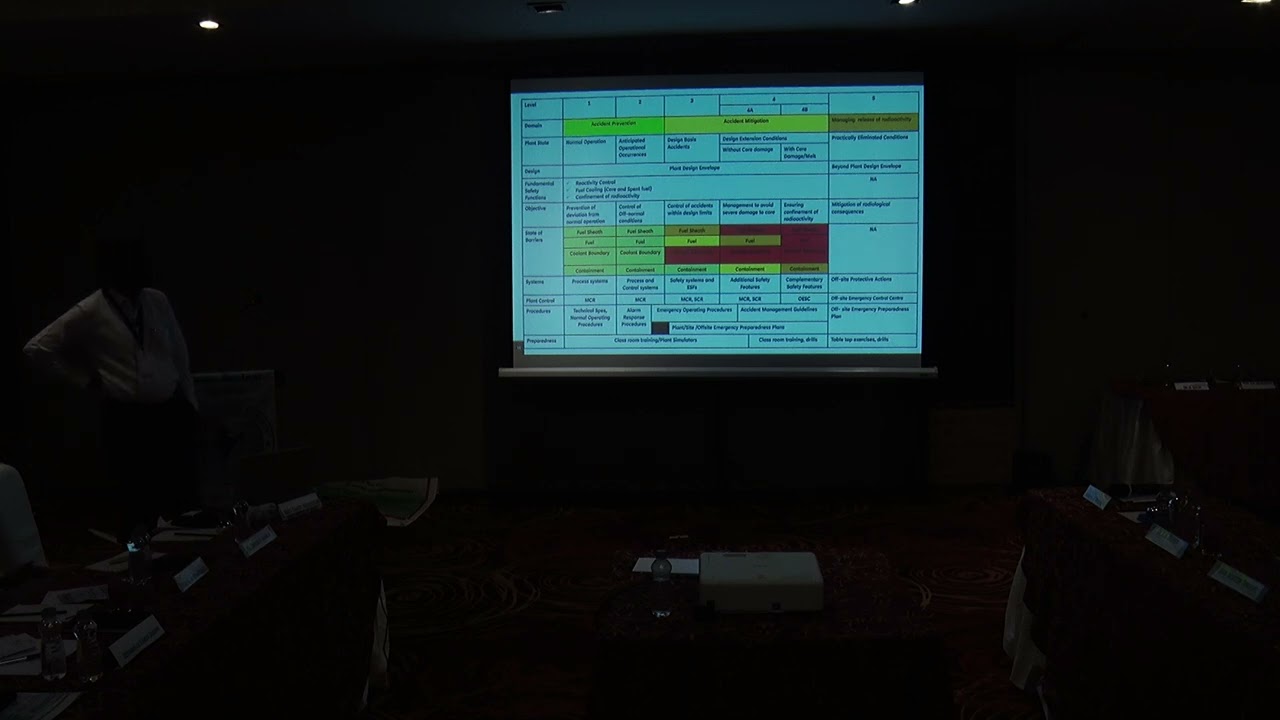
- Detailed discussion of defense-in-depth levels and physical barriers.
- Site selection criteria and external event considerations.
- Design principles including safety classification, redundancy, and diversity.
- Construction, commissioning, and operation safety measures.
- Periodic safety reviews and multi-tier review process.
Cited Sources
- IAEA Fundamental Safety Principles — Referenced as the basis for safety objectives and standards.
- AERB Safety Codes and Guides — Mentioned as regulatory documents guiding design and operation in India.
Concurring Sources
- IAEA Fundamental Safety Principles — Aligns with the safety objectives and principles discussed.
- AERB Safety Codes and Guides — Supports the regulatory framework mentioned in the presentation.
Contribution & Novelties
The presentation provides a comprehensive and structured overview of nuclear safety, integrating IAEA and AERB standards with practical implementation details. It emphasizes the defense-in-depth approach and the importance of maintaining physical barriers. The speaker’s expertise adds credibility, and the discussion of site selection and design criteria offers valuable insights for professionals.
Pour aller plus loin :
- Defense-in-depth (nuclear safety) — Explains the concept in detail.
- IAEA Safety Standards — Official source for safety standards.
- AERB (Atomic Energy Regulatory Board) — Indian regulatory body for nuclear safety.
86 words
Radar Profile
The radar profile shows high scores in quality and technical level, indicating a technically dense and reliable presentation. The quantity of information is also high, providing comprehensive coverage. The overall reliability is strong, reflecting the authoritative source and adherence to recognized standards.