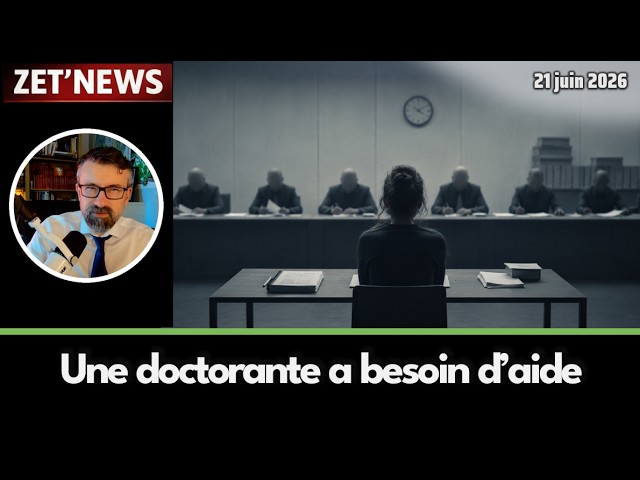
Handicap, intégrité scientifique, risque suicidaire : une doctorante lance l’alerte à l’université
Keywords
Summary
133 words
Critical Evaluation
The video provides a detailed account of a doctoral student’s allegations of institutional failures, including disability discrimination, harassment, and threats to scientific integrity. The presenter, Thomas C. Durand, is known for his critical stance on pseudoscience, and he applies this lens to the case, particularly focusing on the appointment of Alice Guillon as thesis director. The argumentation is structured and relies on documented evidence, such as committee reports and legal filings, which adds credibility. However, the video is inherently one-sided, as it is based on the student’s account and the presenter’s interpretation. The presenter acknowledges this limitation and notes that the legal process will determine the facts. The scientific rigor is moderate; while the presenter correctly identifies red flags in Guillon’s background, he does not provide a balanced view of the university’s perspective. The sources cited are primarily the student’s documents and the presenter’s own website, which may not be sufficient for a fully objective assessment. The title accurately reflects the content, and the video serves as a call to action for public support. Overall, the video is informative and raises important issues, but viewers should be aware of its advocacy nature.
192 words
Title / Content Match
The title accurately reflects the content, which covers the doctoral student's allegations of disability discrimination, threats to scientific integrity, and suicide risk, and her call for support.
Quality & Reliability
7/10
The video is based on a documented case file provided by the doctoral student, with references to official procedures and legal steps. However, it relies heavily on the student's account and the presenter's own commentary, with limited independent verification. The presenter acknowledges the need for judicial resolution.
Key Moments
Markers derived by PSI from the transcript: the creator did not define chapters.
- Introduction: presenter explains the case of Samar El Reiki, a doctoral student at Aix-Marseille University.
- Details of Samar's recruitment and her academic merit, emphasizing she was top of her class.
- Description of the difficulties Samar faced: isolation, inadequate workspace, conflicts, and alleged confidentiality breaches.
- Legal steps taken: request for functional protection, referral to the tribunal administratif, and involvement of various authorities.
- Discussion of scientific integrity issues: alleged interference with her research protocol and concerns about attribution.
- Introduction of Alice Guillon as new thesis director and concerns about her background in pseudoscientific practices.
- Details of the crisis in 2025: referral to the judge, suicide alert, and lack of institutional response.
- Call to action: support for Samar through the legal fund and the importance of defending doctoral students.
Cited Sources
- Article version texte on Menace Théoriste — Written version of the video content, providing detailed documentation of the case.
- Collecte HelloAsso pour le Fonds Justice — Link to the fundraising campaign to support Samar's legal case.
- Extrait du magazine du 21 juin 2026 — Live stream where the case was first discussed.
- Chaîne Twitch de La Tronche en Biais — Presenter's Twitch channel for further discussions.
- Page Ulule de La Tronche en Biais — Support platform for the presenter's work.
- Inscription à la NEWS'Zet — Newsletter subscription for updates on the case.
Concurring Sources
- Article version texte sur Menace Théoriste — Written version of the video, providing additional details and documents.
Dissenting Sources
- Aix-Marseille Université (réponse officielle) — The university contests the allegations, but no specific source is provided in the video. The presenter notes that the university rejects the claims.
Contribution & Novelties
The video brings attention to a specific case of alleged institutional failure in French academia, highlighting issues of disability accommodation, scientific integrity, and mental health support for doctoral students. It provides a detailed narrative based on documentary evidence and calls for public support. The novelty lies in the public exposure of these issues and the potential for setting a precedent.
Pour aller plus loin :
- Intégrité scientifique — Overview of scientific integrity principles.
- Harcèlement moral en milieu universitaire — General concept of moral harassment, applicable to academic settings.
- Défenseur des droits — French institution that can be seized in cases of discrimination.
- Protection fonctionnelle — Legal protection for public servants, including doctoral students.
- Santé intégrative — Concept of integrative medicine, relevant to the controversy around Alice Guillon.
127 words
Radar Profile
The radar profile shows high scores in information quantity and reliability, but lower in technical level, reflecting the video's focus on a case study rather than deep scientific methodology. The overall balance suggests a well-documented but advocacy-oriented presentation.
💬 Très positif. Sur les 30 commentaires analysés, la grande majorité exprime un soutien massif à la doctorante et une indignation face aux pratiques dénoncées, avec des encouragements et des dons. Quelques commentaires critiquent la directrice de thèse et les pratiques pseudoscientifiques, mais aucun ne remet en cause le fond du témoignage.