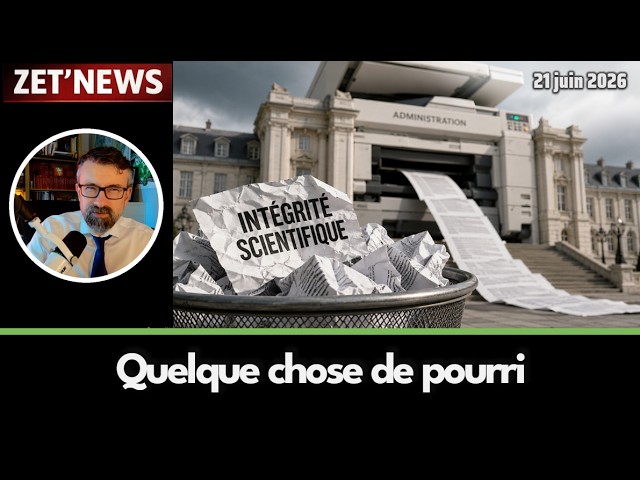
Doctorats, plagiat & conséquences
Keywords
Summary
155 words
Critical Evaluation
The video provides a compelling and well-argued commentary on two significant cases of academic plagiarism. The author, Thomas C. Durand, demonstrates a strong commitment to scientific integrity and consistently applies the same standards to figures he respects, such as Étienne Klein, as he does to those he criticizes, like Idriss Aberkane. The argumentation is solid, grounded in specific facts: the investigation by Université Paris Cité, the unanimous conclusion of the ethics committee at École Polytechnique, and the institutional inaction at Paris-Saclay. Durand carefully distinguishes between the severity of different types of misconduct, noting that Klein’s plagiarism, while serious, does not involve fabrication of data or deliberate misinformation. This nuance adds credibility to his analysis. The video also touches on the broader implications for science communication and public trust, emphasizing that public intellectuals must adhere to high ethical standards. The sources cited include journalistic investigations and official documents, though the video is primarily an opinion piece. The author’s personal involvement in the Aberkane case (he is being sued by Aberkane) is disclosed, which is transparent but could be seen as a potential bias. However, he explicitly states that his legal troubles do not affect his analysis, and the facts he presents are verifiable. The adéquation between title and content is excellent, as the video directly addresses the consequences of plagiarism in doctoral theses. Overall, the video is a valuable contribution to the discussion on academic integrity, offering a clear and reasoned perspective. The main weakness is the lack of direct access to the primary documents, but the author provides enough detail for viewers to verify the claims. The video is well-produced and engaging, making complex issues accessible without oversimplifying.
278 words
Title / Content Match
The title accurately reflects the content, which discusses the consequences of plagiarism in doctoral theses, focusing on two cases.
Quality & Reliability
8/10
The video is a well-structured commentary on recent academic plagiarism cases, referencing specific events, documents, and institutional decisions. The author clearly distinguishes between facts and opinions, and the argumentation is coherent. However, the video is an opinion piece rather than a peer-reviewed analysis, and some claims rely on the author's personal interpretation.
Key Moments
Markers derived by PSI from the transcript: the creator did not define chapters.
- Introduction: the video will discuss plagiarism in doctoral theses and its consequences.
- Mention of the rare sanction: Étienne Klein loses his PhD after 27 years.
- Explanation of the academic contract and why plagiarism in a thesis is a serious offense.
- Details of the investigation: 20 months, experts found plagiarism in two-thirds of the thesis pages.
- The author's opinion: the decision is just, despite his respect for some of Klein's work.
- Comparison with charlatans: Klein's fault is not misinformation, but academic fraud.
- Consequences: France Culture stops Klein's show, articles in Science and Le Monde.
- Klein's response is criticized as dishonest and dismissive.
- Introduction of the Aberkane case: ethics committee recommended revocation, but no action.
- The author reveals he received a document about Aberkane's hearing, and mentions his upcoming trial.
- Conclusion: the contrast between the two cases highlights institutional inconsistency.
Cited Sources
- Ulule page for La Tronche en Biais — Funding platform for the channel.
- Newsletter subscription — To follow the author's work.
- Twitch channel — Live show 'Ça Coule de Source'.
- Extract from the magazine of June 21, 2026 — Source of the video content.
Concurring Sources
- Le Monde article on Étienne Klein's PhD revocation — Reports the decision of Paris Cité to revoke Klein's PhD.
Dissenting Sources
- Étienne Klein's response — Klein's public statement downplaying the severity of plagiarism in the past, which the video criticizes as dishonest.
Contribution & Novelties
This video provides a timely and detailed analysis of two high-profile plagiarism cases in French academia, highlighting the inconsistent application of sanctions. It offers a clear ethical framework for evaluating academic misconduct and emphasizes the importance of institutional accountability. The author’s personal involvement adds a unique perspective, though it also introduces potential bias.
Pour aller plus loin :
- Academic integrity on Wikipedia — Provides a general overview of academic integrity principles.
- Plagiarism on Wikipedia — Defines plagiarism and its various forms.
- Committee on Publication Ethics (COPE) — Offers guidelines and resources on publication ethics, including plagiarism.
- French National Charter for Research Integrity — Official document outlining research integrity standards in France.
111 words
Radar Profile
The radar profile shows high scores in information quantity, quality, and reliability, with a slightly lower technical level. This indicates a well-informed and reliable commentary that is accessible to a broad audience, though it does not delve into highly technical aspects of plagiarism detection or academic procedures.
💬 The comments are predominantly positive, with many viewers expressing support for the author's integrity and thanking him for addressing the issue. Some express disappointment in Étienne Klein, while others highlight the contrast between the two university cases. The overall climate is one of approval and encouragement for the channel's work.