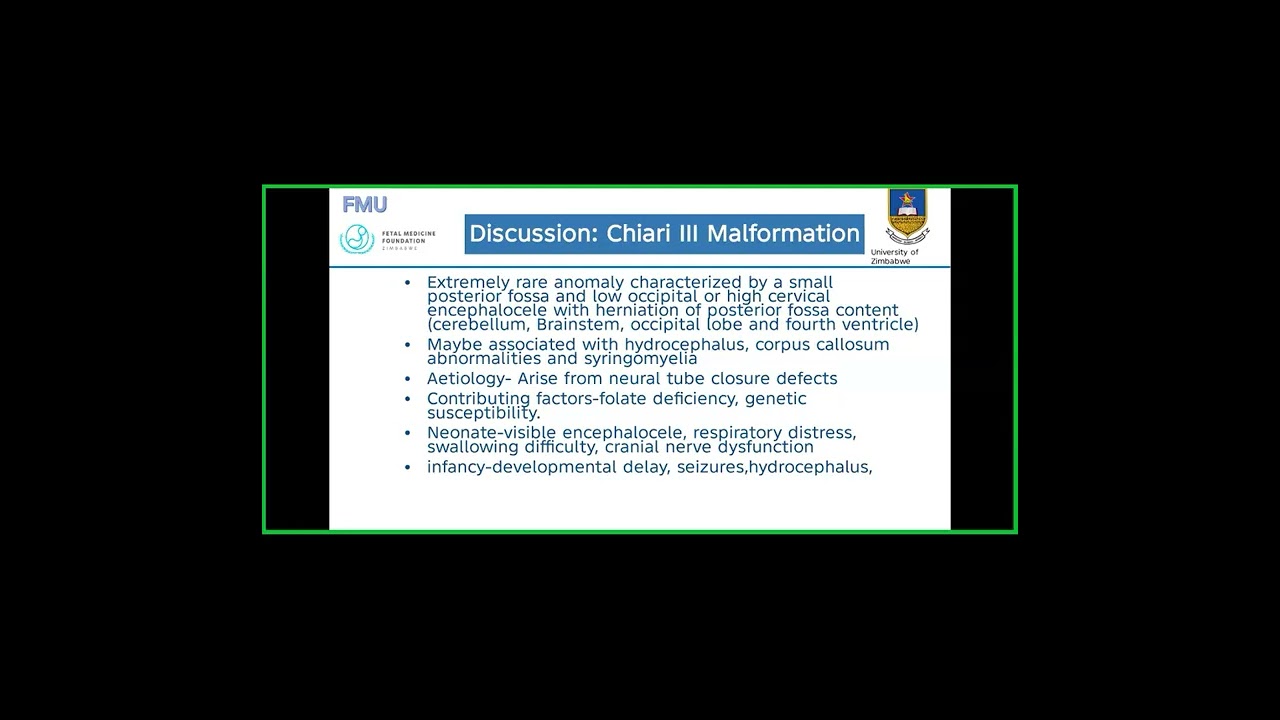
Chiari III Malformation: A case presentation of Encephalocele by Dr Mvundura
Keywords
Summary
131 words
Critical Evaluation
Value of the Information & Strength of the Argument
The value of the information lies in its detailed presentation of a rare fetal anomaly, including ultrasound findings and clinical management. The argumentation is based on a single case, but the discussion includes expert opinions and references to a case series from the Korean Journal of Neurosurgery. The speaker acknowledges limitations, such as the lack of MRI and genetic testing, which adds to the credibility. However, the evidence is largely anecdotal, and the discussion could benefit from more robust literature review.
Scientific Rigor, Source Quality, Title Accuracy
The scientific rigor is moderate. The case is presented with clear ultrasound measurements, but the lack of a systematic literature review and the reliance on a single case limit the strength of the conclusions. The sources cited are not explicitly listed, but the speaker mentions a Korean case series. The title accurately reflects the content, and the video is a case presentation rather than a comprehensive review. The discussion includes expert commentary, which enhances the quality, but the overall rigor is limited by the absence of peer-reviewed references.
184 words
Title / Content Match
The title accurately reflects the content, as the video is a case presentation of Chiari III malformation with encephalocele.
Quality & Reliability
6/10
The presentation is a clinical case report from a registrar, with detailed ultrasound findings and a discussion of management. However, it lacks peer-reviewed references, and the speaker admits to limitations in the ultrasound measurements. The discussion includes expert commentary from senior clinicians, adding credibility, but the overall evidence base is limited to a single case and anecdotal experience.
Key Moments
Markers derived by PSI from the transcript: the creator did not define chapters.
- Introduction of the case: 18-year-old primigravida, referred with suspected fetal defects.
- Ultrasound findings: large encephalocele (130 mm) with herniated neural tissue, severe ventriculomegaly.
- Differential diagnosis: Chiari II, epidermal inclusion cyst, cephalohematoma.
- Delivery: emergency cesarean section, neonate with Apgar 4/10, respiratory distress, bleeding encephalocele.
- Discussion: missed opportunities, need for anomaly scan, folic acid, and multidisciplinary care.
- Prognosis and management: surgical repair, VP shunting, poor outcomes.
- Take-home message: importance of early detection and pre-conception counseling.
Cited Sources
- Korean Journal of Neurosurgery case series — Mentioned in the discussion as a reference for surgical management of Chiari III malformation.
Concurring Sources
- Chiari malformation - Wikipedia — Provides general information on Chiari malformations, supporting the classification and features described.
- Neural tube defects - Wikipedia — Discusses neural tube defects and the role of folic acid, aligning with the case's risk factors.
Dissenting Sources
- No discordant sources identified — No sources contradicting the presented information were found.
Contribution & Novelties
This video provides a detailed case presentation of Chiari III malformation, a rare condition, with emphasis on ultrasound findings and clinical management in a resource-limited setting. It highlights the importance of routine fetal anomaly scans and the consequences of missed opportunities. The discussion offers practical insights for clinicians in similar settings.
Pour aller plus loin :
- Chiari malformation - Wikipedia — Overview of Chiari malformations, including type III.
- Neural tube defects - Wikipedia — Background on neural tube defects and prevention with folic acid.
- Fetal ventriculomegaly - Wikipedia — Information on ventriculomegaly, a key finding in this case.
98 words
Radar Profile
The radar profile shows moderate scores across all dimensions, with a slightly higher level of technical detail (7) compared to other aspects. This indicates a presentation that is clinically informative but lacks comprehensive evidence and rigorous sourcing.
💬 No comments were provided for analysis.