PROPOSED USE OF QR CODE LINKED DIGITAL RECORDS FOR FETAL ULTRASOUND SCANS (FETO SYNC AI)
Keywords
Summary
197 words
Critical Evaluation
Value of the Information & Strength of the Argument
The presentation provides a clear and well-structured argument for digitizing fetal ultrasound records in Zimbabwe. It identifies a real problem (paper-based records are prone to loss and fragmentation) and proposes a practical solution (QR code-linked digital records). The argument is supported by logical reasoning about the benefits of continuity of care and real-time data access. However, the value is limited by the lack of technical details on implementation, data security, and integration with existing systems. The discussion reveals that the proposal, as presented, is essentially a data storage app, and the author acknowledges the need for AI decision support to add value. The argumentation is solid for a proposal, but it lacks depth in addressing potential challenges and alternative solutions.
Scientific Rigor, Source Quality, Title Accuracy
The presentation does not cite any external sources, which is a significant weakness for a scientific proposal. The title accurately reflects the content, but the lack of references to existing literature or standards reduces the scientific rigor. The discussion provides valuable feedback from experts, highlighting the need for AI integration and better privacy measures. The author responds to questions but does not provide concrete solutions for all concerns. Overall, the scientific rigor is moderate, but the proposal would benefit from grounding in existing research and best practices.
222 words
Title / Content Match
The title accurately reflects the content, which is a proposal for using QR code-linked digital records for fetal ultrasound scans.
Quality & Reliability
6/10
The presentation is a proposal for a digital health innovation, clearly structured with background, objectives, methods, expected outcomes, and limitations. However, it lacks detailed technical specifications, data security protocols, and references to existing literature or standards. The discussion highlights critical gaps, particularly the need for AI-driven decision support to move beyond data storage.
Key Moments
Markers derived by PSI from the transcript: the creator did not define chapters.
- Introduction and background on the need for digital records in fetal ultrasound.
- Objectives of the Feto Sync AI platform.
- Methodology: development of MVP, piloting, and expected outcomes.
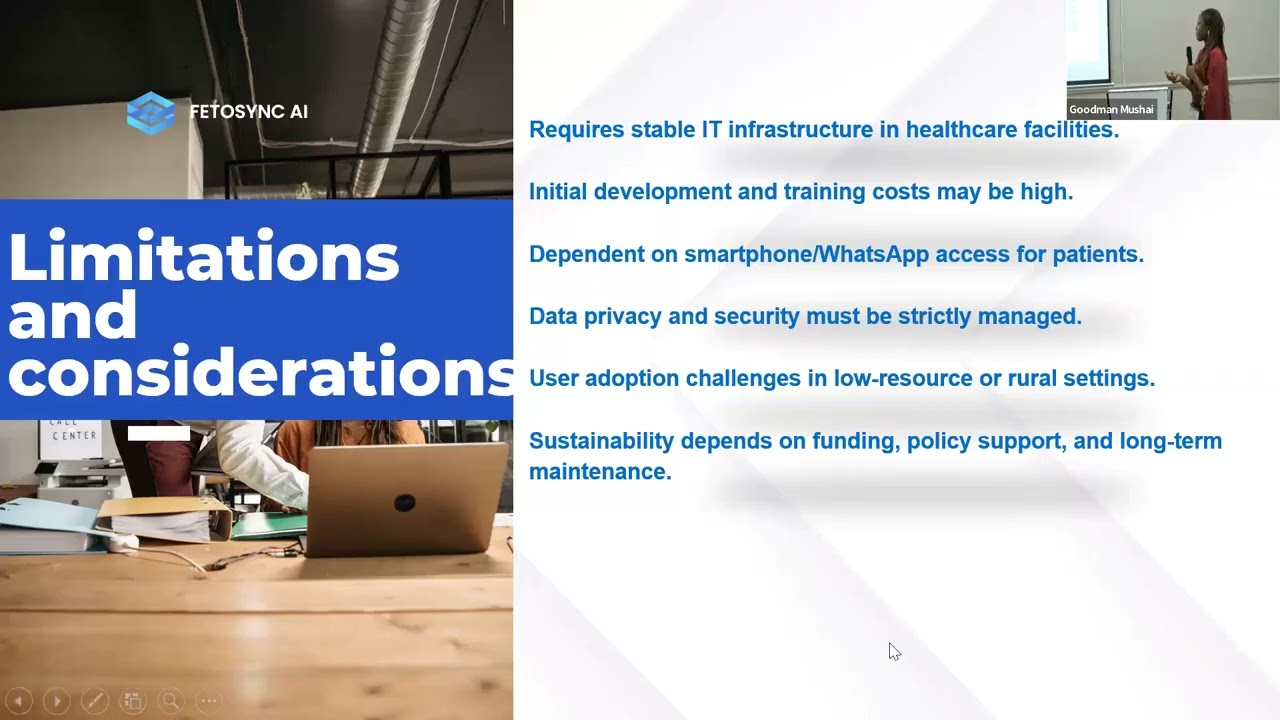
- Limitations and considerations: IT infrastructure, costs, and data privacy.
- Conclusion and call to action for funding and partnerships.
- Q&A: Clarification on how the app differs from existing systems.
- Q&A: Expert feedback on the need for AI decision support.
- Q&A: Discussion on pilot sample size and data retention.
- Q&A: Privacy concerns and access control mechanisms.
- Q&A: Integration with existing electronic health records and standardization.
Contribution & Novelties
The proposal introduces a QR code-based system for linking fetal ultrasound records across facilities, which is a novel approach in the Zimbabwean context. However, the innovation is primarily a data management tool, and the discussion highlights the need for AI-driven decision support to add real value. The proposal could be enhanced by incorporating machine learning algorithms for anomaly detection and clinical decision support.
Pour aller plus loin :
- Fetal Medicine Foundation — The leading organization for fetal medicine education and research, providing guidelines and training.
- Digital health in low-resource settings — WHO’s overview of digital health initiatives, including challenges and opportunities.
- AI in ultrasound imaging — A review of AI applications in ultrasound, including automated fetal biometry and anomaly detection.
120 words
Radar Profile
The radar profile shows moderate scores across all dimensions, indicating a balanced but not outstanding proposal. The highest score is in information quantity, reflecting the comprehensive coverage of the topic, while the lowest is in technical level, suggesting a need for more detailed technical specifications.