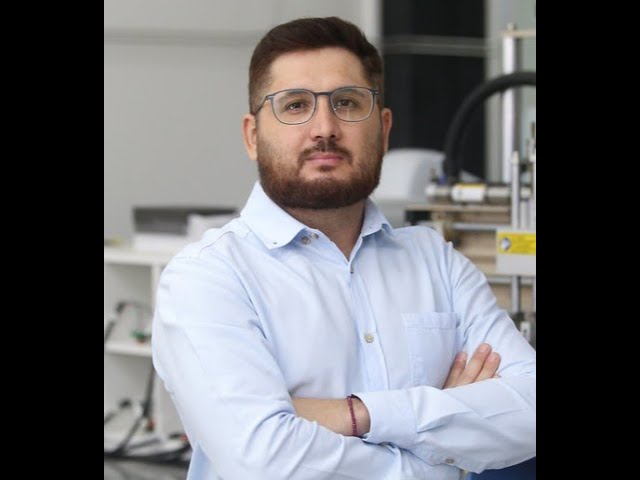
Advances in Li–O₂ Batteries: from nanoscale studies towards a commercial prototype
Keywords
Summary
222 words
Critical Evaluation
Value of the Information & Strength of the Argument
The seminar provides valuable insights into the state-of-the-art research on Li-O2 batteries, presenting original experimental results from the speaker’s laboratory. The argumentation is solid, supported by detailed characterization data and references to published work. The speaker effectively explains complex concepts, such as the role of oxygen vacancies in catalysts and the use of operando synchrotron techniques, making the content accessible to a technical audience. The discussion of challenges and potential solutions, such as flow batteries, is well-reasoned and grounded in experimental evidence.
Scientific Rigor, Source Quality, Title Accuracy
The speaker demonstrates scientific rigor by presenting data from peer-reviewed publications and synchrotron experiments. He explicitly mentions a paper published in Advanced Materials (impact factor 26) and discusses the long publication timeline, indicating thoroughness. The sources cited are credible, including work from his own group and collaborations with synchrotron facilities (SIRIUS, SLAC). The title accurately reflects the content, which covers nanoscale studies and progress towards a commercial prototype. No discrepancies were noted between the title and the actual content.
176 words
Title / Content Match
The title accurately reflects the content, which covers nanoscale studies and progress towards a commercial prototype.
Quality & Reliability
8/10
The seminar is delivered by a postdoctoral researcher with direct expertise in Li-O2 batteries, presenting original research from his laboratory. The content is technical and detailed, with references to peer-reviewed publications and synchrotron experiments. However, the presentation is a seminar, not a peer-reviewed article, and some claims lack explicit citations within the talk.
Key Moments
Markers derived by PSI from the transcript: the creator did not define chapters.
- Introduction and motivation for Li-O2 batteries: electrification and stationary storage.
- Explanation of Li-O2 battery working principle and challenges (triple phase, water/CO2 reactivity).
- Overview of early results and overpotential issues; introduction of catalysts.
- Discussion of cyclability limitations and comparison with Li-ion batteries.
- Presentation of operando XRD study on redox mediators (bromide) for Li2O2 formation/decomposition.
- Electrolyte studies using IR micro/nano spectroscopy; publication in Advanced Materials.
- Catalyst development: Co-Mn-Al spinel, characterization with EXAFS and TXM, role of oxygen vacancies.
- Computational simulations of catalyst surface and Li2O2 formation.
- Introduction of flow battery concept for decoupling power and energy.
- Q&A session addressing capacity fade mechanisms.
Cited Sources
- CINE Talks seminar series — This seminar is part of the 2025 CINE Talks series.
- Advanced Materials (journal) — The speaker mentions a paper published in this journal (impact factor 26) on electrolyte studies.
Concurring Sources
- Lithium–air battery - Wikipedia — Provides general background on Li-air batteries, consistent with the seminar's content.
Contribution & Novelties
The seminar provides an original contribution by presenting recent advances from the speaker’s laboratory, including the development of a Co-Mn-Al spinel catalyst with oxygen vacancies that enhance Li2O2 formation/decomposition, and the implementation of flow battery prototypes for stationary storage. The use of operando synchrotron techniques offers novel insights into reaction mechanisms.
Pour aller plus loin :
- Lithium–air battery - Wikipedia — Overview of Li-air battery technology.
- Oxygen vacancy - Wikipedia — Explanation of oxygen vacancies and their role in catalysis.
- Operando spectroscopy - Wikipedia — Technique used to study catalysts under working conditions.
93 words
Radar Profile
The radar profile shows high scores across all dimensions, indicating a technically rigorous and well-sourced presentation. The speaker's expertise is evident, and the content is both informative and credible.
💬 No comments were provided for analysis.