Lecture 42 | 3rd Semester | Resolving Power
Keywords
Summary
155 words
Critical Evaluation
Value of the Information & Strength of the Argument
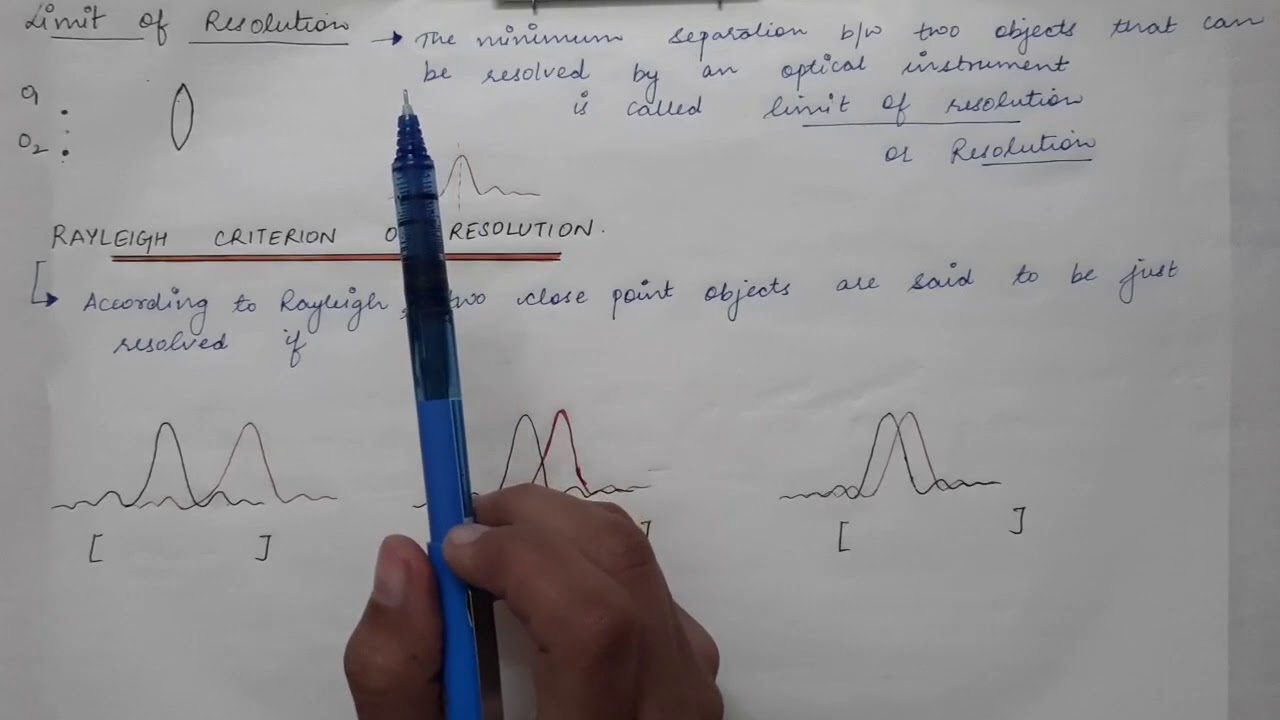
The video provides a basic qualitative introduction to resolving power, emphasizing the role of diffraction in limiting resolution. The argumentation is largely verbal, with little mathematical derivation or quantitative examples. The instructor attempts to explain the Rayleigh criterion but does so without clear equations or diagrams, weakening the argument’s clarity. The value is limited to a conceptual overview, which might be useful for beginners but lacks depth for a university-level course.
Scientific Rigor, Source Quality, Title Accuracy
The video does not cite any sources, and the description only mentions ‘Optics lectures’ without references. The title matches the content, but the delivery is poor due to audio issues. The scientific rigor is low, as the explanation is superficial and lacks precise definitions or derivations. No external sources are provided to support the content.
141 words
Title / Content Match
The title accurately describes the topic, but the content is not well-delivered due to audio issues and lack of depth.
Quality & Reliability
3/10
The video is a lecture on resolving power, but the audio is heavily distorted and the content is difficult to follow. The explanation is superficial and lacks mathematical rigor. No sources are cited, and the presentation is not structured clearly.
Key Moments
Markers derived by PSI from the transcript: the creator did not define chapters.
- Introduction to resolving power and its importance.
- Discussion on diffraction patterns and their role in resolution.
- Definition of resolving power as the minimum distance between two objects.
- Mention of Rayleigh criterion for resolution.
- Examples of telescopes and microscopes.
- Further explanation of diffraction patterns and overlapping.
- Conclusion and summary.
Contribution & Novelties
The video offers a basic introduction to resolving power, but it does not provide any novel insights or advanced content. It is a standard topic in optics courses, and the presentation is not particularly original. The main contribution is a simplified explanation for beginners, but it lacks depth.
Pour aller plus loin :
- Rayleigh criterion — Wikipedia article on angular resolution, which includes the Rayleigh criterion.
- Diffraction — Wikipedia article on diffraction, explaining the phenomenon behind resolution limits.
- Optical telescope — Wikipedia article on optical telescopes, which discusses resolution and design.
91 words
Radar Profile
The radar profile shows low scores across all dimensions, indicating a weak video in terms of information quantity, quality, technical depth, and reliability. The video is a basic tutorial with poor audio and lack of rigor, making it suitable only for a very introductory level.