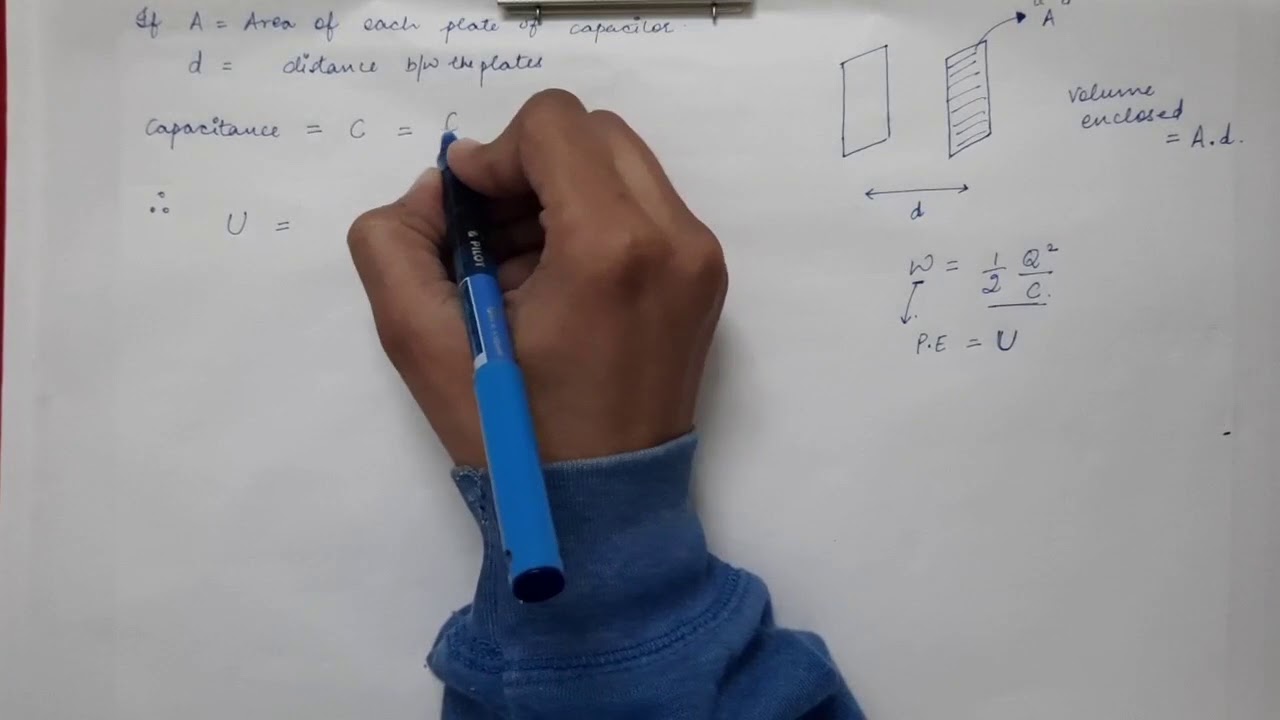
Lecture 40 | 1st Semester | Energy stored in capacitor with dielectric medium
Keywords
Summary
132 words
Critical Evaluation
Value of the Information & Strength of the Argument
The lecture provides a basic introduction to the energy stored in a capacitor with a dielectric, which is a standard topic in introductory physics. The argumentation follows a logical sequence: starting with the definition of capacitance, then considering the effect of a dielectric, and finally deriving the energy expression. However, the presentation is marred by frequent digressions and unclear audio, which undermines the value of the information. The derivation is not rigorously explained, and the instructor often repeats phrases like ‘subscribe’ without adding substantive content. The overall argumentation is weak due to the lack of clarity and the absence of a structured approach.
Scientific Rigor, Source Quality, Title Accuracy
The scientific rigor is low: the lecture does not cite any external sources or references, and the derivation is presented without proper justification. The quality of sources is non-existent, as no sources are mentioned. The title accurately reflects the topic, but the content does not meet the expected standard of a rigorous lecture. The audio quality is poor, and the transcription is garbled, making it difficult to verify the accuracy of the equations presented. There is no evidence of peer review or academic backing. The title is adequate, but the execution is lacking.
211 words
Title / Content Match
The title accurately reflects the content, which focuses on energy stored in a capacitor with a dielectric medium.
Quality & Reliability
4/10
The lecture covers fundamental physics concepts but the audio transcription is heavily garbled, making it difficult to follow. The content appears correct but lacks rigorous derivation and clear explanations.
Key Moments
Markers derived by PSI from the transcript: the creator did not define chapters.
- Introduction to the topic of energy stored in a capacitor with dielectric medium.
- Review of capacitance and the effect of dielectric on capacitance.
- Derivation of the energy stored in a capacitor.
- Discussion of energy density in the electric field.
- Examples and further explanation of the concepts.
- Conclusion and summary of the lecture.
Contribution & Novelties
The lecture provides a basic overview of energy storage in capacitors with dielectrics, but it does not offer any novel insights or original contributions. The content is standard and can be found in any introductory physics textbook. The presentation is not enhanced by any unique pedagogical approach or additional resources.
Pour aller plus loin :
- Capacitor — Provides comprehensive information on capacitors, including energy storage.
- Dielectric — Explains the role of dielectric materials in capacitors.
- Energy density — Discusses energy density in electric fields.
84 words
Radar Profile
The radar profile shows low scores across all dimensions, indicating a lecture that is weak in information quantity, quality, technical depth, and reliability. The content is basic and poorly delivered, with no supporting sources.