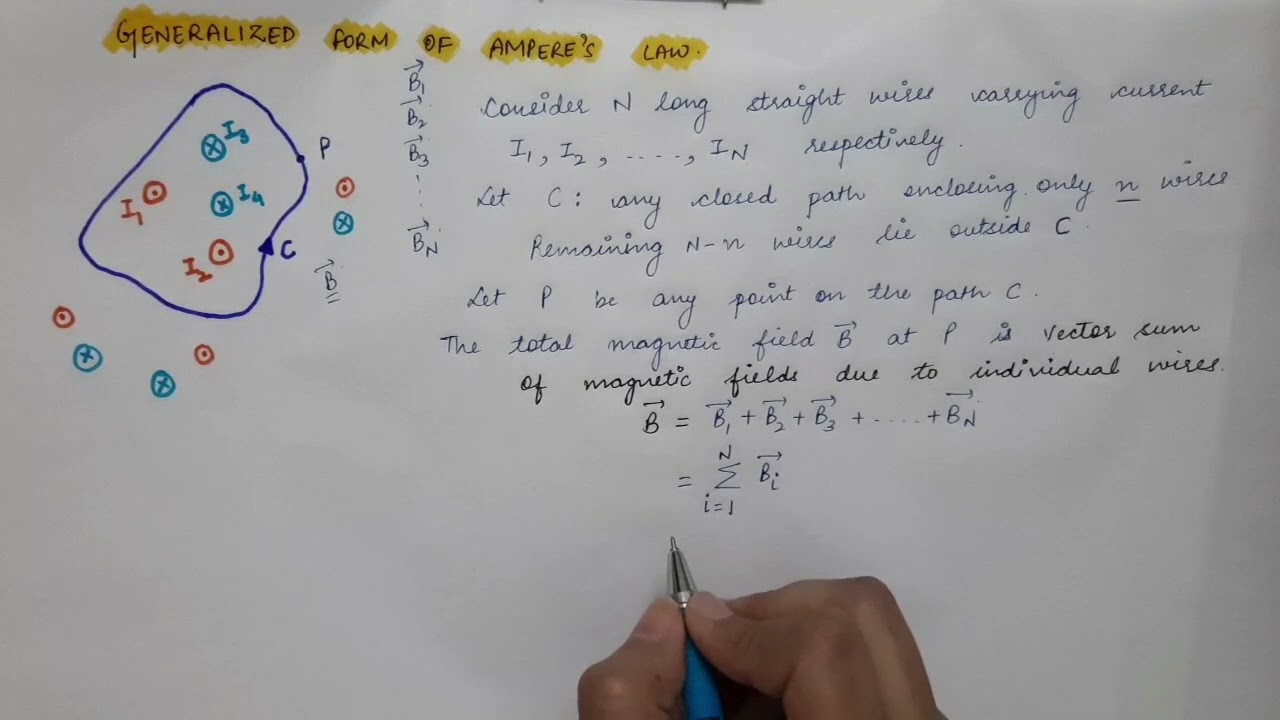
Lecture 26 | 2nd Sem | Generalized form of Ampere's law
Keywords
Summary
176 words
Critical Evaluation
Value of the Information & Strength of the Argument
The video provides a clear, step-by-step derivation of the generalized Ampere’s law, which is valuable for students learning electromagnetism. The argumentation is logically structured, building upon the previously established single-wire case and extending it to multiple wires. The use of vector superposition and the careful treatment of enclosed versus external currents is pedagogically sound. However, the derivation relies on the principle of superposition without explicitly justifying it, and the sign convention is introduced without a deeper explanation of its origin. The presentation is thorough but could benefit from a more rigorous justification of the steps.
Scientific Rigor, Source Quality, Title Accuracy
The scientific rigor is acceptable for an educational tutorial: the derivation follows standard textbook methods and the mathematics is correct. However, no sources are cited, and the video does not reference any external literature or experimental validation. The title accurately describes the content, which is a derivation of the generalized form of Ampere’s law. The video is a tutorial, so the lack of citations is not unusual, but it limits the ability to verify the information independently. The content aligns with standard physics curricula.
194 words
Title / Content Match
The title accurately reflects the content, which is a derivation of the generalized form of Ampere's law.
Quality & Reliability
7/10
The derivation is mathematically sound and follows standard textbook treatment. However, it lacks rigorous justification of the superposition principle and the sign convention is stated without proof. No external sources are cited.
Key Moments
Markers derived by PSI from the transcript: the creator did not define chapters.
- Introduction and recap of Ampere's law for a single wire.
- Setup of multiple wires and definition of the closed path.
- Expression for total magnetic field as vector sum of individual fields.
- Dot product with dl and integration over closed path.
- Application of Ampere's law to each wire, showing contributions from enclosed wires only.
- Reduction of summation to enclosed currents and introduction of I_net.
- Discussion of sign convention for currents (dot and cross).
- Final statement of generalized Ampere's law and example with I_net calculation.
Contribution & Novelties
The video provides a clear pedagogical derivation of the generalized Ampere’s law, which is a fundamental concept in electromagnetism. It extends the basic law to multiple wires, emphasizing the importance of enclosed currents and sign conventions. This is a standard topic, but the step-by-step approach is useful for students.
Pour aller plus loin :
- Ampere’s circuital law — Provides background and applications.
- Maxwell’s equations — The generalized Ampere’s law is part of Maxwell’s equations; this page offers broader context.
- Biot–Savart law — Related law for calculating magnetic fields from currents.
90 words
Radar Profile
The radar profile shows balanced scores across all dimensions, with slightly higher quality and reliability compared to quantity and technical level. This indicates a solid educational video that is accurate but not exhaustive in depth or breadth.