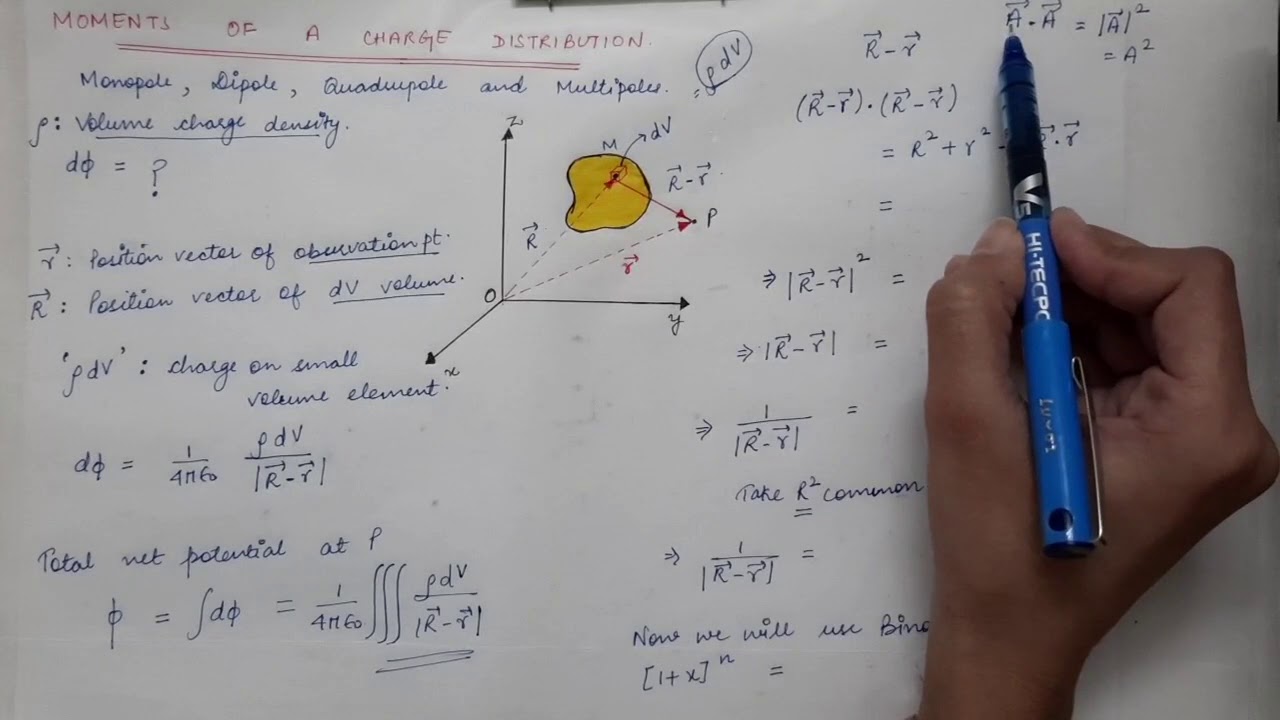
Lecture 29 | 1st Semester | Moments of a charge distribution
Keywords
Summary
178 words
Critical Evaluation
Value of the Information & Strength of the Argument
The lecture covers a fundamental topic in electrostatics: the multipole expansion of the potential due to a charge distribution. The value lies in introducing the concept that the potential can be expressed as a series of moments (monopole, dipole, quadrupole, etc.), which is essential for understanding fields far from sources. The argumentation follows a standard derivation: starting from the integral expression for the potential, expanding the denominator using Legendre polynomials, and identifying the terms. However, the presentation is marred by the poor transcription, which obscures the logical flow. The instructor’s explanations are not clearly articulated, and the frequent interruptions with ‘subscribe’ requests detract from the scientific content. The mathematical steps are not rigorously justified, and the lecture lacks a clear summary or illustrative examples.
Scientific Rigor, Source Quality, Title Accuracy
The lecture does not cite any external sources, which is typical for a course lecture but limits its scientific rigor. The content is standard textbook material, but the lack of references means viewers cannot verify or deepen their understanding. The title accurately reflects the content, as the lecture indeed focuses on moments of a charge distribution. However, the presentation quality is poor: the transcription is heavily corrupted, and the instructor’s speech is often unintelligible. The lecture would benefit from clearer enunciation and better production quality. No comments were provided for analysis.
230 words
Title / Content Match
The title accurately reflects the content: the lecture discusses moments of a charge distribution, specifically the multipole expansion of the potential.
Quality & Reliability
3/10
The lecture presents standard physics content (multipole expansion) but the transcription is heavily corrupted by auto-generated captions, making the explanation difficult to follow. No sources are cited, and the presentation lacks rigor.
Key Moments
Markers derived by PSI from the transcript: the creator did not define chapters.
- Introduction and review of potential for point charges
- Definition of volume charge density and potential integral
- Expansion of 1/|R - r| using Legendre polynomials
- Identification of monopole term as total charge
- Discussion of dipole and higher-order terms
- General expression for potential in terms of moments
- Special case of neutral distribution and dipole dominance
- Conclusion and summary of multipole expansion
Contribution & Novelties
The lecture provides a standard introduction to multipole expansion, which is a fundamental technique in electrostatics. It does not present new research but serves as an educational resource. The main value is in explaining how the potential due to a charge distribution can be approximated by a series of moments, which is crucial for understanding fields at large distances. The lecture could be improved by including visual aids and clearer derivations.
Pour aller plus loin :
- Multipole expansion - Wikipedia — Overview of multipole expansion in physics.
- Legendre polynomials - Wikipedia — Mathematical background for the expansion.
- Electric dipole moment - Wikipedia — Detailed discussion of the dipole term.
109 words
Radar Profile
The radar profile shows moderate scores in information quantity and technical level, but low scores in information quality and reliability, reflecting the poor transcription and lack of sources. The lecture is technically oriented but poorly presented.