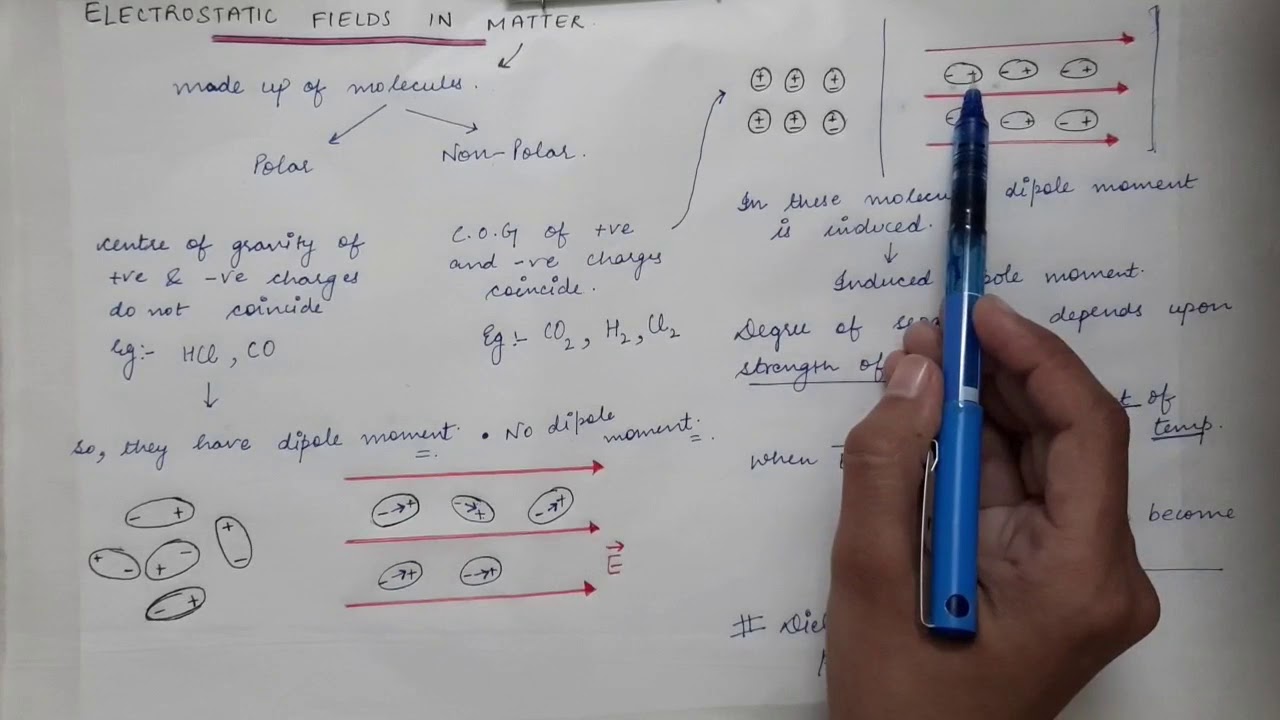
Lecture 36 | 1st Semester | Electrostatic fields in Matter
Keywords
Summary
158 words
Critical Evaluation
Value of the Information & Strength of the Argument
The lecture provides a very basic introduction to polarization and dielectric materials, but the argumentation is weak. The instructor relies on verbal explanations without mathematical derivations or visual aids, and the frequent interruptions for subscription requests undermine the scientific value. The content is too superficial for a university-level course and does not offer any novel insights or rigorous treatment of the subject.
Scientific Rigor, Source Quality, Title Accuracy
The scientific rigor is low: no sources are cited, and the lecture does not reference any textbooks or research. The title is appropriate for the topic, but the content does not live up to the expectation of a formal lecture. The transcription is of poor quality, and the audio seems to be a mix of Hindi and English, making it hard to follow. There is no evidence of peer review or verification of the information presented.
153 words
Title / Content Match
The title accurately reflects the topic of electrostatic fields in matter, but the content is not well-structured and often veers into unrelated promotional content.
Quality & Reliability
2/10
The content is severely compromised by a poor transcription and unclear audio, making it difficult to follow the scientific argument. The lecture appears to cover basic concepts of polarization and dielectric materials, but the delivery is marred by repetitive requests to subscribe, which detracts from the scientific content. No sources are cited, and the presentation lacks rigor.
Key Moments
Markers derived by PSI from the transcript: the creator did not define chapters.
- Introduction to the topic: electrostatic fields in matter, classification of molecules into polar and nonpolar.
- Discussion of polar molecules with examples like carbon monoxide, and nonpolar molecules like carbon dioxide.
- Explanation of how an external electric field affects polar and nonpolar molecules, leading to induced dipole moments.
- Mention of thermal agitation at room temperature preventing complete alignment of dipoles.
- Introduction of polarization and its relevance to dielectrics and insulators.
- Illustration of electric field between capacitor plates and the effect of a dielectric material.
- Further discussion on induced dipole moments and their dependence on field strength.
- Conclusion and final remarks, with repeated requests to subscribe.
Contribution & Novelties
The lecture offers a very elementary overview of polarization in matter, but it does not provide any new or original contributions to the field. It is essentially a basic tutorial that could be found in any introductory physics textbook. The presentation is marred by technical issues and a lack of depth.
Pour aller plus loin :
- Dielectric — Provides a comprehensive overview of dielectric materials and their properties.
- Electric polarization — Explains the concept of polarization in detail, including mathematical formulations.
- Dipole — Discusses electric dipoles and their behavior in electric fields.
92 words
Radar Profile
The radar profile shows low scores across all dimensions, indicating a weak lecture with minimal information content, poor quality, low technical depth, and low reliability. The lecture is not recommended for serious study.