Lecture 24 (3rd Semester) - Fresnel's Half Period Zones
Keywords
Summary
147 words
Critical Evaluation
Value of the Information & Strength of the Argument
The video provides a basic introduction to Fresnel’s half-period zones, a fundamental concept in wave optics. The argumentation is based on geometric construction and superposition principle, but the presentation is not rigorous. The instructor uses diagrams and verbal explanations, but the lack of clear derivations and the poor audio quality weaken the value. The concept is explained qualitatively, but quantitative aspects are not thoroughly developed. The video could be useful for a first exposure, but it lacks depth and clarity.
Scientific Rigor, Source Quality, Title Accuracy
The video does not cite any external sources or references. The title accurately reflects the content, but the presentation is not scientifically rigorous due to the lack of proper derivations and the degraded audio. The instructor seems knowledgeable but fails to convey the material effectively. The absence of references and the informal style reduce the scientific credibility.
152 words
Title / Content Match
The title accurately describes the topic, but the content is poorly presented due to audio issues.
Quality & Reliability
4/10
The video is a lecture on Fresnel's half-period zones, but the audio is heavily degraded with repeated 'subscribe' requests and unclear speech, making it difficult to follow. The content appears correct but lacks rigorous derivation and references.
Key Moments
Markers derived by PSI from the transcript: the creator did not define chapters.
- Introduction to Fresnel's half-period zones and their significance in diffraction.
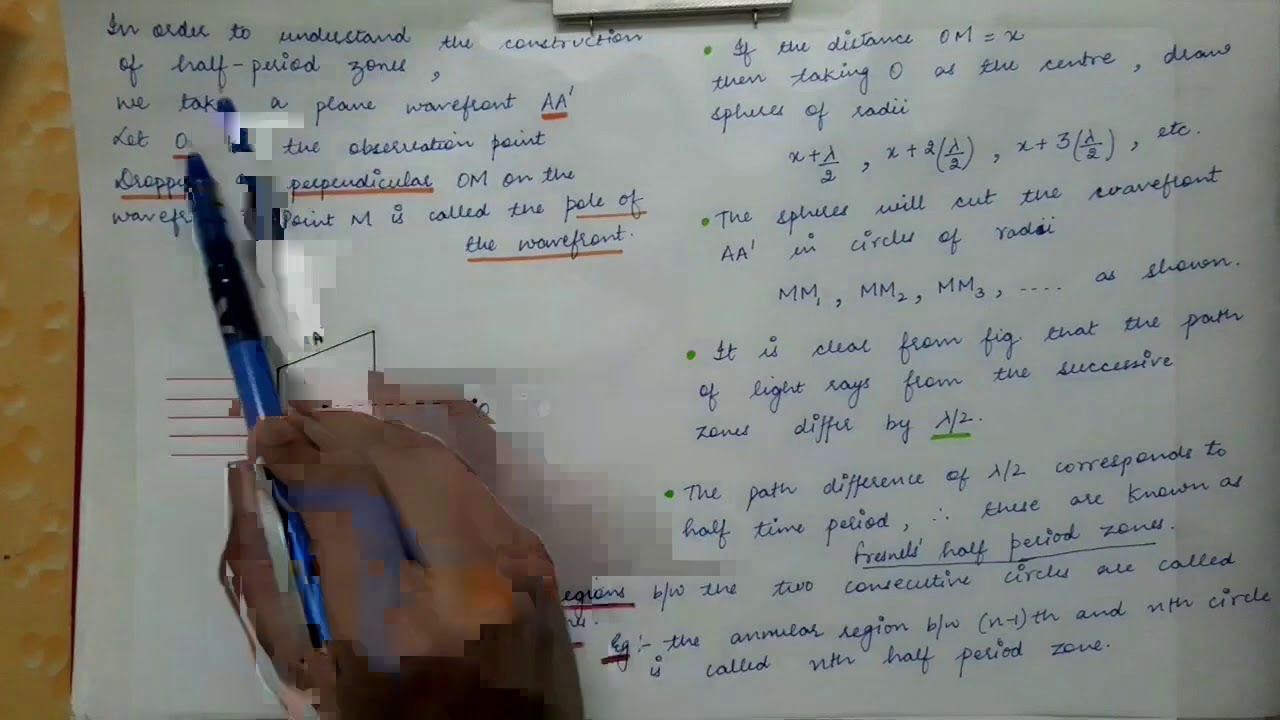
- Construction of half-period zones on a spherical wavefront.
- Explanation of the path difference between successive zones.
- Calculation of the area of each half-period zone.
- Discussion on the equality of areas and the resultant amplitude.
- Derivation of the resultant amplitude at the observation point.
- Summary and conclusion of the lecture.
Contribution & Novelties
The video attempts to explain Fresnel’s half-period zones, a classic topic in wave optics. However, the presentation is not original and lacks depth. It may serve as a basic introduction for students, but it does not offer new insights or advanced applications.
Pour aller plus loin :
- Fresnel diffraction — Provides a comprehensive overview of Fresnel diffraction and half-period zones.
- Huygens–Fresnel principle — Explains the underlying principle used in the construction of half-period zones.
- Zone plate — A practical application of half-period zones in focusing light.
86 words
Radar Profile
The radar profile shows moderate scores in information quantity and technical level, but lower scores in information quality and reliability, reflecting the poor audio and lack of references.