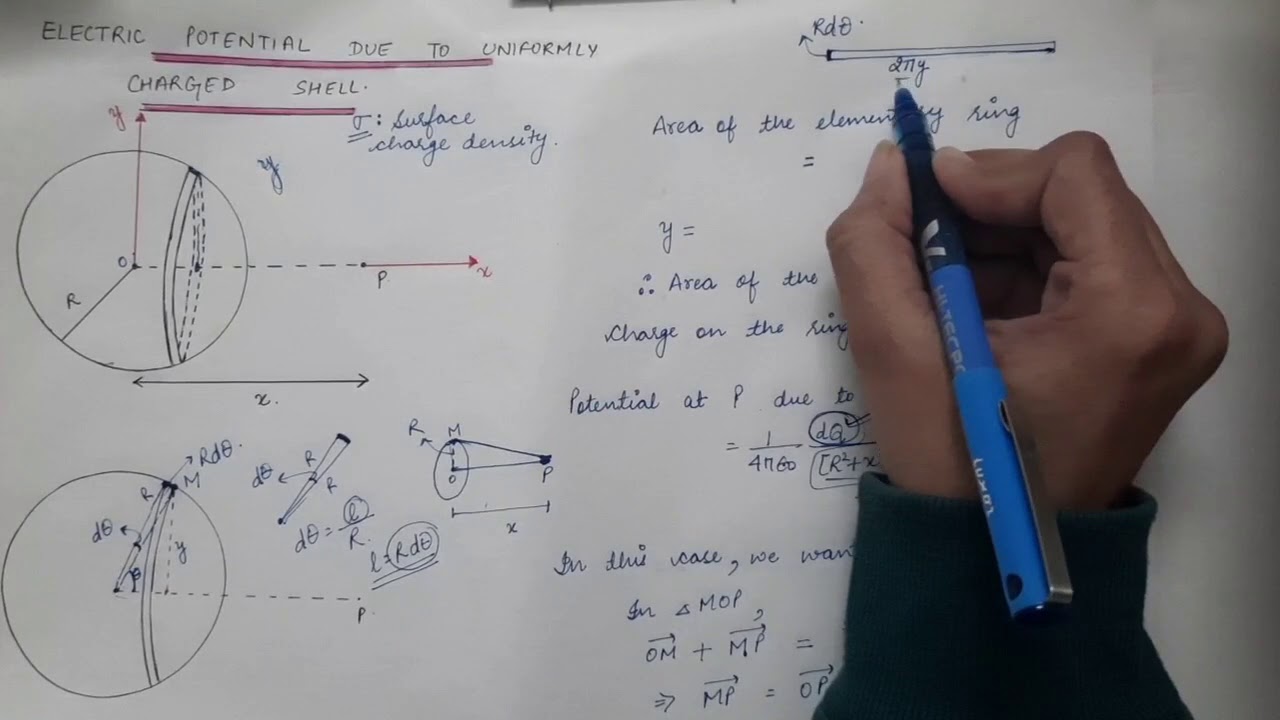
Lecture 31 | 1st Semester | Electric potential due to charged shell
Keywords
Summary
160 words
Critical Evaluation
Value of the Information & Strength of the Argument
The lecture provides a step-by-step derivation of the electric potential for a charged spherical shell, which is a fundamental topic in electrostatics. The argumentation is logically structured: it starts with the division of the shell into rings, calculates the potential for a ring, and then integrates over the shell. The instructor correctly applies the principle of superposition and uses symmetry to simplify the problem. However, the presentation lacks rigorous mathematical formalism, and the frequent digressions to ask for subscriptions detract from the scientific value. The derivation is correct but not particularly insightful, as it follows standard textbook methods without offering alternative perspectives or deeper physical insights.
Scientific Rigor, Source Quality, Title Accuracy
The lecture does not cite any external sources, which is typical for a tutorial. The content is based on established physics principles, but the lack of references reduces its scientific rigor. The title accurately reflects the content, as the lecture indeed focuses on electric potential due to a charged shell. However, the presentation quality is poor: the audio is unclear, and the frequent subscription prompts are distracting. The scientific content is correct, but the delivery is not professional, which affects the overall reliability.
204 words
Title / Content Match
The title accurately describes the content: a lecture on electric potential due to a charged shell.
Quality & Reliability
5/10
The lecture is a standard derivation of electric potential for a uniformly charged spherical shell, but the presentation is marred by frequent subscription prompts and unclear audio, reducing clarity and reliability.
Key Moments
Markers derived by PSI from the transcript: the creator did not define chapters.
- Introduction to the topic: electric potential due to a uniformly charged shell.
- Division of the shell into infinitesimal circular rings.
- Derivation of potential due to a single ring.
- Integration over the shell for external points.
- Result for external points: potential equals kQ/r.
- Case for points on the surface: potential = kQ/R.
- Case for points inside the shell: potential is constant.
- Conclusion and summary of results.
Contribution & Novelties
The lecture provides a clear, step-by-step derivation of the electric potential for a uniformly charged spherical shell, which is a standard topic in introductory electromagnetism. While the content is not novel, it serves as a useful tutorial for students. The approach of dividing the shell into rings and integrating is a classic technique that reinforces the concept of superposition.
Pour aller plus loin :
- Electric potential — Background on the definition and properties of electric potential.
- Spherical shell — Geometric and physical properties of spherical shells.
- Gauss’s law — Alternative method to derive the electric field and potential for symmetric charge distributions.
102 words
Radar Profile
The radar profile shows moderate scores across all dimensions, with a slightly higher technical level relative to information quantity and quality. This indicates a lecture that is technically sound but lacks depth and clarity in presentation.