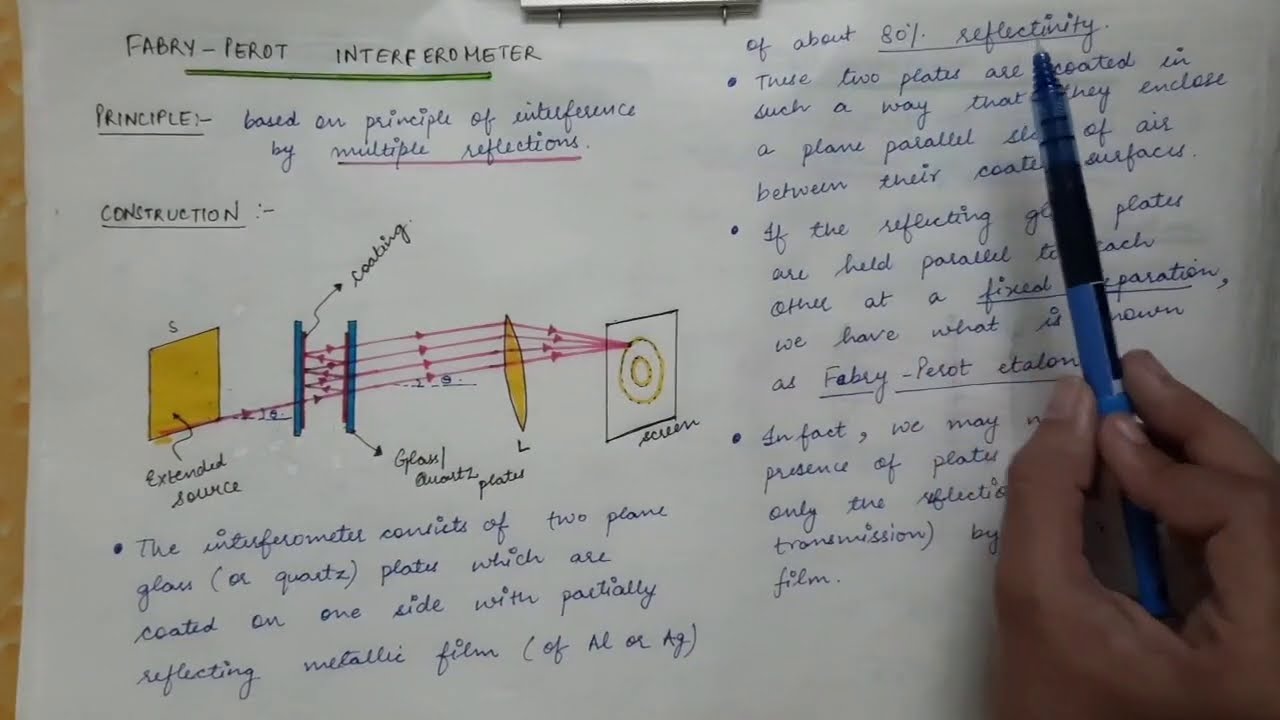
Lecture 21 (3rd Semester) - Fabry-Perot Interferometer Part 1
Keywords
Summary
158 words
Critical Evaluation
Value of the Information & Strength of the Argument
The video provides a standard derivation of the Fabry-Perot interferometer’s intensity distribution, which is a fundamental topic in optics. The argumentation follows a logical sequence: starting from the instrument’s construction, then considering multiple reflections, and finally deriving the Airy function. However, the presentation is marred by severe audio issues, including background noise and repeated subscription prompts, which distract from the content. The mathematical steps are not clearly explained, and the instructor often mumbles or speaks in a way that is hard to understand. The derivation itself is correct, but the lack of clarity reduces its value for students trying to learn the topic.
Scientific Rigor, Source Quality, Title Accuracy
The video does not cite any sources, and the description only mentions ‘Lecture notes’ without providing links. The title accurately reflects the content, but the lack of references and the poor audio quality undermine the scientific rigor. The instructor appears to be knowledgeable, but the presentation is not polished. There are no comments provided for analysis, so no public feedback is considered.
180 words
Title / Content Match
The title accurately describes the content: a lecture on the Fabry-Perot interferometer, part 1.
Quality & Reliability
3/10
The video is a formal lecture on the Fabry-Perot interferometer, but the audio is heavily corrupted by background noise and repeated calls to subscribe, making it difficult to follow. The mathematical derivations are presented but not clearly explained. No sources are cited, and the content is not verified.
Key Moments
Markers derived by PSI from the transcript: the creator did not define chapters.
- Introduction to the Fabry-Perot interferometer and its construction.
- Discussion of multiple reflections and transmissions between plates.
- Derivation of the amplitude of successive transmitted beams.
- Summation of amplitudes to obtain the transmitted intensity expression.
- Introduction of the Airy function and its properties.
- Conditions for maxima and minima of intensity.
- Discussion on the effect of reflectivity on fringe sharpness.
- Summary and conclusion of the lecture.
Contribution & Novelties
The video offers a standard derivation of the Fabry-Perot interferometer intensity distribution, which is a classic topic in optics. While it does not present new research, it serves as an educational resource for undergraduate physics students. The derivation is correct but poorly presented due to audio issues.
Pour aller plus loin :
- Fabry–Pérot interferometer - Wikipedia — Provides a comprehensive overview of the theory and applications.
- Airy function - Wikipedia — Details the mathematical function used in the intensity distribution.
- Optical cavity - Wikipedia — Related concept of multiple reflections in optical resonators.
93 words
Radar Profile
The radar profile shows moderate scores in information quantity and technical level, but low scores in information quality and reliability, reflecting the poor audio and lack of sources. The video is technically dense but not effectively communicated.