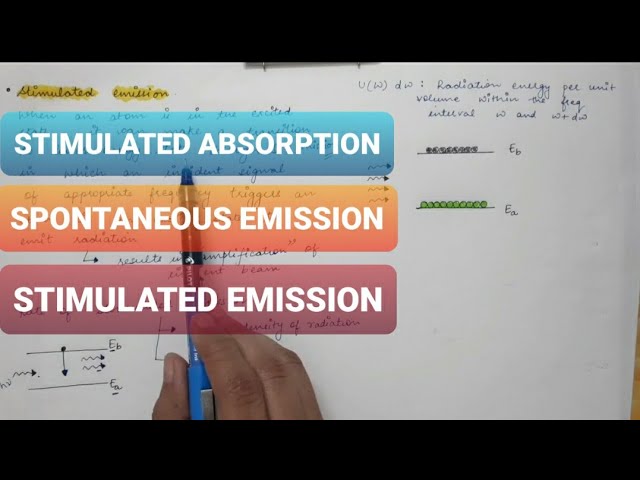
LASER | Lecture 2 | Absorption | Spontaneous emission | Stimulated emission
Keywords
Summary
145 words
Critical Evaluation
Value of the Information & Strength of the Argument
The lecture provides a basic introduction to the three fundamental processes of laser physics, which is valuable for beginners. The explanation of stimulated emission is correct, and the mention of Einstein’s work and the first maser adds historical context. However, the argumentation is weak due to the disorganized structure, with the instructor frequently repeating phrases and going off-topic. The lack of clear definitions and derivations reduces the overall value for a serious learner.
82 words
Title / Content Match
The title accurately reflects the content, which focuses on the three key processes of laser operation.
Quality & Reliability
3/10
The lecture covers fundamental concepts of laser physics (absorption, spontaneous and stimulated emission) but the presentation is marred by poor audio quality, numerous transcription errors, and a lack of clear structure. The content is scientifically accurate but presented in a disorganized manner with frequent repetitions and digressions.
Key Moments
Markers derived by PSI from the transcript: the creator did not define chapters.
- Introduction to the lecture and brief history of laser, mentioning Einstein's prediction of stimulated emission.
- Explanation of stimulated absorption: an atom absorbs a photon and transitions to a higher energy level.
- Discussion of spontaneous emission: an excited atom returns to a lower energy level, emitting a photon randomly.
- Introduction to stimulated emission: an incoming photon triggers the emission of a second photon with the same properties.
- Explanation of the rate of absorption and emission, depending on the number of atoms and energy density.
- Discussion of the conditions for stimulated emission to dominate, including population inversion.
- Mention of the first maser built in 1954 and the development of the laser in 1960.
- Further elaboration on the energy density of radiation and its role in the emission rates.
- Recap of the three processes and their importance in laser operation.
- Conclusion of the lecture, with a brief summary and a request to subscribe.
Contribution & Novelties
The lecture offers a basic overview of laser principles, but it does not provide any novel insights or advanced material. It is a standard tutorial for undergraduate students. For further exploration, consider the following resources:
- Einstein coefficients - Wikipedia — Detailed explanation of the coefficients governing absorption and emission.
- Stimulated emission - Wikipedia — Comprehensive article on the concept and its role in lasers.
- Laser - Wikipedia — Overview of laser history, principles, and applications.
75 words
Radar Profile
The radar profile shows moderate scores across all dimensions, indicating a lecture that is informative but not exceptional. The low reliability score reflects the poor audio and presentation quality, while the technical level is suitable for beginners.