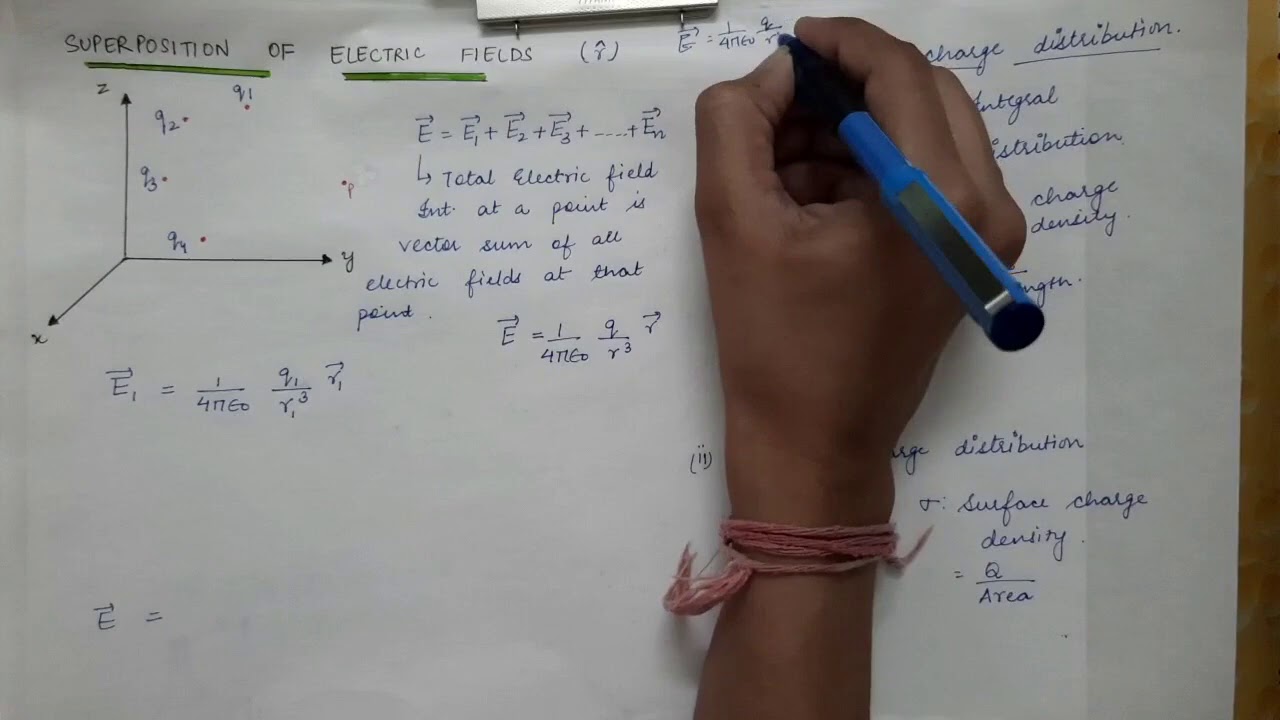
Lecture 12 (1st Semester) - Electric field due to charges (discrete & continuous)
Keywords
Summary
126 words
Critical Evaluation
Value of the Information & Strength of the Argument
The lecture provides a basic overview of electric fields, but the argumentation is weak due to the lack of clear derivations and the heavy emphasis on subscription prompts. The value is limited to a high-level introduction, with no novel insights or detailed explanations. The instructor’s reasoning is not systematically presented, and the transcription errors further undermine the clarity.
Scientific Rigor, Source Quality, Title Accuracy
The lecture does not cite any external sources, and the description contains no references. The title accurately reflects the content, but the scientific rigor is low due to the informal presentation and lack of citations. The transcription is heavily corrupted, making it difficult to assess the accuracy of the technical content.
124 words
Title / Content Match
The title accurately reflects the content: the lecture covers electric fields due to discrete and continuous charge distributions.
Quality & Reliability
4/10
The lecture provides a basic introduction to electric fields, but the transcription is heavily corrupted by repeated 'subscribe' prompts and unclear audio, making it difficult to assess the accuracy of the content. The lack of clear derivations and references reduces reliability.
Key Moments
Markers derived by PSI from the transcript: the creator did not define chapters.
- Introduction to electric field intensity and definition as force per unit test charge.
- Discussion of electric field lines for positive and negative charges.
- Explanation of electric field due to discrete charges and vector addition.
- Introduction to continuous charge distributions and division into small elements.
- Integration method for calculating electric field from continuous distributions.
- Examples of line, surface, and volume charge distributions.
- Conclusion and summary of key points.
Contribution & Novelties
The lecture offers a basic tutorial on electric fields, but its originality is limited. It does not introduce new concepts or methods beyond standard textbook material. The presentation is marred by frequent subscription requests and poor audio quality.
Pour aller plus loin :
- Electric field - Wikipedia — Provides a comprehensive overview of electric fields, including mathematical formulations and applications.
- Coulomb’s law - Wikipedia — Fundamental law governing the force between charges, essential for understanding electric fields.
- Gauss’s law - Wikipedia — An alternative method to calculate electric fields for symmetric charge distributions.
93 words
Radar Profile
The radar profile shows low scores across all dimensions, indicating a lecture with minimal information density, weak technical depth, and poor reliability. The only relatively higher score is in information quantity, but it is still below average.