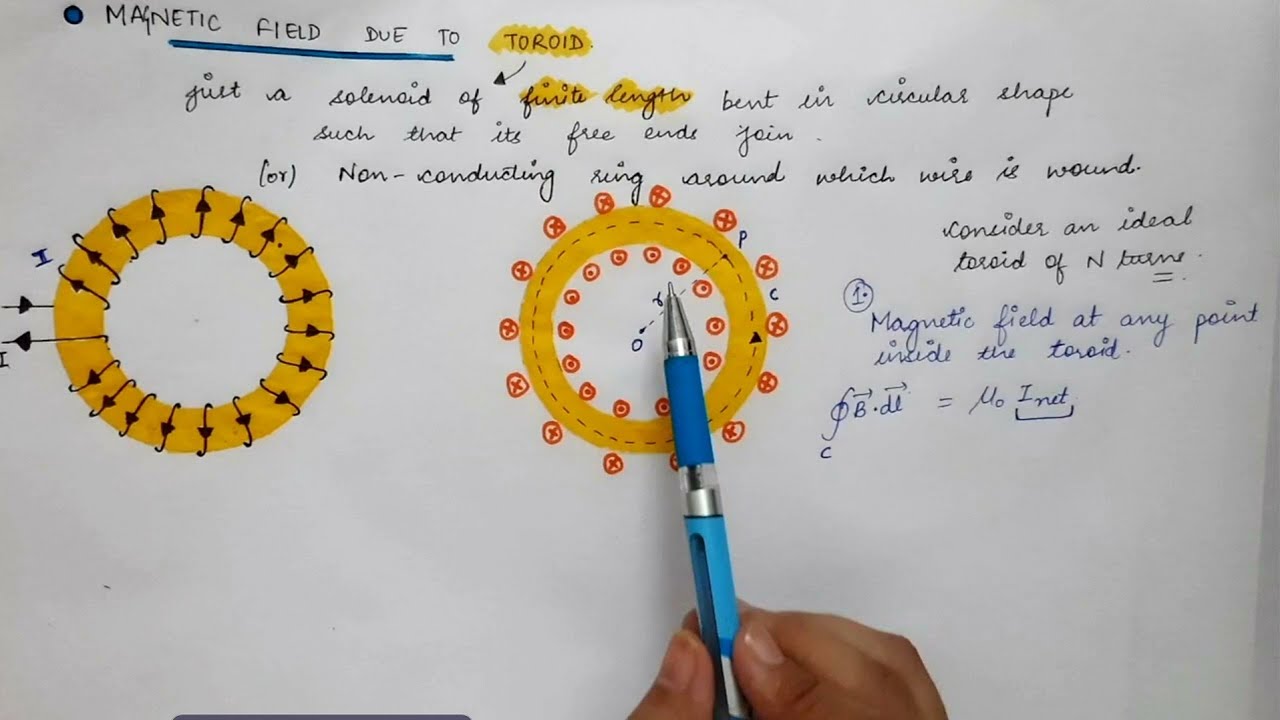
Lecture 28 | 2nd Sem | Magnetic field due to Toroid
Keywords
Summary
197 words
Critical Evaluation
Value of the Information & Strength of the Argument
The lecture provides a clear and systematic derivation of the magnetic field inside a toroid, using Ampère’s circuital law. The argumentation is logically sound, starting with the definition of a toroid and an ideal toroid, then setting up the Amperian loop and calculating the enclosed current. The symmetry arguments are well-explained, and the step-by-step integration is easy to follow. The discussion of limiting cases (small cross-section) and the behavior outside the toroid adds depth. However, the lecture does not provide any physical intuition or real-world applications, which could enhance its value. The presentation is straightforward but lacks visual aids or demonstrations, which might make it less engaging for some learners.
Scientific Rigor, Source Quality, Title Accuracy
The lecture is scientifically rigorous in its derivation, adhering to standard electromagnetic theory. However, it does not cite any external sources or references, which limits its scholarly depth. The title accurately reflects the content, and the lecture stays on topic throughout. The absence of citations is a minor weakness, but the content itself is accurate and well-presented.
182 words
Title / Content Match
The title accurately reflects the content, which is a lecture on deriving the magnetic field due to a toroid.
Quality & Reliability
8/10
The lecture provides a clear, step-by-step derivation of the magnetic field inside and outside a toroid using Ampère's circuital law. The explanation is logically structured, with appropriate assumptions and simplifications. The content is accurate and aligns with standard physics textbooks, though it lacks citations and references to external sources.
Key Moments
Markers derived by PSI from the transcript: the creator did not define chapters.
- Introduction: definition of a toroid as a bent solenoid.
- Explanation of an ideal toroid and setup for Ampère's law.
- Drawing the Amperian loop and calculating enclosed current.
- Derivation of the magnetic field expression B = μ₀NI / (2πr).
- Discussion of field variation with radius and limiting case of small cross-section.
- Derivation for points outside the toroid, showing B = 0.
- Summary and conclusion.
Contribution & Novelties
The lecture provides a clear pedagogical derivation of the magnetic field inside a toroid, which is a standard topic in electromagnetism. Its contribution lies in its step-by-step approach, making the derivation accessible to undergraduate students. However, it does not introduce new concepts or novel perspectives beyond textbook treatments.
Pour aller plus loin :
- Ampère’s circuital law — Foundational law used in the derivation.
- Toroid — General definition and properties of toroids.
- Solenoid — Related concept; a toroid is a bent solenoid.
81 words
Radar Profile
The radar profile shows high scores in quality of information and reliability, with moderate scores in quantity and technical level. This indicates a focused, accurate lecture that may lack breadth and advanced depth.