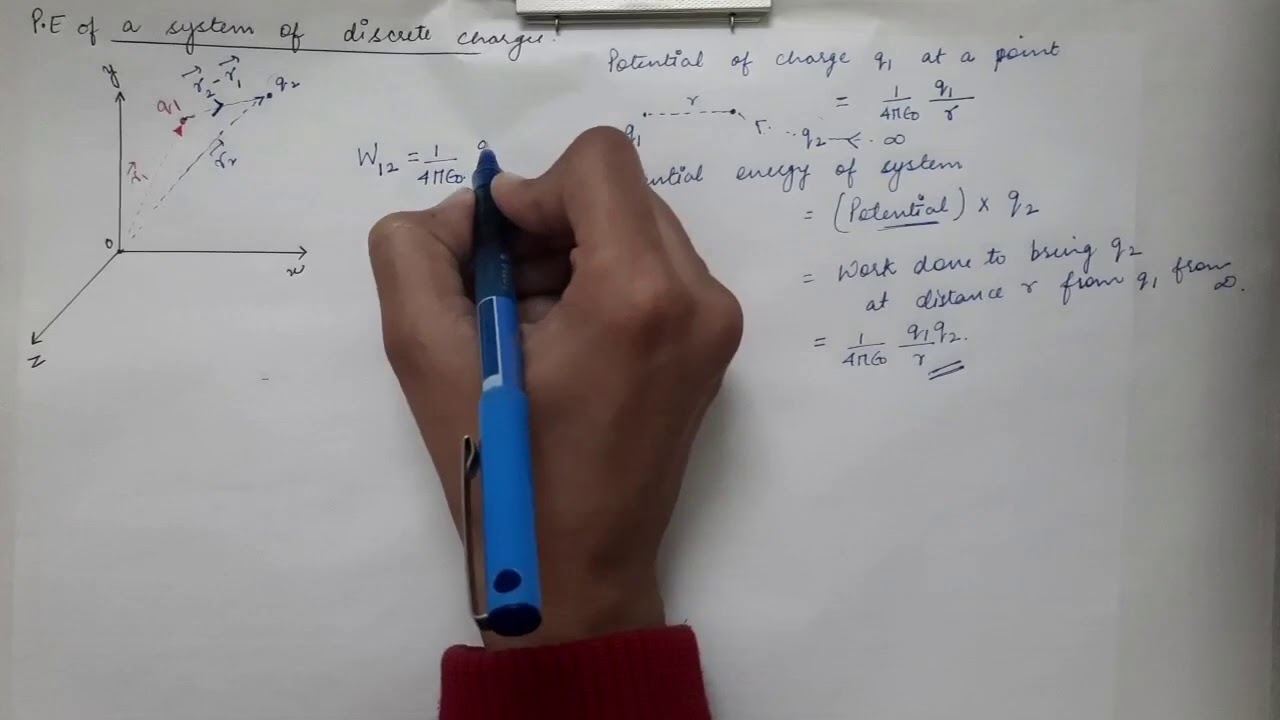
Lecture 34 | 1st Semester | Potential energy of system of discrete charges| Equipotential surfaces
Keywords
Summary
133 words
Critical Evaluation
Value of the Information & Strength of the Argument
The video provides a standard derivation of potential energy for discrete charge systems, which is valuable for introductory physics students. The argumentation is logical, building from single charge potential to multiple charges. However, the presentation is marred by frequent digressions and repetitive subscription prompts, which detract from the clarity. The instructor uses examples and step-by-step reasoning, but the audio quality and disorganized delivery reduce the effectiveness of the argumentation.
Scientific Rigor, Source Quality, Title Accuracy
The scientific rigor is acceptable for a basic lecture; the formulas and concepts are correct. No external sources are cited, and the video relies on standard physics knowledge. The title accurately reflects the content, covering both potential energy and equipotential surfaces. However, the lack of clear structure and the poor audio quality undermine the overall quality.
140 words
Title / Content Match
The title accurately describes the topics covered: potential energy of discrete charges and equipotential surfaces.
Quality & Reliability
3/10
The video is a basic physics lecture covering standard concepts, but the audio is heavily distorted and the presentation is disorganized, with frequent requests to subscribe. The content is correct but lacks depth and clarity.
Key Moments
Markers derived by PSI from the transcript: the creator did not define chapters.
Contribution & Novelties
The video offers a basic tutorial on potential energy of discrete charges and equipotential surfaces, which is standard material in introductory electromagnetism. It does not present new research or unique insights. For further exploration, consider the following:
- Electric potential - Wikipedia — Provides a comprehensive overview of electric potential and related concepts.
- Equipotential surface - Wikipedia — Detailed explanation of equipotential surfaces and their applications.
- Coulomb’s law - Wikipedia — Fundamental law governing interactions between charges, relevant to the derivation.
80 words
Radar Profile
The radar profile shows low scores across all dimensions, indicating a basic and poorly presented lecture. The content is correct but lacks depth and clarity, making it suitable only for absolute beginners.