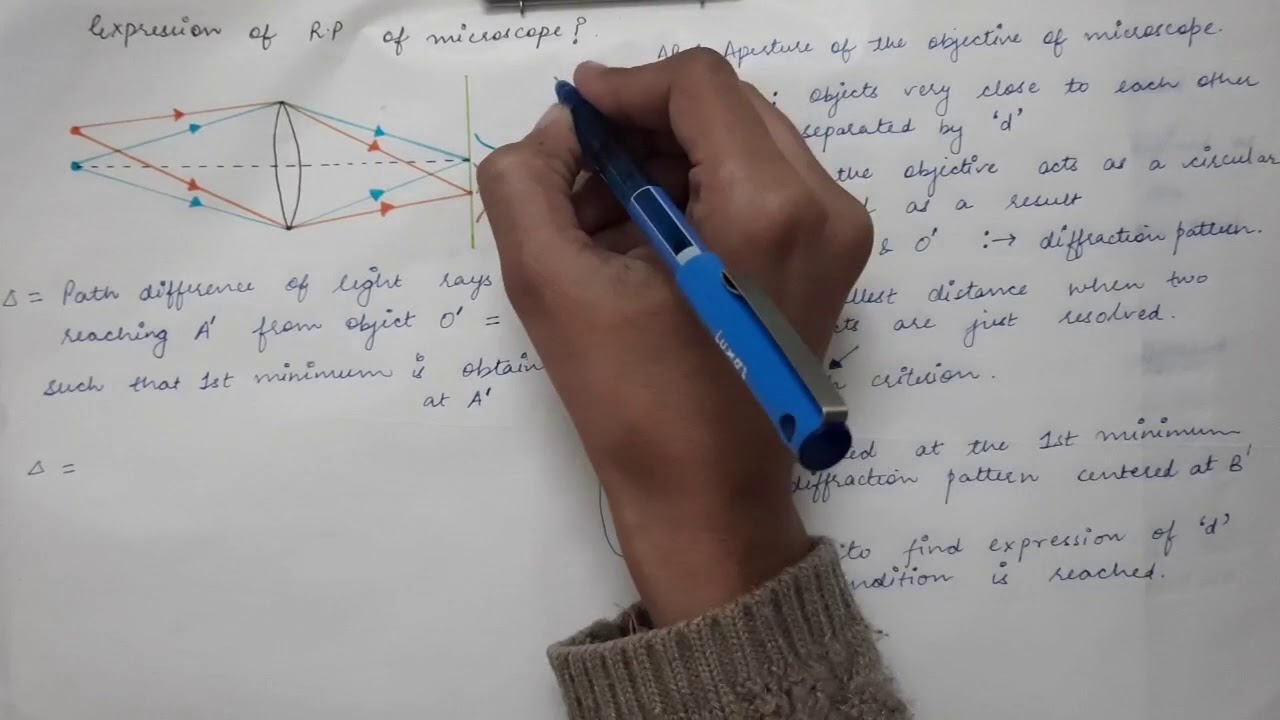
Lecture 44 | 3rd Semester | Resolving power of microscope
Keywords
Summary
186 words
Critical Evaluation
Value of the Information & Strength of the Argument
The video provides a basic explanation of the resolving power of a microscope, but the argumentation is weak due to the poor audio and unclear presentation. The derivation of the formula is not clearly structured, and the speaker often digresses to ask for subscriptions. The scientific content is standard and can be found in any optics textbook, but the delivery is not effective for learning.
Scientific Rigor, Source Quality, Title Accuracy
The video does not cite any specific sources or references. The title accurately reflects the topic, but the content is not presented with scientific rigor. The lack of clear explanations and the poor audio quality undermine the credibility of the lecture. There are no comments provided to analyze.
128 words
Title / Content Match
The title accurately reflects the topic, but the content is poorly delivered due to audio issues.
Quality & Reliability
2/10
The lecture is a basic tutorial on the resolving power of a microscope, but the audio is heavily distorted and the transcription is garbled, making it difficult to follow. The content appears to be a standard derivation from optics, but the presentation lacks clarity and depth.
Key Moments
Markers derived by PSI from the transcript: the creator did not define chapters.
- Introduction to the lecture and definition of resolving power.
- Discussion on the resolving power of telescope vs microscope.
- Explanation of diffraction patterns and Rayleigh criterion.
- Derivation of the formula for minimum resolvable distance.
- Factors affecting resolving power and ways to improve it.
- Summary and concluding remarks.
Contribution & Novelties
The video offers a basic tutorial on the resolving power of a microscope, but it does not provide any novel insights or original contributions. The content is standard and can be found in textbooks.
Pour aller plus loin :
- Rayleigh criterion — Wikipedia article on angular resolution and Rayleigh criterion.
- Numerical aperture — Wikipedia article on numerical aperture, a key parameter in the resolving power formula.
- Abbe diffraction limit — Wikipedia article on diffraction-limited systems, which includes the Abbe limit for microscopes.
82 words
Radar Profile
The radar profile shows low scores across all dimensions, indicating a weak educational resource. The quantity of information is moderate, but the quality and technical level are low, and the reliability is very low due to poor audio and lack of sources.