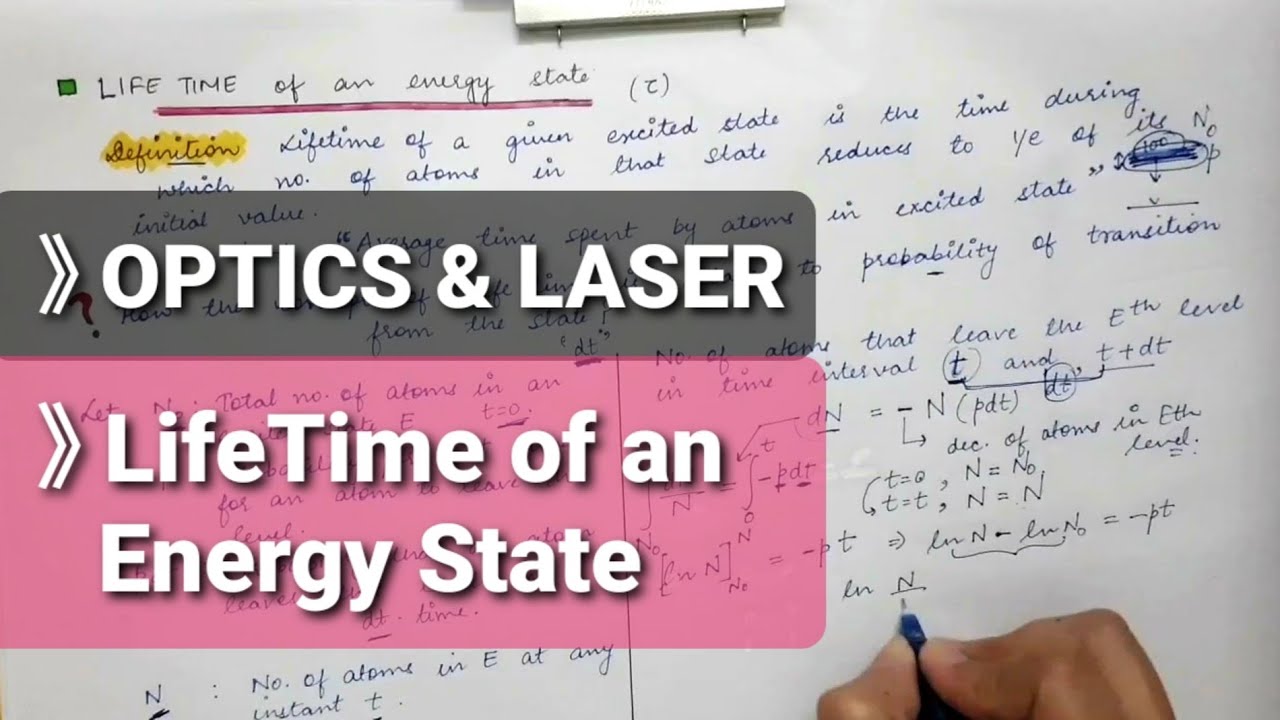
LASER | Lecture 15 | Lifetime of an Energy State
Keywords
Summary
158 words
Critical Evaluation
Value of the Information & Strength of the Argument
The lecture provides a basic introduction to the concept of lifetime of an energy state, which is fundamental in laser physics. The argumentation is based on standard principles of quantum mechanics and atomic physics, such as the exponential decay of excited state populations and the relationship between transition probability and lifetime. However, the presentation is not rigorous, and the reasoning is often unclear due to the garbled transcription. The instructor attempts to derive the expression for lifetime using integration, but the steps are not clearly articulated. The value of the information is limited to a superficial overview, with no in-depth analysis or examples. The argumentation lacks solidity, as the logical flow is disrupted by the poor quality of the audio transcription.
Scientific Rigor, Source Quality, Title Accuracy
The lecture does not cite any external sources, and the content appears to be based on standard textbook material. The title accurately reflects the topic, but the content is not presented with scientific rigor. The transcription is heavily corrupted, which undermines the reliability of the information. There are no comments provided, so no analysis of public reception is possible. The lecture lacks clear structure, and the instructor frequently repeats phrases and makes digressions, which further reduces the scientific quality. The adequacy between the title and the content is acceptable, but the execution is poor.
230 words
Title / Content Match
The title accurately reflects the topic, as the lecture discusses the lifetime of an energy state in the context of lasers.
Quality & Reliability
4/10
The lecture provides a basic introduction to the concept of lifetime of an energy state, but the transcription is heavily corrupted by automatic speech recognition errors, making it difficult to follow. The content appears to be a standard physics lecture, but the lack of clear structure and the presence of numerous inaccuracies in the transcription reduce its reliability.
Key Moments
Markers derived by PSI from the transcript: the creator did not define chapters.
- Introduction to the concept of lifetime of an energy state.
- Definition of lifetime as the average time an atom stays in an excited state.
- Discussion on the probability of transition per unit time.
- Derivation of the exponential decay of excited state population.
- Explanation of the relationship between lifetime and transition probability.
- Integration to calculate the average lifetime.
- Importance of lifetime in laser operation.
Contribution & Novelties
The lecture offers a basic introduction to the lifetime of an energy state, which is a standard topic in laser physics. It does not present any novel insights or original research. The content is derivative of common textbook material.
Pour aller plus loin :
- Spontaneous emission — Provides background on the process that determines the lifetime.
- Exponential decay — Mathematical basis for the population decay.
- Einstein coefficients — Relates transition probabilities to lifetimes.
73 words
Radar Profile
The radar profile shows low scores across all dimensions, indicating a lecture with limited information content, poor technical depth, and low reliability. The lecture is likely suitable for absolute beginners but lacks the rigor expected in a scientific presentation.