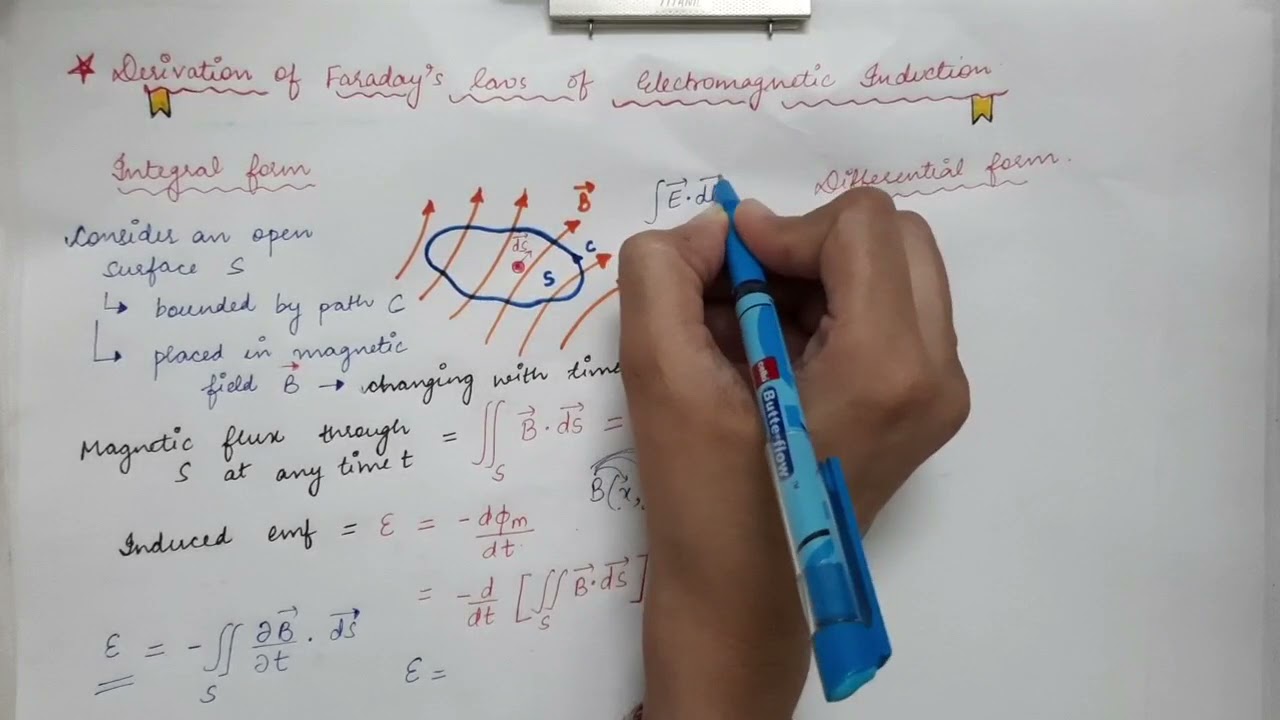
Integral & Differential form of Faraday's Law
Keywords
Summary
151 words
Critical Evaluation
Value of the Information & Strength of the Argument
The video provides a standard derivation of Faraday’s law in both integral and differential forms. The argumentation follows a logical sequence: starting with the definition of magnetic flux, then introducing the integral form, and finally using Stokes’ theorem to obtain the differential form. However, the presentation is not rigorous; the speaker jumps between concepts without clear transitions, and the audio quality is poor, with many inaudible parts. The value of the information is limited to a basic review of the topic, with no additional insights or applications. The argumentation is weakened by the lack of clear explanations and the presence of numerous distractions.
Scientific Rigor, Source Quality, Title Accuracy
The video does not cite any sources, and the description contains no links. The title accurately reflects the content, but the execution is not rigorous. The scientific content is correct, but the presentation is disorganized, and the lack of references reduces its credibility. The video does not engage with any experimental evidence or historical context, which could have strengthened the explanation. Overall, the scientific rigor is low due to the poor presentation and lack of sources.
194 words
Title / Content Match
The title accurately describes the content, which covers both integral and differential forms of Faraday's law.
Quality & Reliability
3/10
The video is a tutorial on Faraday's law, but the transcription is heavily garbled and contains many irrelevant phrases and subscription prompts. The scientific content is correct but presented in a disorganized manner, with poor audio quality and unclear explanations. No sources are cited, and the video lacks rigorous structure.
Key Moments
Markers derived by PSI from the transcript: the creator did not define chapters.
- Introduction to magnetic flux and its time derivative.
- Definition of induced EMF and its relation to electric field.
- Integral form of Faraday's law: EMF = -dΦ/dt.
- Application of Stokes' theorem to derive the differential form.
- Differential form: ∇×E = -∂B/∂t.
- Discussion on the non-conservative nature of the induced electric field.
Contribution & Novelties
The video offers a basic tutorial on Faraday’s law, but it does not provide any novel insights or original perspectives. The content is standard and can be found in any electromagnetism textbook. The presentation is marred by technical issues, making it less useful for learning.
Pour aller plus loin :
- Faraday’s law of induction — Provides a comprehensive overview of the law, including historical context and applications.
- Maxwell’s equations — Contextualizes Faraday’s law within the broader framework of classical electromagnetism.
- Stokes’ theorem — The mathematical tool used to derive the differential form from the integral form.
96 words
Radar Profile
The radar profile shows a relatively balanced but low overall performance, with scores around 3-5 across all dimensions. This indicates a video that is technically adequate but lacks depth, clarity, and reliability, making it a mediocre educational resource.