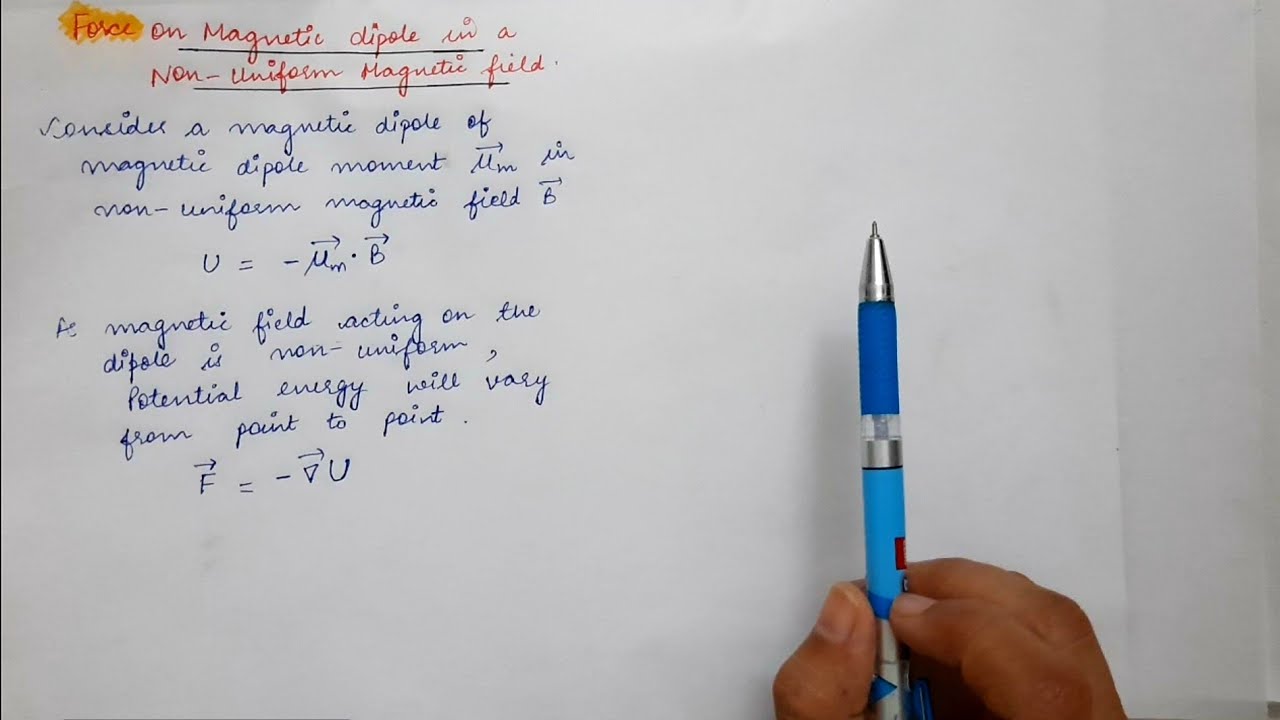
Force on Magnetic Dipole in Non-Uniform Magnetic field
Keywords
Summary
169 words
Critical Evaluation
Value of the Information & Strength of the Argument
The video provides a standard derivation of the force on a magnetic dipole in a non-uniform magnetic field, which is a fundamental topic in electromagnetism. The argumentation is logically sound, following the standard approach of using the potential energy expression and taking its gradient. However, the presentation is not particularly insightful or original; it is a straightforward tutorial. The instructor does not provide any novel perspectives or deeper physical insights beyond the basic derivation. The discussion of paramagnetic and diamagnetic materials is also standard. The value of the information is moderate, suitable for beginners, but it lacks depth and does not engage with more advanced aspects such as the quantum mechanical origin of magnetic moments or the limitations of the point-dipole approximation.
Scientific Rigor, Source Quality, Title Accuracy
The scientific rigor is limited. The derivation is correct but presented without clear references to textbooks or research papers. The instructor does not cite any sources, and the description contains no links. The title accurately describes the content, but the video’s production quality is poor, with frequent audio issues and a distracting number of subscription prompts. The lack of citations and the informal style reduce the overall reliability. There are no comments provided, so no analysis of public reception is possible.
218 words
Title / Content Match
The title accurately reflects the content, which focuses on deriving the force expression for a magnetic dipole in a non-uniform field.
Quality & Reliability
5/10
The video provides a basic derivation of the force on a magnetic dipole in a non-uniform magnetic field, but the presentation is marred by poor audio quality, numerous transcription errors, and a lack of clear citations. The physics content is standard and correct, but the delivery is not rigorous.
Key Moments
Markers derived by PSI from the transcript: the creator did not define chapters.
- Introduction: recalling potential energy of magnetic dipole in magnetic field.
- Derivation of force as negative gradient of potential energy.
- Component-wise expansion of force in non-uniform field.
- Physical interpretation: force towards stronger field, paramagnetic attraction.
- Classification of materials: dia-, para-, ferromagnetic.
- Discussion of atomic magnetic moments and electron orbits.
- Behavior of diamagnetic materials in external field.
- Summary and conclusion.
Contribution & Novelties
The video offers a basic tutorial on the force on a magnetic dipole in a non-uniform magnetic field, which is a standard topic in electromagnetism. It does not present new research or novel insights, but it serves as an educational resource for undergraduate students. The derivation is clear but lacks depth.
Pour aller plus loin :
- Magnetic dipole — Provides a comprehensive overview of magnetic dipoles, including their potential energy and force in external fields.
- Magnetic moment — Discusses the concept of magnetic moment and its role in the force experienced by dipoles.
- Gradient — Mathematical background for the gradient operator used in the force derivation.
106 words
Radar Profile
The radar profile shows moderate scores across all dimensions, with slightly higher scores in technical level and reliability, but lower in information quantity and quality. This indicates a basic tutorial that is technically correct but lacks depth and comprehensive coverage.