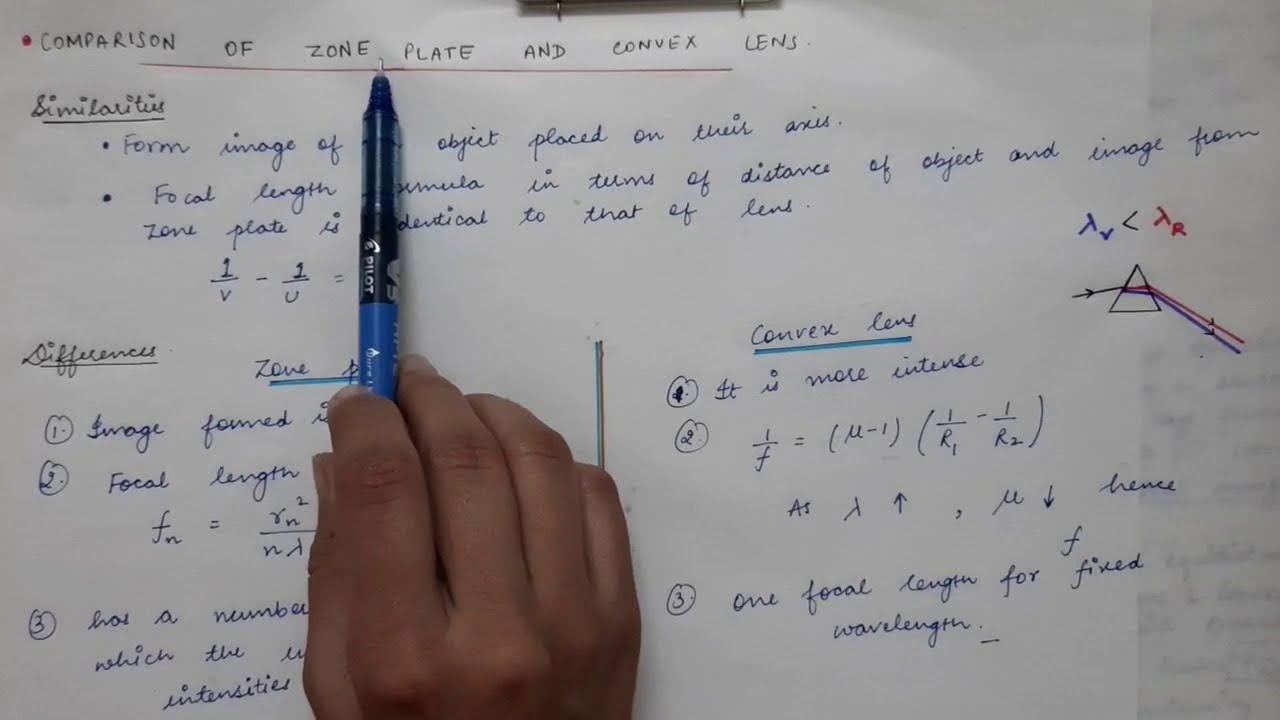
Lecture 29 | 3rd Semester |Diff b/w Zone plate & Convex lens| Fraunhaufer diffraction at single slit
Keywords
Summary
156 words
Critical Evaluation
Value of the Information & Strength of the Argument
The lecture provides a clear and systematic comparison between zone plates and convex lenses, emphasizing key formulas and physical reasoning. The argumentation is logical, building from established principles like Huygens’ principle to explain diffraction. However, the presentation is largely descriptive and lacks quantitative derivations or experimental evidence. The explanation of the central maximum in single-slit diffraction is intuitive but could benefit from a more rigorous treatment of path differences and intensity distribution.
Scientific Rigor, Source Quality, Title Accuracy
The lecture does not cite any external sources, relying solely on standard textbook knowledge. The content is accurate but not supported by references. The title accurately describes the topics covered. No comments were provided for analysis.
123 words
Title / Content Match
The title accurately reflects the content: the lecture compares zone plates and convex lenses, then covers Fraunhofer diffraction at a single slit.
Quality & Reliability
6/10
The lecture provides a clear, step-by-step explanation of the differences between zone plates and convex lenses, and introduces Fraunhofer diffraction at a single slit. The content is accurate but lacks citations to external sources and does not engage with primary literature. The presentation is pedagogical but somewhat repetitive.
Key Moments
Markers derived by PSI from the transcript: the creator did not define chapters.
- Introduction: comparing zone plate and convex lens
- Similarities: both focus light on axis, same focal length formula
- Differences: multiple foci vs single focus, intensity comparison
- Focal length vs wavelength: zone plate inversely proportional, lens directly proportional
- Start of Fraunhofer diffraction at single slit: setup and conditions
- Explanation of diffraction using Huygens' principle
- Central maximum: constructive interference at point opposite slit center
Contribution & Novelties
The lecture offers a clear pedagogical comparison between zone plates and convex lenses, highlighting the inverse vs direct wavelength dependence of focal length, which is a subtle point. It also provides an intuitive explanation of the central maximum in single-slit diffraction using Huygens’ principle. However, it does not introduce novel concepts beyond standard textbook material.
Pour aller plus loin :
- Zone plate — Overview of zone plates, their construction, and applications.
- Fraunhofer diffraction — Detailed treatment of Fraunhofer diffraction, including single-slit case.
- Huygens–Fresnel principle — The principle underlying diffraction explanations.
90 words
Radar Profile
The radar profile shows moderate scores across all dimensions, with quantity of information slightly higher than quality and technical level. This suggests a lecture that covers a fair amount of material but lacks depth and rigor in presentation.