NUCLEAR PHYSICS | Lecture 18 | Scintillation Counter
Keywords
Summary
120 words
Critical Evaluation
Value of the Information & Strength of the Argument
The lecture provides a basic introduction to scintillation counters, covering the fundamental principles and components. However, the argumentation is not very solid; it lacks detailed explanations and quantitative data. The content is presented in a straightforward manner but is not deeply developed. The value of the information is limited for an advanced audience, as it stays at an introductory level.
Scientific Rigor, Source Quality, Title Accuracy
The lecture does not cite any specific sources or references. The title accurately reflects the content, which is a lecture on scintillation counters. The scientific rigor is moderate; the explanations are simplified and may not be entirely precise. The lack of sources and the poor audio quality reduce the overall reliability.
126 words
Title / Content Match
The title accurately reflects the content, which is a lecture on scintillation counters in nuclear physics.
Quality & Reliability
5/10
The lecture provides a basic overview of scintillation counters, but the audio quality is poor and the transcription is garbled, making it difficult to follow. The content is not detailed and lacks rigorous scientific depth.
Key Moments
Markers derived by PSI from the transcript: the creator did not define chapters.
- Introduction to scintillation counter and its difference from gas detectors.
- Explanation of the principle: ionizing radiation produces light flashes in scintillating material.
- Discussion on the properties of an ideal scintillation material.
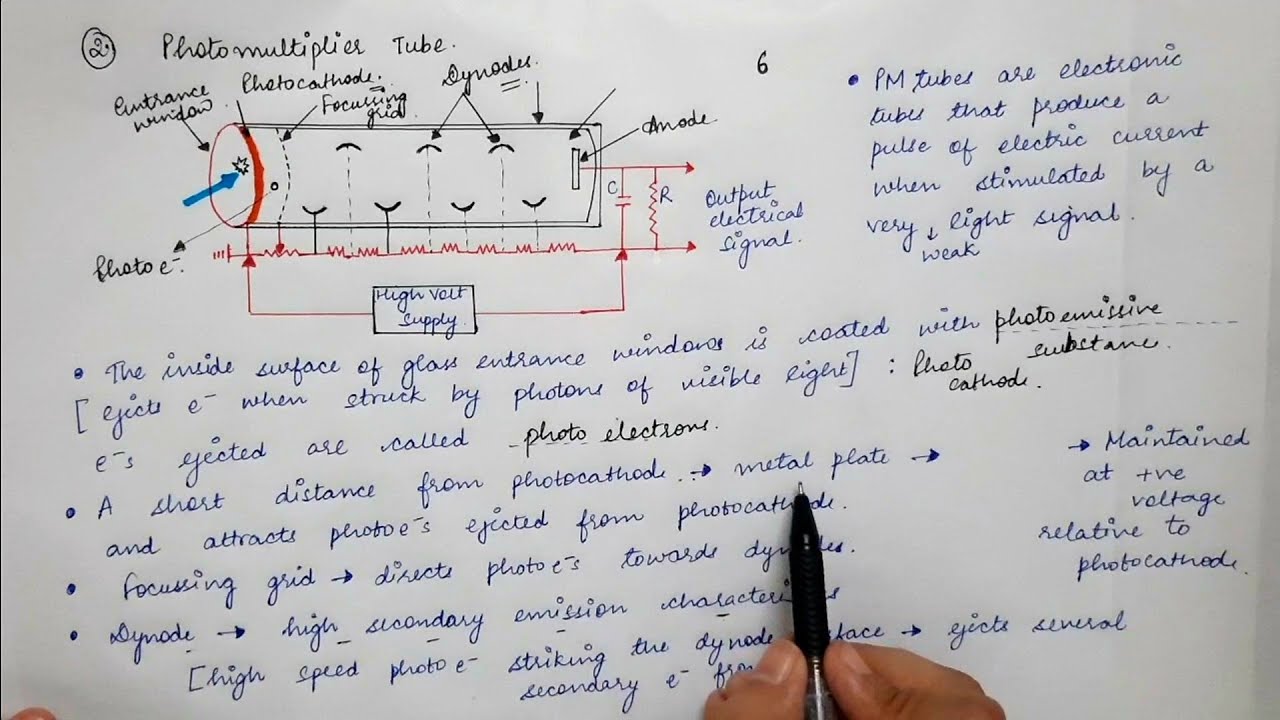
- Introduction to photomultiplier tube (PMT) and its role in converting light to electrical signal.
- Classification of scintillators: organic and inorganic, with examples.
- Advantages of scintillation counters: high efficiency, fast response, and good energy resolution.
Contribution & Novelties
The lecture offers a basic overview of scintillation counters, which is not particularly novel for those familiar with nuclear physics. It serves as an introductory resource for undergraduates.
Pour aller plus loin :
- Scintillation counter - Wikipedia — Provides a comprehensive overview of scintillation counters, including history and applications.
- Photomultiplier tube - Wikipedia — Detailed explanation of PMT operation and characteristics.
- Scintillator - Wikipedia — Discusses various scintillating materials and their properties.
72 words
Radar Profile
The radar profile shows moderate scores across all dimensions, indicating a basic but not highly rigorous lecture. The content is informative but lacks depth and technical detail.