Keywords
Summary
210 words
Critical Evaluation
Value of the Information & Strength of the Argument
The video provides practical, actionable guidance for undergraduate physics students, covering essential laboratory procedures. The explanation of least count calculation is clear and well-illustrated with examples, which is valuable for beginners. The argumentation is straightforward and logical, building from general principles to specific examples. However, the content is basic and does not delve into deeper theoretical or advanced topics, limiting its value for more experienced students. The instructor’s teaching style is methodical, but the lack of visual aids or demonstrations beyond simple diagrams may reduce engagement.
Scientific Rigor, Source Quality, Title Accuracy
The video does not cite any external sources or references, which is typical for introductory tutorials but limits its scientific rigor. The information presented is standard and accurate, but without citations, it cannot be independently verified. The title ‘Introductory Lecture’ accurately reflects the content, which is a basic introduction to physics practicals. The video’s structure is clear, but the lack of sources and the elementary nature of the content prevent it from being considered highly rigorous.
177 words
Title / Content Match
The title 'Introductory Lecture' accurately reflects the content, which is a basic introduction to physics practicals for undergraduate students.
Quality & Reliability
6/10
The video provides a clear, step-by-step tutorial on laboratory practices, including least count calculation and graph plotting. However, it lacks citations, references, or external sources, and the content is basic and introductory, with no advanced or novel material.
Key Moments
Markers derived by PSI from the transcript: the creator did not define chapters.
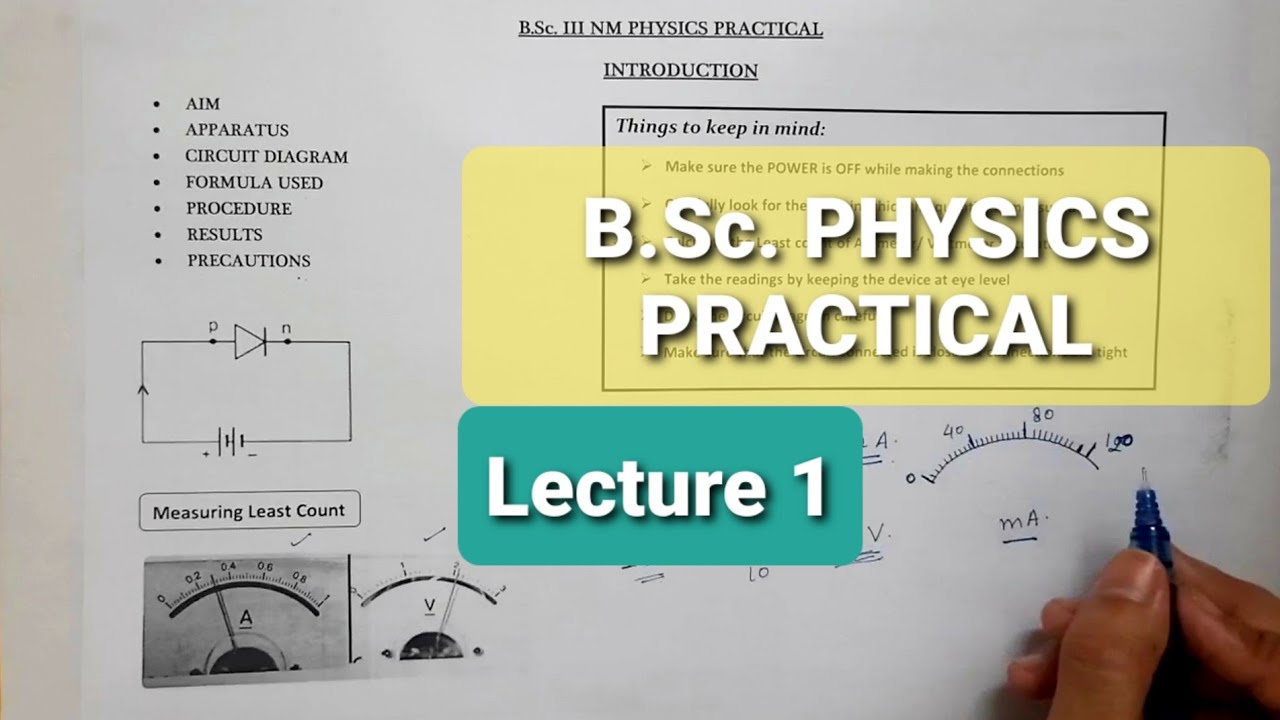
- Introduction to the lecture and overview of essential steps for physics experiments.
- Explanation of the importance of knowing the aim and apparatus required for an experiment.
- Discussion on drawing circuit diagrams and common mistakes students make.
- Listing of steps: formula, procedure, results, and precautions.
- Safety tips: switching off power before connections, checking units, and eye-level readings.
- Introduction to least count and calculation for ammeter and voltmeter examples.
- Practice problems for students: calculate least count and readings.
- Tabular observations for PN junction diode characteristics and graph plotting.
- Explanation of knee voltage and breakdown voltage.
- Importance of mentioning scale on graph paper and conclusion.
Contribution & Novelties
The video offers a clear, step-by-step guide for undergraduate physics students on laboratory practices, particularly focusing on least count calculation and graph plotting. While the content is not novel, it serves as a useful refresher for students. The instructor’s approach of using examples and interactive questions (asking students to calculate least counts) enhances engagement.
Pour aller plus loin :
- Least count — Provides a general definition and examples.
- PN junction diode — Background on the diode’s characteristics.
- Graph plotting — General principles of graphing data.
85 words
Radar Profile
The radar profile shows moderate scores across all dimensions, with a notably low score for technical level, reflecting the introductory nature of the content. The video is strong in providing clear explanations but lacks depth and external validation.