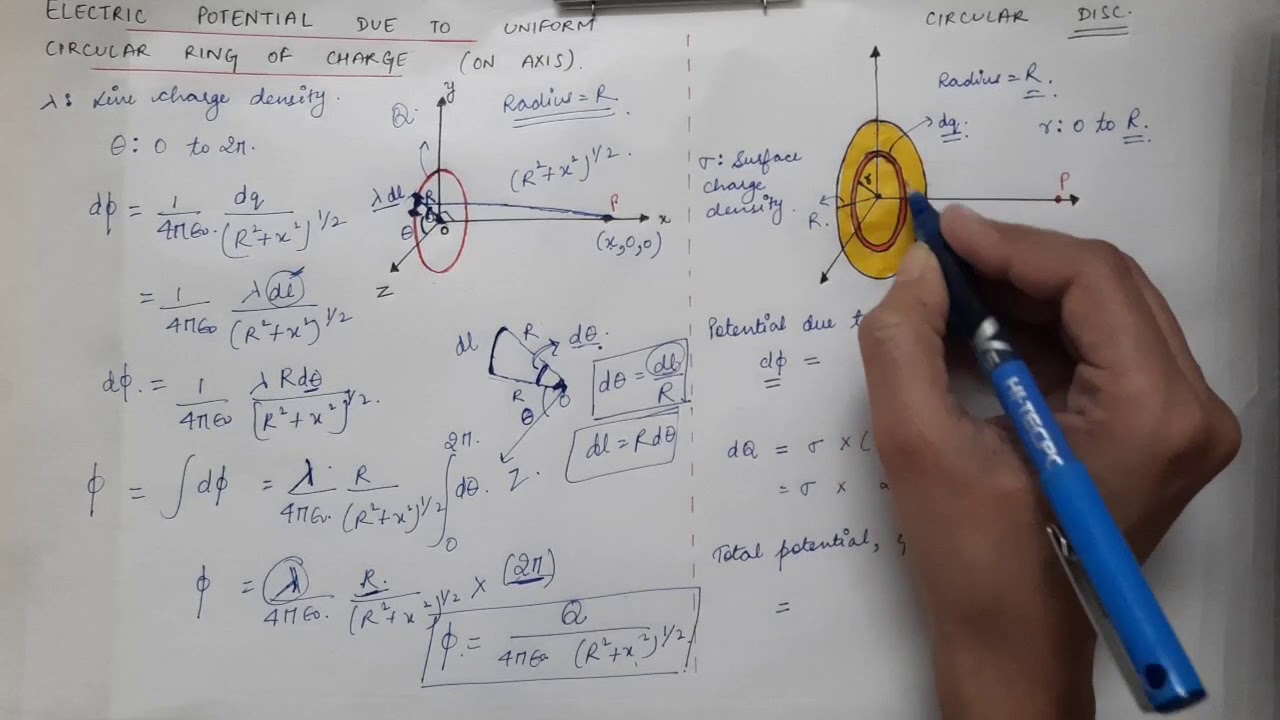
Homework | 1st Semester | Potential due to Circular disc
Keywords
Summary
130 words
Critical Evaluation
Value of the Information & Strength of the Argument
The video provides a basic derivation of the electric potential due to a uniformly charged disc, which is a standard problem in electrostatics. The argumentation is logical: it correctly uses the superposition principle by integrating contributions from infinitesimal rings. However, the explanation is rushed and lacks clarity, with many steps skipped or glossed over. The instructor does not justify the choice of integration limits or the treatment of the charge density in detail. The value of the information is limited to a straightforward problem-solving approach, with no additional insights or applications. The argumentation is solid but not rigorous, and the presentation is not engaging.
Scientific Rigor, Source Quality, Title Accuracy
The video does not cite any sources or references. The scientific rigor is moderate: the physics is correct, but the derivation is not fully detailed, and there is no discussion of assumptions or limitations. The title accurately reflects the content, which is a homework problem on potential due to a circular disc. The video is a tutorial, so it does not present original research or a literature review. The lack of sources and the informal presentation style reduce its credibility as a rigorous scientific resource.
204 words
Title / Content Match
The title accurately describes the content: a homework problem on potential due to a circular disc.
Quality & Reliability
3/10
The video is a basic physics tutorial on calculating electric potential due to a uniformly charged circular disc. The explanation is mathematically correct but lacks depth, rigorous derivations, and references. The audio quality is poor, and the constant requests for subscriptions are distracting. The content is suitable for beginners but not for advanced learners.
Key Moments
Markers derived by PSI from the transcript: the creator did not define chapters.
- Introduction and problem statement: potential due to a uniformly charged circular disc.
- Breakdown of the disc into infinitesimal ring elements.
- Derivation of potential contribution from a single ring.
- Setting up the integral for the total potential.
- Performing the integration and obtaining the final expression.
- Discussion of the result and its physical interpretation.
- Conclusion and summary.
Contribution & Novelties
The video offers a step-by-step solution to a standard physics problem, which is useful for students learning electrostatics. However, it does not present any novel insights or original contributions. The approach is conventional and can be found in any standard textbook.
Pour aller plus loin :
- Electric potential — Provides a comprehensive overview of electric potential and its calculation.
- Superposition principle — Explains the principle used to integrate contributions from infinitesimal elements.
- Surface charge density — Defines the concept of charge per unit area used in the derivation.
88 words
Radar Profile
The radar profile shows moderate scores across all dimensions, indicating a basic tutorial with limited depth and rigor. The quantity and quality of information are average, and the technical level is suitable for beginners. The overall reliability is moderate, but the lack of sources and poor presentation reduce its value.