NUCLEAR PHYSICS | Lecture 13 | Radiation Detectors
Keywords
Summary
155 words
Critical Evaluation
Value of the Information & Strength of the Argument
The video provides a very basic and superficial overview of radiation detectors. The argumentation is weak, with no clear structure or logical progression. The instructor jumps between topics without depth, and the explanation of the working principle is muddled. There is no critical analysis or comparison of different detector types. The value of information is low for anyone with prior knowledge, and even beginners would struggle due to the poor delivery.
80 words
Title / Content Match
The title accurately reflects the topic of radiation detectors, but the content is superficial and poorly delivered.
Quality & Reliability
3/10
The lecture provides a basic overview of radiation detectors, but the transcription is heavily corrupted by auto-generated subtitles, making the content difficult to follow. The presentation lacks depth and scientific rigor, with no references or citations.
Key Moments
Markers derived by PSI from the transcript: the creator did not define chapters.
- Introduction to radiation detectors and their purpose.
- Classification of detectors into gas-filled and solid-state types.
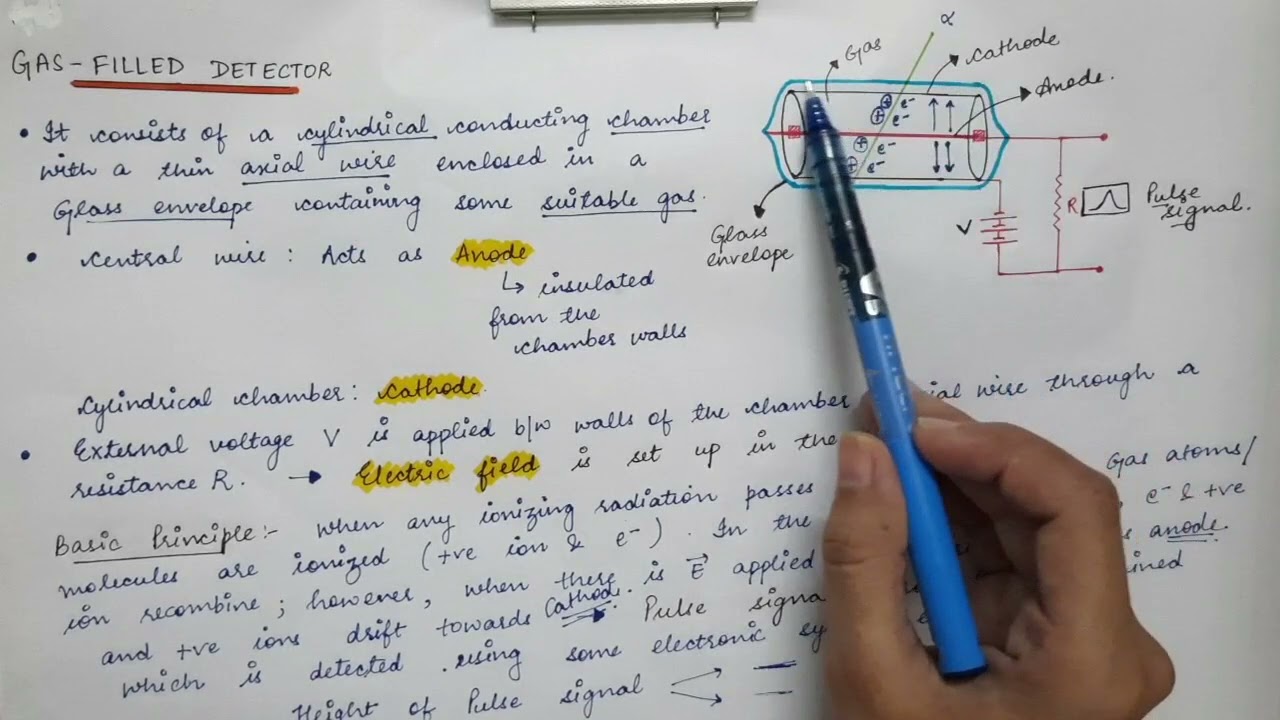
- Basic construction of a gas-filled detector chamber.
- Explanation of ionization process and signal generation.
- Discussion on the effect of external voltage on signal height.
- Mention of different operating regions: ionization chamber, proportional counter, Geiger-Müller.
Contribution & Novelties
The video offers a basic introduction to radiation detectors, but it does not provide any novel insights or advanced concepts. It is a rudimentary tutorial that might serve as a starting point for absolute beginners, but it lacks depth and clarity.
Pour aller plus loin :
- Gas ionization detector — Provides a comprehensive overview of gas-filled detectors, including operating regions.
- Geiger–Müller tube — Detailed explanation of the Geiger-Müller counter, a specific type of gas-filled detector.
- Scintillation counter — Discusses solid-state detectors and scintillation mechanisms, complementing the video’s brief mention.
89 words
Radar Profile
The radar profile shows low scores across all dimensions, indicating a weak educational resource. The quantity and quality of information are insufficient, and the technical level is basic. The reliability is compromised by the poor transcription and lack of sources.