Lecture 3 (5th Semester) - Discovery of neutron & proton - neutron theory
Keywords
Summary
179 words
Critical Evaluation
Value of the Information & Strength of the Argument
The lecture provides a basic overview of the discovery of the neutron and proton, and introduces key concepts in nuclear physics. The argumentation is largely narrative and descriptive, with limited quantitative analysis. The instructor mentions experiments and observations but does not provide detailed derivations or rigorous evidence. The value of the information is moderate for an introductory audience, but the lack of clarity in the transcription and the absence of citations weaken the overall argumentation.
Scientific Rigor, Source Quality, Title Accuracy
The lecture does not cite specific sources or references. The content is based on well-established historical facts in physics, but the presentation lacks scientific rigor due to the poor quality of the transcription and the absence of citations. The title accurately reflects the content, but the lecture’s technical depth is limited. No comments were provided for analysis.
147 words
Title / Content Match
The title accurately reflects the content, which focuses on the discovery of the neutron and proton and introduces neutron theory.
Quality & Reliability
4/10
The lecture covers historical discoveries and basic nuclear physics concepts, but the transcription is heavily corrupted by automatic speech recognition errors, making it difficult to verify accuracy. The content is largely qualitative and lacks rigorous derivations or citations.
Key Moments
Markers derived by PSI from the transcript: the creator did not define chapters.
- Introduction to the lecture on discovery of neutron and proton.
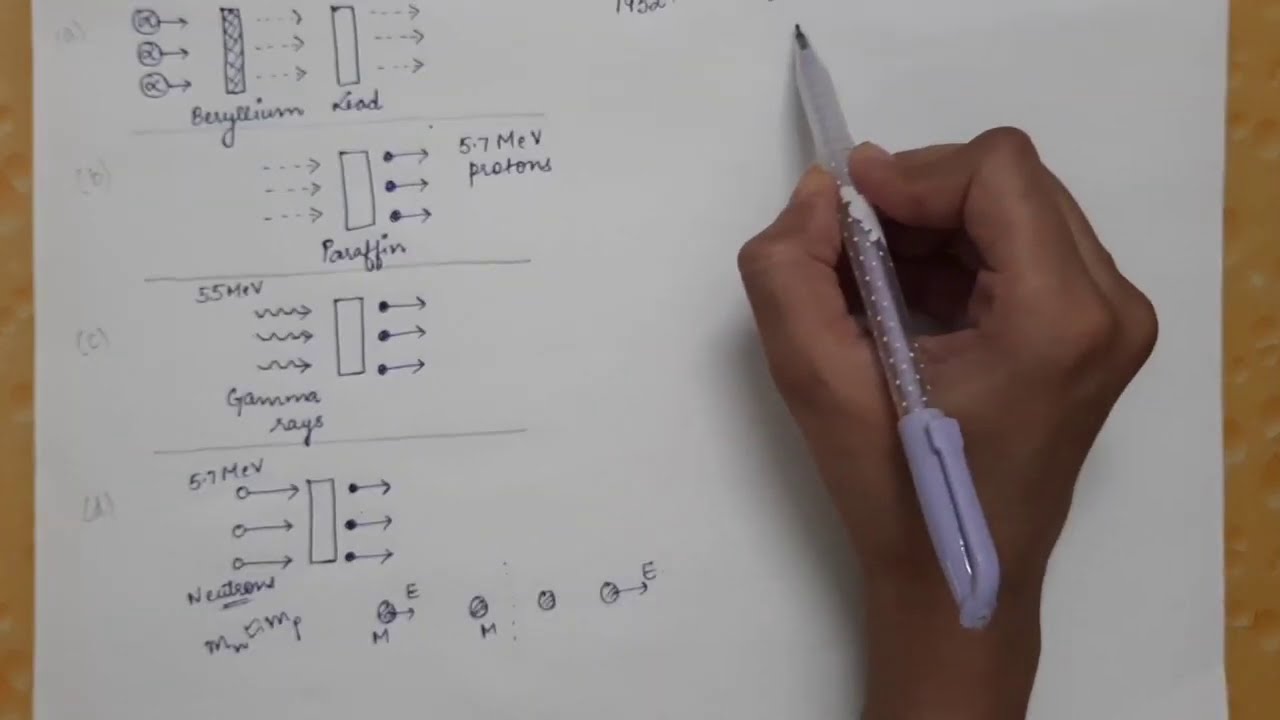
- Discussion of Chadwick's experiment with alpha particles on beryllium.
- Explanation of the properties of neutrons and protons.
- Introduction to atomic number and mass number.
- Discussion of nuclear radius and shape.
- Introduction to atomic mass unit and energy equivalence.
- Conclusion and summary of key points.
Contribution & Novelties
The lecture provides a basic introduction to the discovery of the neutron and proton, and introduces fundamental concepts in nuclear physics. It is suitable for undergraduate students but does not offer novel insights or advanced material.
Pour aller plus loin :
- James Chadwick — Biography and discovery of the neutron.
- Neutron — Properties and role in the nucleus.
- Atomic nucleus — Composition and structure.
- Nuclear magnetic moment — Explanation of nuclear magnetic properties.
73 words
Radar Profile
The radar profile shows low scores across all dimensions, indicating a lecture with limited information density, moderate technical level, and questionable reliability due to transcription errors. The overall quality is low, making it suitable only for a very basic introduction.