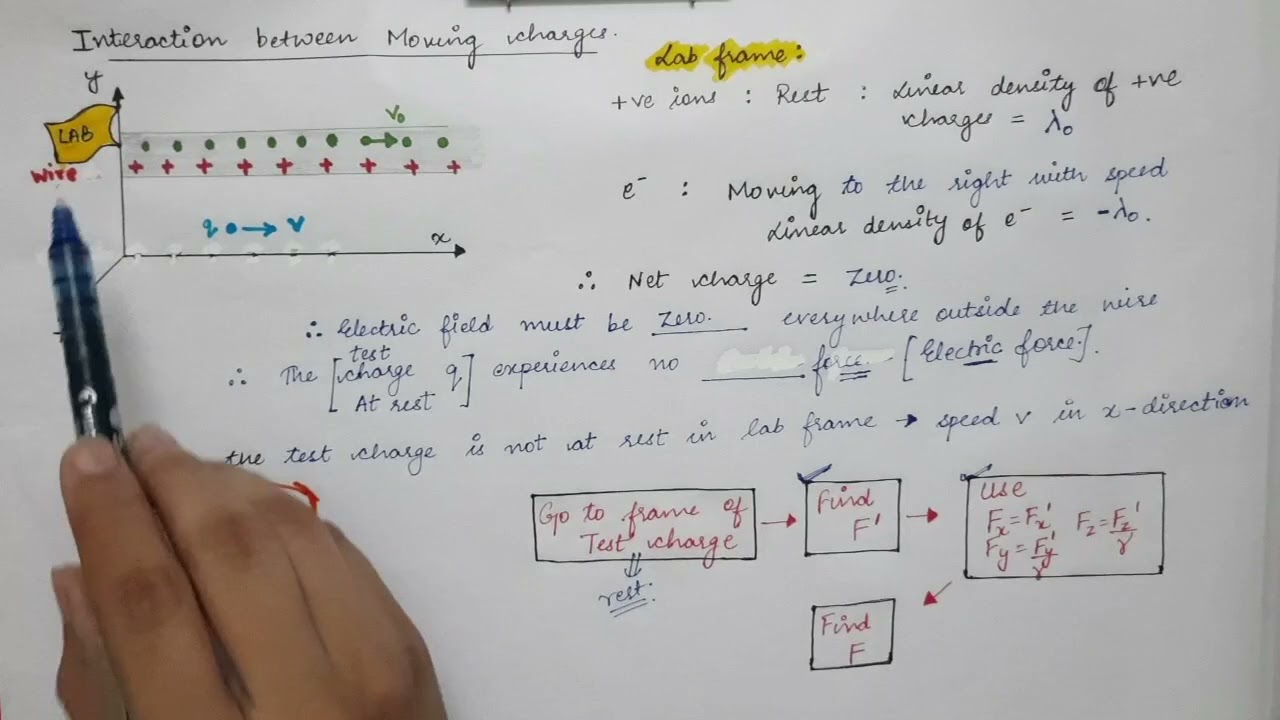
Lecture 19 | 2nd Sem | Interaction between Moving Charges
Keywords
Summary
129 words
Critical Evaluation
Value of the Information & Strength of the Argument
The lecture attempts to provide a valuable insight: that magnetic forces between moving charges can be understood as electric forces in a different inertial frame, a classic relativistic explanation. The argumentation is based on the idea of Lorentz contraction affecting charge density, leading to a net charge in a current-carrying wire from a moving observer’s perspective. However, the execution is poor. The reasoning is disjointed and difficult to follow due to the poor audio and unclear explanations. The instructor jumps between ideas without clear structure, and the mathematical steps are not properly derived or explained. The value of the information is thus diminished by the presentation’s ineffectiveness.
Scientific Rigor, Source Quality, Title Accuracy
The lecture does not cite any external sources, and the description contains no references. The scientific rigor is low due to the lack of clear derivations and the poor quality of the presentation. The title accurately reflects the intended topic, but the content does not meet the expected standard of a university lecture. The lack of clear explanations and the numerous distractions (e.g., repeated requests to subscribe) further reduce the scientific quality.
194 words
Title / Content Match
The title accurately reflects the topic, but the content is not effectively delivered due to the poor quality of the recording.
Quality & Reliability
2/10
The lecture attempts to explain the interaction between moving charges using special relativity, but the presentation is severely hindered by poor audio quality, unclear enunciation, and a transcription that is largely unintelligible. The scientific content is difficult to follow, and the reasoning is often obscured. The lack of clear derivations and the presence of numerous unrelated phrases reduce the reliability of the information as presented.
Key Moments
Markers derived by PSI from the transcript: the creator did not define chapters.
- Introduction to the topic of interaction between moving charges.
- Discussion on charge density and its variation with motion.
- Introduction of Lorentz contraction and its effect on charge density.
- Attempt to derive the electric field experienced by a test charge near a current-carrying wire.
- Explanation of how the wire appears charged in a moving frame.
- Discussion on the force experienced by a test charge due to the apparent charge density.
- Mention of using transformation equations to find the force in different frames.
- Further elaboration on the relativistic approach to magnetic forces.
- Conclusion and summary of the lecture.
Contribution & Novelties
The lecture attempts to present the relativistic origin of magnetism, a concept that is often not emphasized in introductory courses. However, the presentation is too poor to provide any new insights effectively.
Pour aller plus loin :
- Special relativity — Foundational theory for understanding relativistic effects on moving charges.
- Lorentz contraction — Key concept used to explain charge density changes.
- Magnetism and relativity — Explains how magnetic fields arise from electric fields in different frames.
75 words
Radar Profile
The radar profile shows low scores across all dimensions, indicating a lecture that is weak in information quantity, quality, technical depth, and reliability. The only relatively higher score is in technical level, but it is still low, reflecting the advanced topic attempted but poorly delivered.