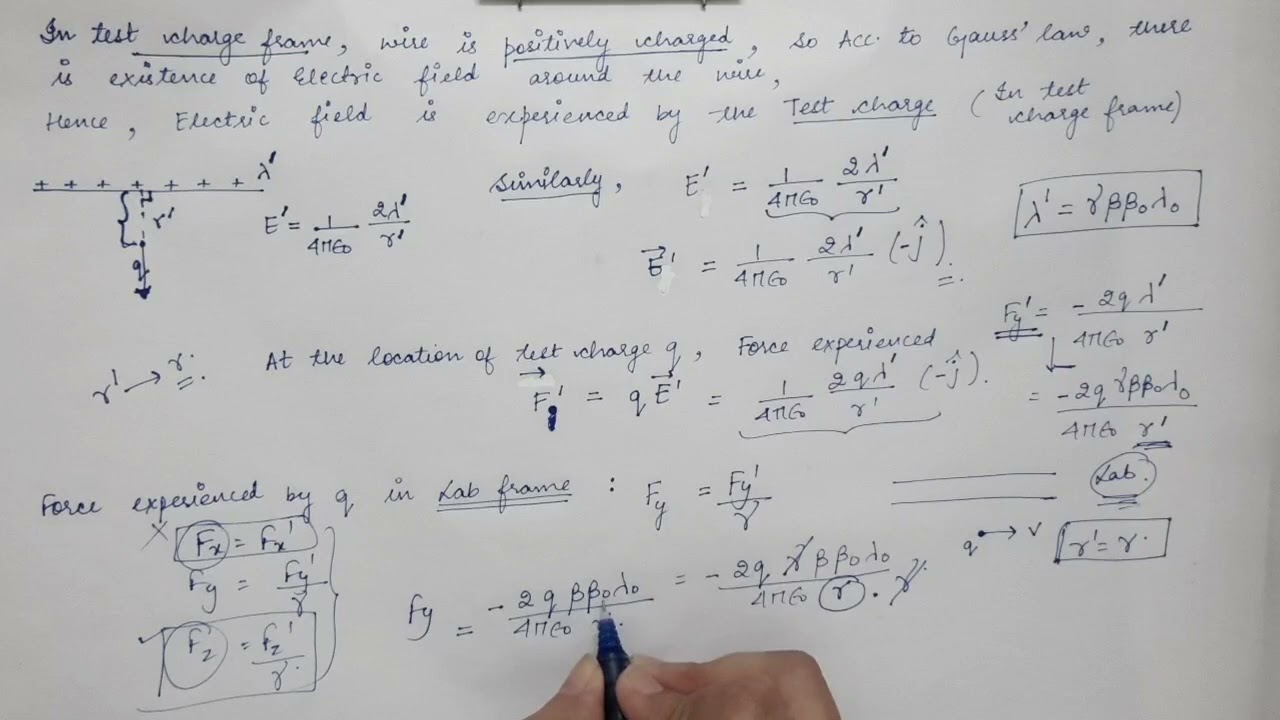
Lecture 20 | 2nd Sem | Interaction between moving charges Part 2
Keywords
Summary
154 words
Critical Evaluation
Value of the Information & Strength of the Argument
The lecture provides a valuable pedagogical demonstration of how magnetic forces arise from relativistic effects, offering a deep conceptual understanding beyond the standard Lorentz force law. The argumentation is solid, with a step-by-step derivation that connects the electric field in the test charge frame to the magnetic force in the lab frame. The use of length contraction and time dilation is well-explained, and the transformation of forces is correctly applied. The extension to two wires is logical and reinforces the underlying principles. However, the presentation could benefit from a more explicit discussion of the assumptions and limitations, such as the idealization of infinite wires and the neglect of magnetic field effects in the test charge frame.
Scientific Rigor, Source Quality, Title Accuracy
The lecture is scientifically rigorous, with a correct application of special relativity to derive the magnetic force. The derivation is consistent with established physics, and the final expression matches the standard formula for the magnetic force on a moving charge. However, the lecture does not cite any external sources, which limits its utility for further verification. The title accurately reflects the content, focusing on the interaction between moving charges. The presentation is clear and well-structured, making it suitable for advanced undergraduate students.
213 words
Title / Content Match
The title accurately reflects the content, which focuses on the interaction between moving charges, specifically deriving the magnetic force via relativistic transformations.
Quality & Reliability
7/10
The lecture provides a rigorous derivation of the magnetic force between moving charges using special relativity, with clear step-by-step reasoning. However, it lacks citations to external sources and does not address potential limitations or alternative interpretations.
Key Moments
Markers derived by PSI from the transcript: the creator did not define chapters.
- Introduction: Recap of previous lecture and outline of the derivation.
- Electric field in the test charge frame due to the positively charged wire.
- Force on the test charge in the test charge frame.
- Transformation of force to the lab frame using relativistic relations.
- Derivation of the final expression for the magnetic force in the lab frame.
- Introduction to the interaction between two current-carrying wires.
- Analysis in the frame of the electrons of the first wire.
- Conclusion: Repulsive force for opposite currents, attractive for same direction.
Contribution & Novelties
The lecture provides a clear and rigorous derivation of the magnetic force between moving charges using special relativity, offering a deeper understanding than the standard Lorentz force law. It emphasizes the role of length contraction and frame transformations, which is a valuable pedagogical approach.
Pour aller plus loin :
- Special relativity — Foundational theory underlying the derivation.
- Magnetic field — The field responsible for the force on moving charges.
- Length contraction — Key relativistic effect used in the derivation.
- Lorentz force — The standard formula for the force on a moving charge in electric and magnetic fields.
97 words
Radar Profile
The radar profile shows high scores in quantity of information and technical level, indicating a dense and advanced lecture. The quality and reliability scores are moderate, reflecting the lack of external citations and the reliance on a single instructor's presentation.