NUCLEAR PHYSICS | Lecture 5 | Bohr formula of Energy loss
Keywords
Summary
137 words
Critical Evaluation
Value of the Information & Strength of the Argument
The value of the information is limited due to the poor quality of the presentation. The derivation of the Bohr formula is a standard topic, but the argumentation is not clearly structured. The presenter jumps between concepts without clear logical flow, and the transcription errors obscure the mathematical steps. The argumentation lacks rigor, as key steps are not properly explained, and the reliance on classical mechanics without addressing quantum corrections is not discussed. Overall, the content is not presented in a way that adds value beyond what is available in standard textbooks.
Scientific Rigor, Source Quality, Title Accuracy
The scientific rigor is low. No sources are cited, and the derivation is not presented with sufficient detail or clarity. The title accurately reflects the topic, but the content does not meet the expected standard for a scientific lecture. The lack of references and the poor presentation quality undermine the credibility of the content. The video does not provide a reliable educational resource for students.
172 words
Title / Content Match
The title accurately reflects the content, which focuses on the Bohr formula for energy loss in nuclear physics.
Quality & Reliability
4/10
The lecture presents the Bohr formula for energy loss in a tutorial format, but the transcription is heavily corrupted by automatic speech recognition errors, making the content difficult to follow. The derivation is incomplete and lacks rigorous mathematical steps. No sources are cited, and the presentation is not clear.
Key Moments
Markers derived by PSI from the transcript: the creator did not define chapters.
- Introduction to the lecture and topic of energy loss.
- Discussion of stopping power and definition of energy loss per unit length.
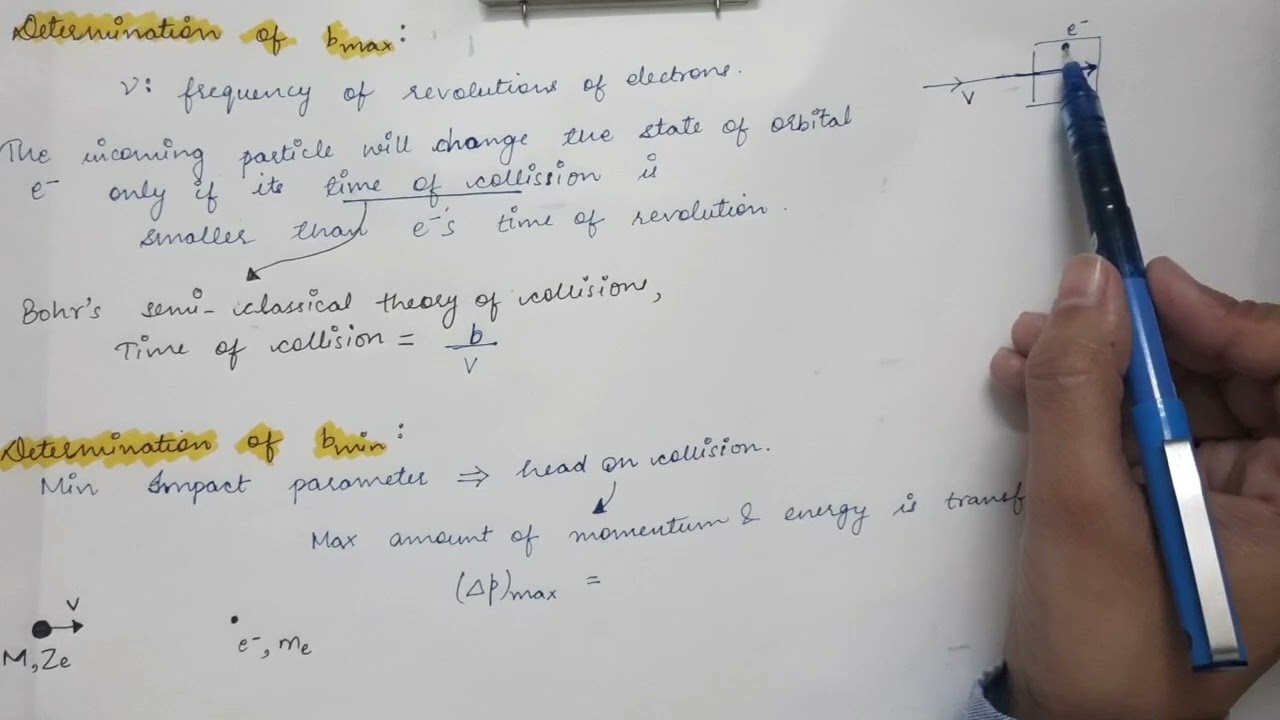
- Introduction of impact parameter and its role in the derivation.
- Consideration of maximum and minimum impact parameters.
- Application of uncertainty principle to determine minimum impact parameter.
- Derivation of the energy transfer to a single electron.
- Integration over impact parameters to obtain total energy loss.
- Final expression for the Bohr formula.
- Discussion of the limitations and applicability of the formula.
- Conclusion and summary of the lecture.
Contribution & Novelties
The lecture attempts to present the Bohr formula for energy loss, but due to the poor quality, it does not offer any novel insights. The content is standard and can be found in textbooks.
Pour aller plus loin :
- Bohr formula on Wikipedia — Provides a clear derivation and context.
- Stopping power (particle radiation) — Discusses the general concept and related formulas.
- Bethe formula — A quantum mechanical extension of the Bohr formula.
73 words
Radar Profile
The radar profile shows low scores across all dimensions, indicating poor quality. The technical level is moderate, but the information quantity and quality are low, and reliability is very low.