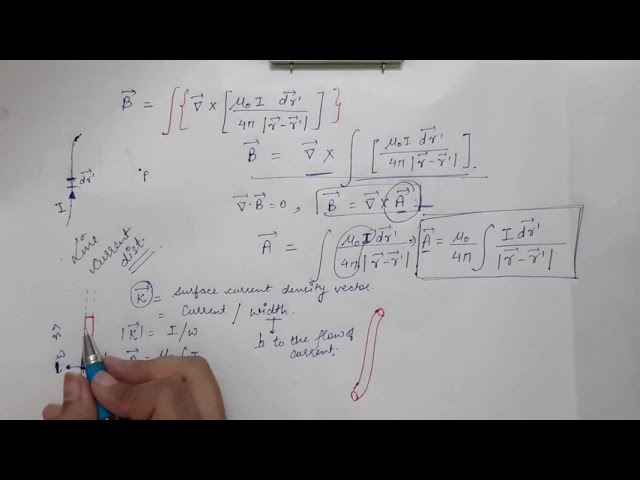
Lecture 32 | 2nd Sem | Magnetic vector potential for Surface & Volume current distribution
Keywords
Summary
147 words
Critical Evaluation
Value of the Information & Strength of the Argument
The video provides a basic derivation of magnetic vector potential for surface and volume currents, which is a standard topic in electromagnetism. The argumentation is logical but poorly articulated due to audio issues. The instructor attempts to show how the line current expression can be generalized, but the steps are rushed and not clearly justified. The value of the information is limited because the presentation is confusing and lacks depth. The derivation is not rigorously explained, and there is no discussion of the physical significance or applications of the results.
Scientific Rigor, Source Quality, Title Accuracy
The video does not cite any sources, and the description contains no references. The title accurately reflects the content, but the scientific rigor is low due to the lack of clear explanations and the poor audio quality. The presentation is not well-structured, and the instructor frequently repeats ‘subscribe’ and ’like’, which distracts from the content. There is no evidence of peer review or verification of the material. The adequacy between title and content is good, but the execution fails to meet the expectations set by the title.
192 words
Title / Content Match
The title accurately describes the topic: deriving expressions for magnetic vector potential for surface and volume current distributions.
Quality & Reliability
3/10
The video is a lecture on magnetic vector potential, but the audio quality is extremely poor, with frequent inaudible segments and a heavy accent, making it difficult to follow. The content appears to be a standard derivation, but the presentation is disorganized and lacks clear structure. No sources are cited, and the video is not well-produced.
Key Moments
Markers derived by PSI from the transcript: the creator did not define chapters.
- Introduction and outline of the lecture: deriving magnetic vector potential for surface and volume currents.
- Review of magnetic vector potential for line current distribution.
- Definition of surface current density and its units.
- Derivation of magnetic vector potential for surface current distribution.
- Definition of volume current density and its units.
- Derivation of magnetic vector potential for volume current distribution.
- Summary and conclusion, with repeated requests to subscribe.
Contribution & Novelties
The video attempts to present the derivation of magnetic vector potential for surface and volume currents, which is a standard topic. However, the presentation is not original and lacks clarity. The main contribution is the step-by-step derivation, but it is poorly executed.
Pour aller plus loin :
- Magnetic vector potential - Wikipedia — Provides a comprehensive overview of the concept and its applications.
- Biot-Savart law - Wikipedia — Fundamental law used in the derivation of magnetic fields from current distributions.
- Maxwell’s equations - Wikipedia — Context for the role of magnetic vector potential in electromagnetic theory.
96 words
Radar Profile
The radar profile shows low scores across all dimensions, indicating a video with limited information quality, poor technical depth, and low reliability. The only relatively higher score is in technical level, but it is still moderate. Overall, the video is not recommended for learning due to its poor presentation.