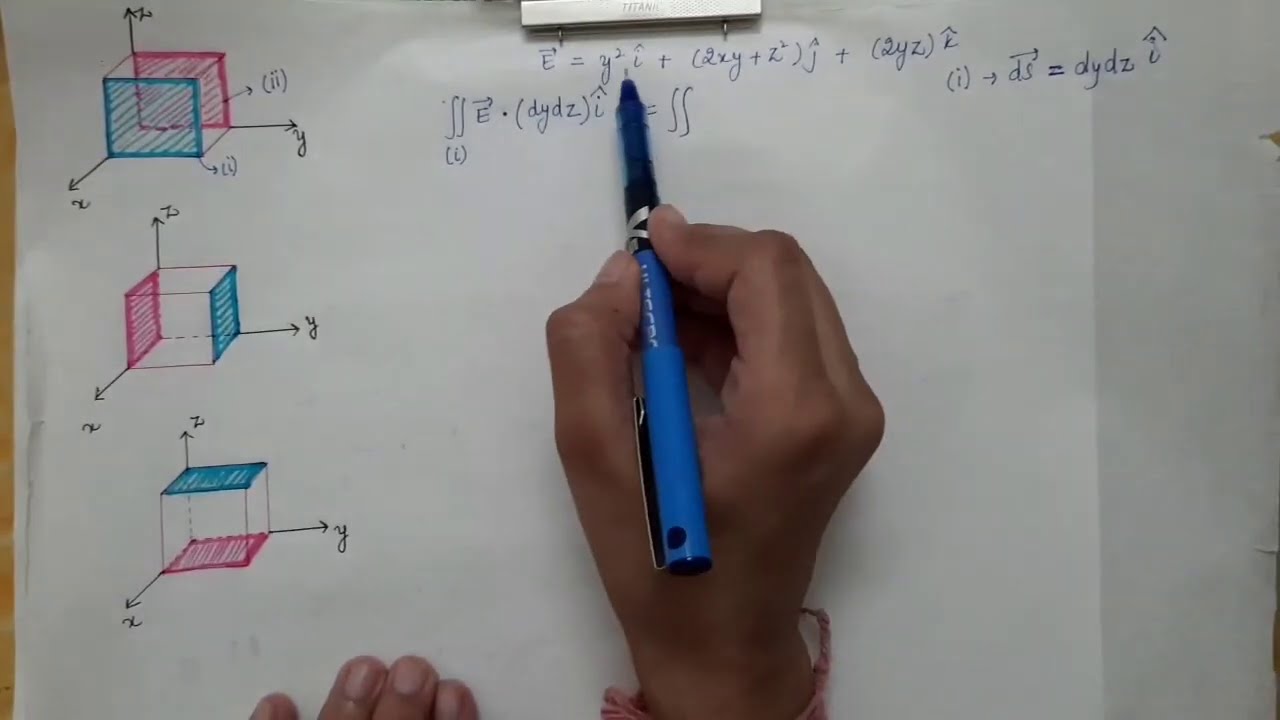
Lecture 4 - Part 2 - (1st Semester) - Verification of Gauss-Divergence theorem using an example
Keywords
Summary
167 words
Critical Evaluation
Value of the Information & Strength of the Argument
The video provides a worked example of verifying the Gauss divergence theorem, which is a fundamental concept in vector calculus. The argumentation is based on direct computation: calculating the divergence of the given vector field, setting up the volume integral, and then computing the surface integral over the closed surface. However, the presentation is not rigorous; the steps are not clearly explained, and the audio quality severely hampers understanding. The instructor does not provide a general proof but only a specific example, which is typical for a tutorial. The value of the information is limited by the poor delivery, but the underlying mathematics is correct.
Scientific Rigor, Source Quality, Title Accuracy
The video does not cite any external sources, and the description contains no references. The title accurately reflects the content, but the execution is flawed due to technical issues. The scientific rigor is low because the explanation is unclear and lacks depth. The video appears to be a raw lecture recording without editing, which further reduces its quality. There are no comments provided, so no analysis of public reception is possible.
191 words
Title / Content Match
The title accurately describes the content: a lecture on verifying the Gauss divergence theorem with an example.
Quality & Reliability
3/10
The video is a tutorial on verifying the Gauss divergence theorem, but the audio is heavily distorted and the transcription is garbled, making it difficult to follow. The mathematical steps are not clearly explained, and there is a lack of rigorous derivation. The content appears correct in principle but is poorly presented.
Key Moments
Markers derived by PSI from the transcript: the creator did not define chapters.
Contribution & Novelties
The video offers a step-by-step verification of the Gauss divergence theorem for a specific vector field, which can be helpful for students learning vector calculus. However, the presentation is marred by poor audio and lack of clarity. The example itself is standard and does not introduce new concepts.
Pour aller plus loin :
- Divergence theorem — Provides a comprehensive overview of the theorem and its applications.
- Vector calculus — Background on the mathematical tools used in the video.
- Surface integral — Explanation of surface integrals, which are central to the theorem.
91 words
Radar Profile
The radar profile shows moderate scores in quantity and technical level, but low scores in quality and reliability, reflecting the poor audio and unclear presentation. The overall shape is imbalanced, with a dip in quality and reliability.