Leçon 15: Energies renouvelables
Keywords
Summary
157 words
Critical Evaluation
Value of the Information & Strength of the Argument
The video provides a solid introduction to renewable energy, with clear explanations of the physical principles behind each source. The argumentation is logical, building from the definition of renewable vs. non-renewable to specific technologies. It effectively uses examples and maps to illustrate points, such as the solar map of Switzerland and the geothermal flux map. However, the video lacks depth in discussing economic and policy aspects, and some claims are simplified without full context, such as the potential of wind energy in Switzerland. Overall, the information is valuable for educational purposes, but it is not exhaustive.
Scientific Rigor, Source Quality, Title Accuracy
The scientific rigor is generally good, with accurate descriptions of energy conversion processes. However, the video does not cite specific sources or references, which limits the ability to verify claims. The title accurately reflects the content, and the video is well-structured. The presentation is clear, but the lack of citations and the absence of discussion on uncertainties or controversies reduce its scientific robustness.
174 words
Title / Content Match
The title accurately reflects the content, which is a lesson on renewable energies.
Quality & Reliability
7/10
The video provides a clear and structured overview of renewable energy sources, with accurate scientific explanations and relevant examples. However, it lacks citations and detailed data sources, and some simplifications may omit nuances.
Key Moments
Markers derived by PSI from the transcript: the creator did not define chapters.
- Introduction to the lesson and distinction between renewable and non-renewable energy.
- Explanation that most energy sources originate from the sun, except nuclear, geothermal, and tidal.
- Discussion on the temporal scale for defining renewable energy, using human civilization timescale.
- Solar energy: constant solar flux, map of Switzerland, and photovoltaic vs. thermal conversion.
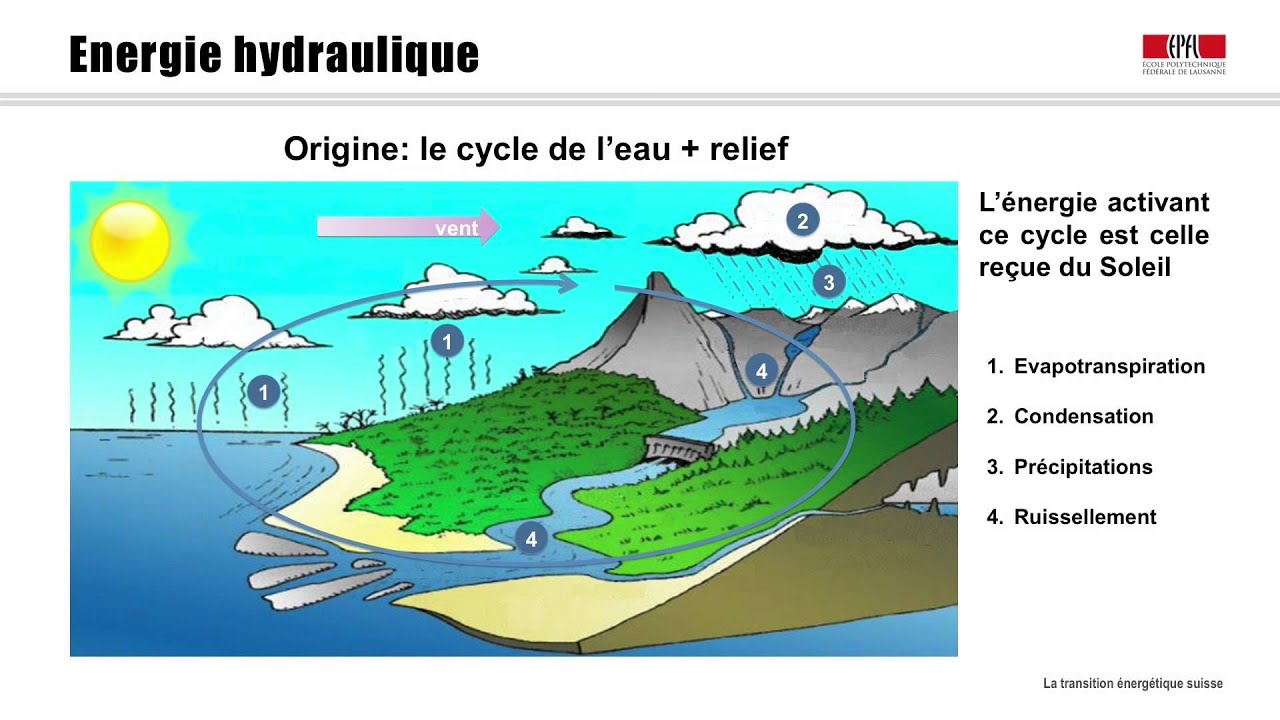
- Hydropower: hydrological cycle, importance of altitude, and types of plants (run-of-river, storage, pumped-storage).
- Wind energy: origin from solar heating, power proportional to cube of wind speed, and potential in Switzerland.
- Biomass: solar-driven growth, virtuous cycle of CO2 and H2O, and use in thermal plants.
- Geothermal energy: non-solar source, radioactive decay, and applications for heating and electricity.
- Conclusion: definition of renewable energy and variability of production.
Contribution & Novelties
The video provides a clear and concise educational overview of renewable energy sources, emphasizing the temporal definition of renewability. It effectively uses visual aids like maps to illustrate regional potentials. The content is not highly novel but serves as a good introductory resource.
Pour aller plus loin :
- Renewable energy - Wikipedia — Comprehensive overview of renewable energy types and policies.
- Solar constant - Wikipedia — Detailed explanation of the solar constant and its measurement.
- Pumped-storage hydroelectricity - Wikipedia — In-depth look at pumped-storage technology and its role in energy storage.
- Geothermal energy - Wikipedia — Overview of geothermal energy sources and applications.
103 words
Radar Profile
The radar profile shows a balanced performance across all dimensions, with slightly higher scores in information quantity and technical level, indicating a solid educational resource with good depth and clarity.