Lektion 11: Energieeinsparungen im Gebäudesektor II
Keywords
Summary
198 words
Critical Evaluation
Value of the Information & Strength of the Argument
The video provides valuable information on active energy-saving technologies, with clear explanations and quantitative comparisons. The argumentation is solid, based on thermodynamic principles and efficiency calculations. It effectively demonstrates the benefits of heat pumps and condensing boilers, and the comparative analysis of system chains is particularly insightful. The presentation is logical and well-structured, making complex concepts accessible.
Scientific Rigor, Source Quality, Title Accuracy
The scientific rigor is high, with accurate technical details and correct use of terms like COP and efficiency. The video does not cite specific sources, but it is produced by an academic institution (EPFL) and aligns with established engineering knowledge. The title accurately reflects the content, which is a continuation of a series on energy savings in buildings. No comments were provided, so no analysis of public reception is possible.
142 words
Title / Content Match
The title accurately reflects the content, which focuses on active measures for energy savings in buildings, continuing from a previous lesson.
Quality & Reliability
8/10
The video provides a clear, technically accurate overview of active energy-saving measures in buildings, with correct thermodynamic principles and quantitative comparisons. It is produced by an academic institution (EPFL) and aligns with established engineering knowledge.
Key Moments
Markers derived by PSI from the transcript: the creator did not define chapters.
- Introduction to active measures and overview of heating and hot water as main energy consumers.
- Historical context of fire and heating, and the use of fossil fuels.
- Explanation of conventional boilers and their inefficiencies.
- Introduction to condensing boilers and their efficiency gains.
- Detailed analysis of flue gas temperatures and condensation.
- Explanation of heat pumps and their COP.
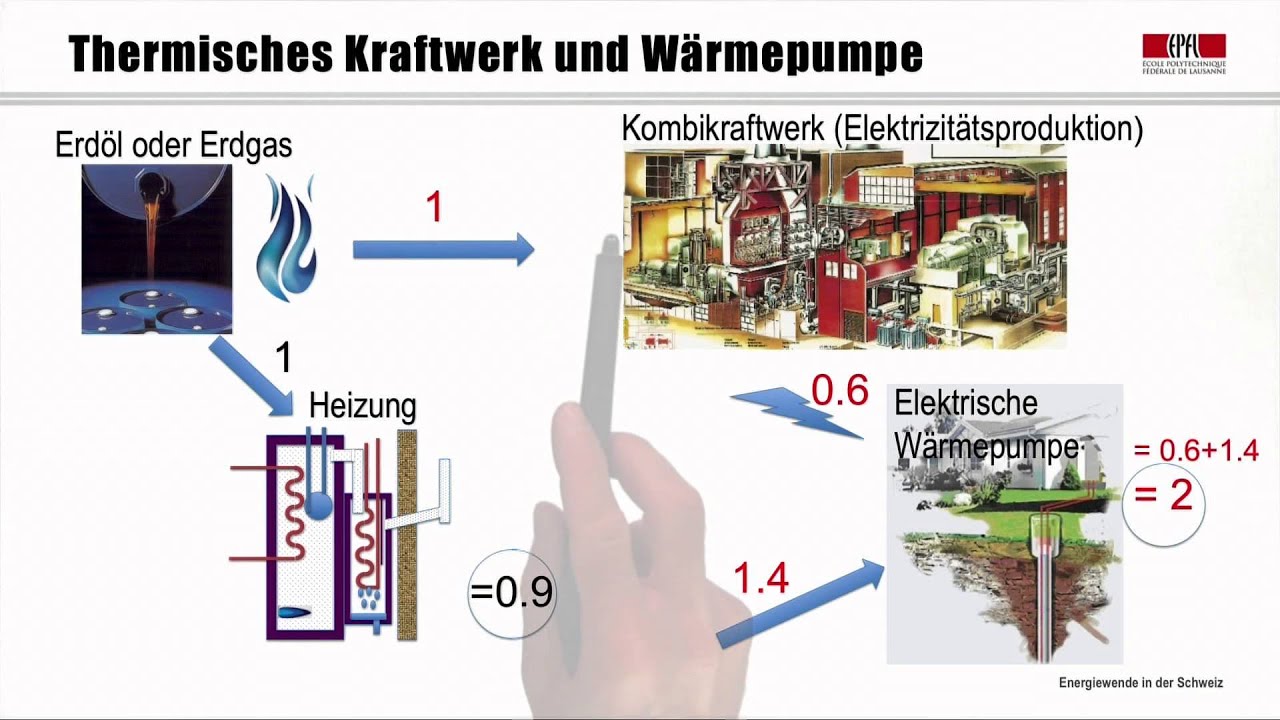
- Comparison of conventional boiler vs. combined cycle power plant with heat pump.
- Discussion of gas-driven heat pumps and CHP systems.
- Urban applications: lake water heat pumps and district heating.
- Lighting technologies and LED efficiency.
- Ventilation with heat recovery and other measures.
Contribution & Novelties
The video provides a comprehensive overview of active energy-saving measures in buildings, with a clear comparative analysis of different heating systems. It effectively demonstrates the potential of heat pumps and combined systems to reduce energy consumption and CO2 emissions. The content is educational and well-structured, making it a valuable resource for understanding building energy efficiency.
Pour aller plus loin :
- Heat pump — Provides background on heat pump technology and COP.
- Condensing boiler — Explains the principle of condensing boilers and their efficiency.
- Coefficient of performance — Defines COP and its relevance in heating systems.
- Combined heat and power — Discusses CHP systems and their efficiency.
106 words
Radar Profile
The radar profile shows high scores in information quantity, quality, and technical level, with a slightly lower but still good reliability score. This indicates a well-rounded educational video that is both informative and technically sound.