Lektion 12: Energieeinsparungen im Individualverkehr
Keywords
Summary
152 words
Critical Evaluation
Value of the Information & Strength of the Argument
The video provides a comprehensive and structured overview of energy-saving options in individual transport, combining behavioral and technical perspectives. It effectively uses diagrams and examples to illustrate concepts like energy density and engine efficiency maps. The argumentation is logical, moving from general strategies to specific technical details, and it supports claims with references to Swiss energy scenarios and IEA projections. However, the video does not delve into the economic or social feasibility of these measures, and some statements lack explicit sources, which slightly weakens the overall argumentation.
Scientific Rigor, Source Quality, Title Accuracy
The video demonstrates scientific rigor by referencing official Swiss energy scenarios and IEA data, and it accurately explains technical concepts. However, it does not provide explicit citations or links to the mentioned studies in the description, which limits the verifiability of the information. The title accurately reflects the content, and the video is well-structured for an educational purpose. The lack of detailed source references is a minor weakness, but the overall content is reliable and consistent with established knowledge in the field.
184 words
Title / Content Match
The title accurately reflects the content, which focuses on energy savings in individual transport.
Quality & Reliability
7/10
The video provides a structured overview of energy-saving measures in individual transport, referencing data from the Swiss energy scenarios and the IEA. It explains technical concepts (e.g., energy density, engine efficiency maps) accurately, but lacks explicit citations to specific studies or reports, and the data points are not sourced in the description.
Key Moments
Markers derived by PSI from the transcript: the creator did not define chapters.
- Introduction to the lesson and overview of Swiss energy scenarios for reducing fuel consumption.
- Discussion of behavioral measures: slow traffic, carpooling, carsharing, and public transport.
- Explanation of energy density of different fuels and batteries, highlighting the limitations of electric vehicles.
- Overview of the Swiss vehicle fleet composition in 2011, including the share of petrol, diesel, hybrid, and electric vehicles.
- Discussion of pollutant emissions from internal combustion engines and the role of catalytic converters and particulate filters.
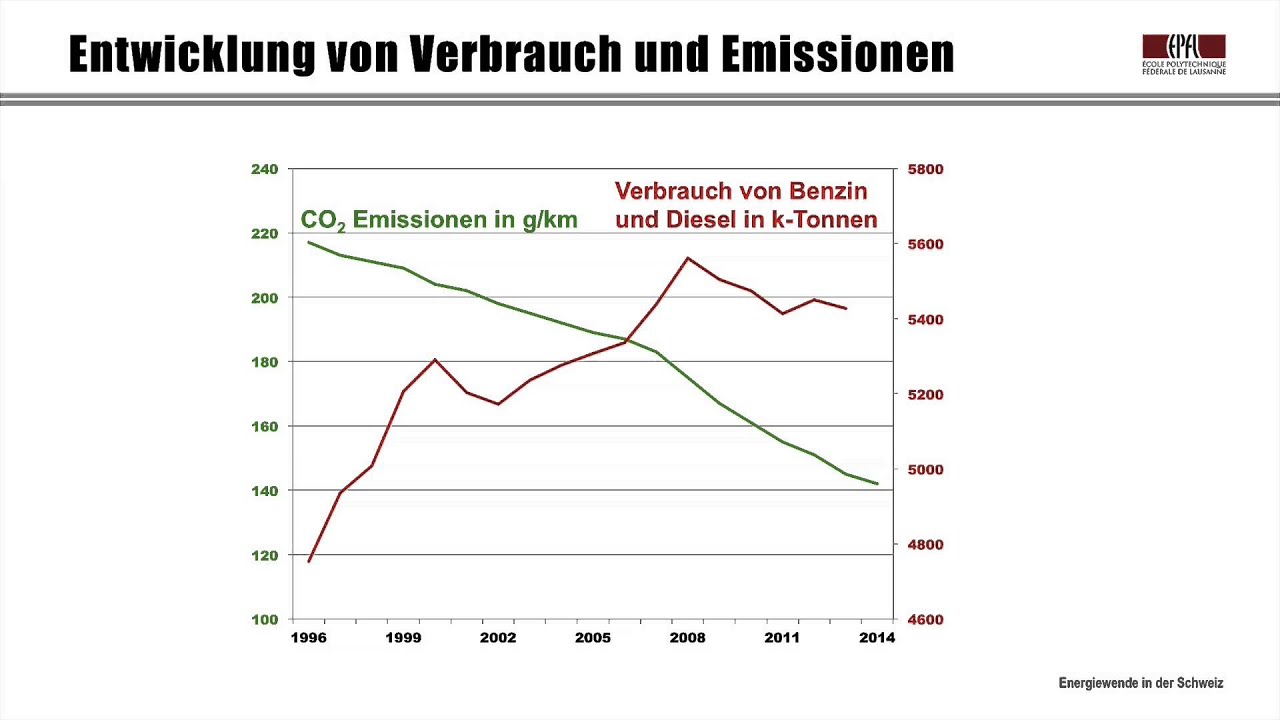
- Analysis of CO2 emissions trends and the impact of increased driving distances on total fuel consumption.
- Explanation of engine efficiency maps and the benefits of operating engines at low speeds and high torque.
- Discussion of downsizing, turbocharging, and hybrid drivetrains as technical solutions for energy savings.
- Introduction to range extenders and fuel cell vehicles as alternatives to pure electric vehicles.
- Conclusion with IEA projections for future vehicle fleet composition and the need for ambitious measures.
Cited Sources
- Swiss Energy Scenarios — Referenced as the basis for the energy-saving targets in Switzerland.
- International Energy Agency (IEA) projections — Cited for future vehicle fleet composition and biofuel share.
Concurring Sources
- IEA World Energy Outlook — The IEA's projections on vehicle fleet composition align with the video's claims.
Contribution & Novelties
The video provides a clear and concise synthesis of energy-saving measures in individual transport, integrating behavioral and technical aspects. It effectively explains the trade-offs between different vehicle technologies, such as energy density and efficiency, and highlights the importance of considering the entire vehicle fleet’s evolution. The inclusion of historical context (e.g., Porsche’s early hybrid) adds depth.
Pour aller plus loin :
- Energy density — Relevant for understanding the comparison of fuels and batteries.
- Internal combustion engine — Provides background on engine operation and efficiency.
- Hybrid electric vehicle — Explains different hybrid architectures.
- Fuel cell vehicle — Discusses the technology and its challenges.
- Swiss energy policy — Official source for Swiss energy strategy.
112 words
Radar Profile
The radar profile shows balanced scores across all dimensions, with slightly higher scores in quantity of information and technical level, indicating a well-rounded educational content. The lower score in reliability reflects the lack of explicit citations, but overall the video is informative and technically sound.