Lektion 18: Windenergie Teil 2
Keywords
Summary
201 words
Critical Evaluation
Value of the Information & Strength of the Argument
The video provides valuable information on wind energy technology, including quantitative data on efficiency limits and capacity statistics. The argumentation is solid, based on established physics (Betz limit) and real-world examples. It presents a balanced view of advantages and disadvantages, and supports claims with diagrams and data from the Swiss-Energyscope tool. The explanation of wake effects and optimization is particularly insightful. However, the video lacks in-depth analysis of economic or policy aspects, and some claims could be better sourced.
Scientific Rigor, Source Quality, Title Accuracy
The scientific rigor is generally high, with accurate technical explanations and references to the Betz limit and efficiency curves. The sources are not explicitly cited within the video, but the content aligns with established knowledge. The title accurately reflects the content, which is a continuation of a lesson on wind energy. The video is produced by an academic institution, adding credibility. However, the lack of explicit citations and the age of the video (2016) slightly reduce its reliability.
172 words
Title / Content Match
The title accurately reflects the content, which is the second part of a lesson on wind energy, covering technologies, challenges, and Swiss context.
Quality & Reliability
7/10
The video provides a scientifically accurate overview of wind energy technology, including the Betz limit, efficiency curves, and challenges. It is produced by an academic institution (EPFL) and presents data from the Swiss-Energyscope tool. However, it lacks detailed citations and is somewhat dated (2016).
Key Moments
Markers derived by PSI from the transcript: the creator did not define chapters.
- Introduction to the second part on wind energy technologies and challenges.
- Explanation of the Betz limit and efficiency curves for different turbine types.
- Discussion on the trend towards larger rotors and higher towers.
- Comparison of offshore and onshore wind farms, and the optimization of turbine placement.
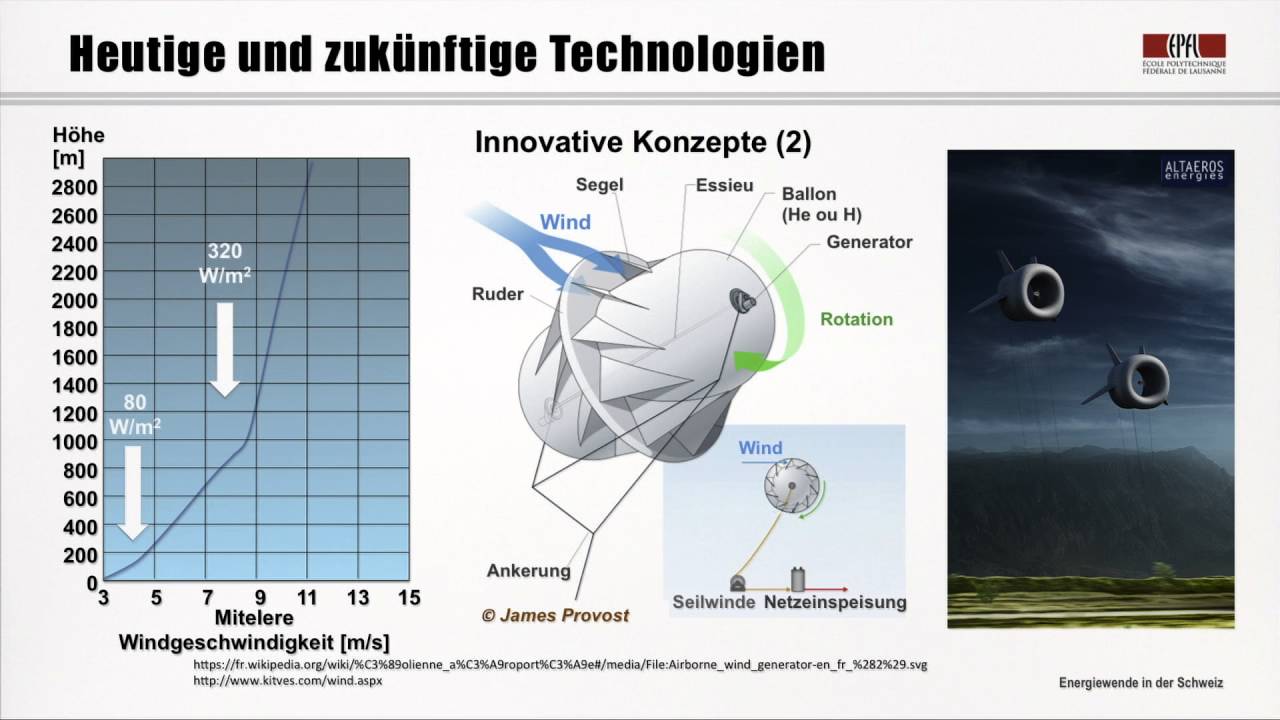
- Alternative turbine designs: vertical-axis, kites, and airborne systems.
- Global and European wind capacity statistics, with focus on Switzerland.
- Seasonal complementarity between wind and solar energy, and reversibility of wind installations.
- Disadvantages of wind energy: noise, visual impact, wildlife risks, and safety concerns.
Cited Sources
- Swiss-Energyscope — The video references the Swiss-Energyscope tool for data on solar and wind installations in Switzerland.
Concurring Sources
- Betz's law — The video's explanation of the Betz limit aligns with this established physical principle.
Contribution & Novelties
The video provides a concise and accessible overview of wind energy technology, with a focus on the Swiss context. It explains the Betz limit and efficiency comparisons, and discusses the challenges of turbine placement and local acceptance. The seasonal complementarity between wind and solar is a key insight. The video is part of an educational series, making it a useful resource for students and the general public.
Pour aller plus loin :
- Betz’s law — The fundamental limit on wind turbine efficiency.
- Wind power — Overview of wind energy technology and deployment.
- Swiss Energy Strategy 2050 — Swiss policy context for renewable energy expansion.
104 words
Radar Profile
The radar profile shows a balanced performance with high scores in information quality and reliability, moderate in quantity and technical level. This indicates a well-structured educational video that is scientifically sound but may not delve deeply into advanced technical details.