Lektion 6: Schweizer Energieszenarien
Keywords
Summary
214 words
Critical Evaluation
Value of the Information & Strength of the Argument
The video provides a clear and structured overview of Swiss energy scenarios, using the EnergyScope tool to visualize data. It effectively communicates the key differences between scenarios and the main sectors targeted for energy savings. The argumentation is logical, building from the current situation to future projections, and it emphasizes the importance of policy choices. However, it does not delve into the underlying models or uncertainties, and it presents the scenarios as given without critical evaluation.
Scientific Rigor, Source Quality, Title Accuracy
The video is produced by Swiss-Energyscope, an academic project from EPFL, which lends credibility. It references official Swiss energy scenarios (NEP, Federal Council measures) and uses the EnergyScope calculator, which is a recognized tool. However, no specific sources or references are cited in the video or description, and the data is from 2015, so it may be outdated. The title accurately reflects the content, which is a tutorial on Swiss energy scenarios.
163 words
Title / Content Match
The title accurately reflects the content, which focuses on Swiss energy scenarios.
Quality & Reliability
7/10
The video is produced by an academic group (EPFL) and presents official Swiss energy scenarios with transparent assumptions, but lacks detailed citations and is dated (2015).
Key Moments
Markers derived by PSI from the transcript: the creator did not define chapters.
- Introduction to Swiss energy situation and scenarios.
- Comparison of 2011 end-energy consumption with 2035 NEP scenario.
- Overview of three scenarios for 2035 and 2050.
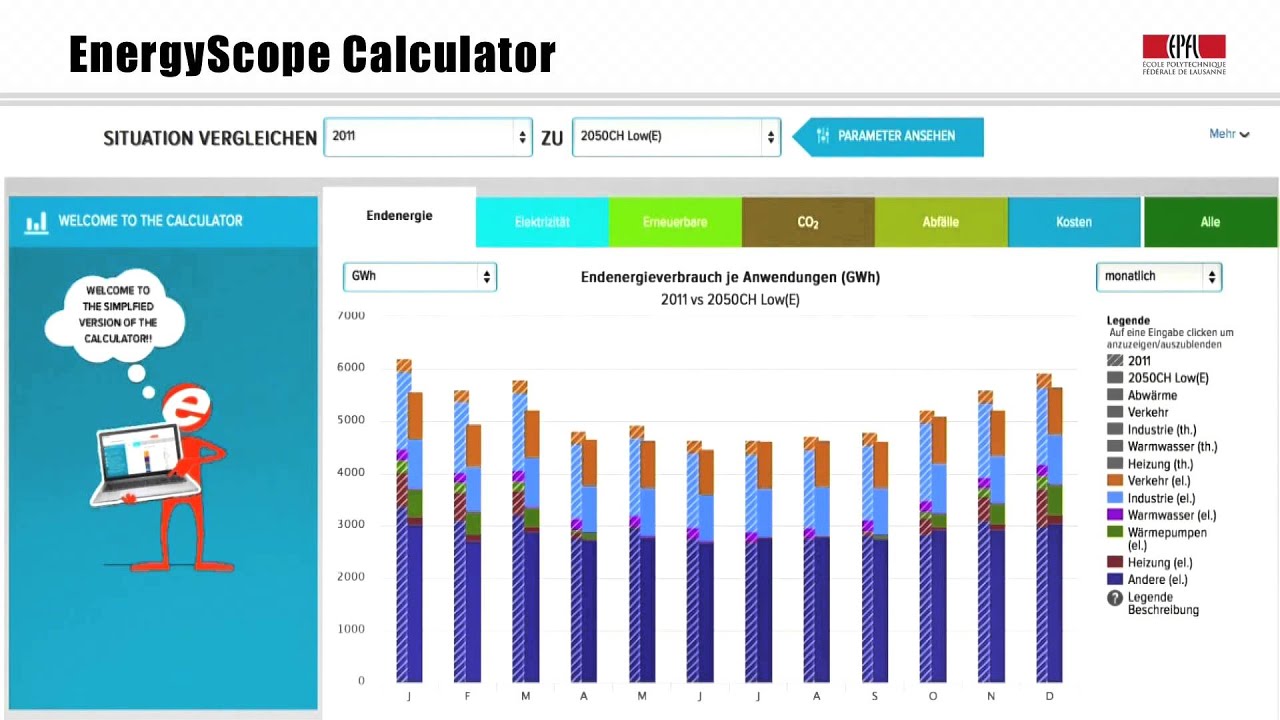
- Using EnergyScope to compare annual consumption 2011 vs 2050 NEP.
- Monthly consumption comparison and seasonal variations.
- Detailed breakdown of electricity consumption by sector.
- Reduction in fossil fuel heating and transport fuels.
- Waste heat reduction and overall consumption comparison.
- Exploring assumptions: population, GDP, and electricity mix.
- Renewable energy assumptions and interactive parameter adjustment.
Contribution & Novelties
The video provides an accessible introduction to Swiss energy scenarios and demonstrates the use of the EnergyScope calculator, which is a valuable tool for exploring energy futures. It highlights the key sectors for energy savings and the trade-offs between different policy paths.
Pour aller plus loin :
- Swiss Energy Strategy 2050 — Official Swiss government page on the Energy Strategy 2050.
- EnergyScope — The web-based tool used in the video for energy scenario modeling.
- Swiss Federal Office of Energy — Official source for Swiss energy data and policies.
88 words
Radar Profile
The radar profile shows balanced scores across information quantity, quality, technical level, and reliability, with slightly higher quality and reliability, indicating a solid educational resource.