Lektion 15: Erneuerbare Energien
Keywords
Summary
162 words
Critical Evaluation
Value of the Information & Strength of the Argument
The video offers valuable information on renewable energy sources, clearly explaining the underlying principles and their relevance to Switzerland. The argumentation is logical and well-structured, progressing from definitions to specific technologies and finally to a comparative analysis. It effectively uses examples and visual aids to enhance understanding. The scientific explanations are accurate, such as the solar constant and the cubic relationship between wind speed and energy. The video also addresses practical considerations like flexibility and environmental impact, providing a balanced view. However, it lacks depth in some areas, such as detailed technical specifications or economic analysis, but for an introductory lesson, it is comprehensive and informative.
Scientific Rigor, Source Quality, Title Accuracy
The video demonstrates scientific rigor by presenting accurate information and using appropriate terminology. It does not cite specific sources, but the content aligns with established knowledge in the field. The title accurately reflects the content, which is a lesson on renewable energies. The video is well-structured and educational, with clear explanations and visual aids. While it does not provide citations, the information is reliable and consistent with current understanding. The lack of explicit sources is a minor weakness, but the overall quality is high.
205 words
Title / Content Match
The title accurately reflects the content, which is a lesson on renewable energies.
Quality & Reliability
8/10
The video provides a clear and accurate overview of renewable energy sources, with correct scientific explanations (e.g., solar constant, wind power scaling, geothermal gradients). It is educational and well-structured, though it lacks citations and in-depth technical details.
Key Moments
Markers derived by PSI from the transcript: the creator did not define chapters.
- Introduction to the lesson on renewable energies.
- Definition of renewable vs. non-renewable based on regeneration time.
- Explanation of solar energy and the solar constant.
- Discussion on solar thermal and photovoltaic conversion.
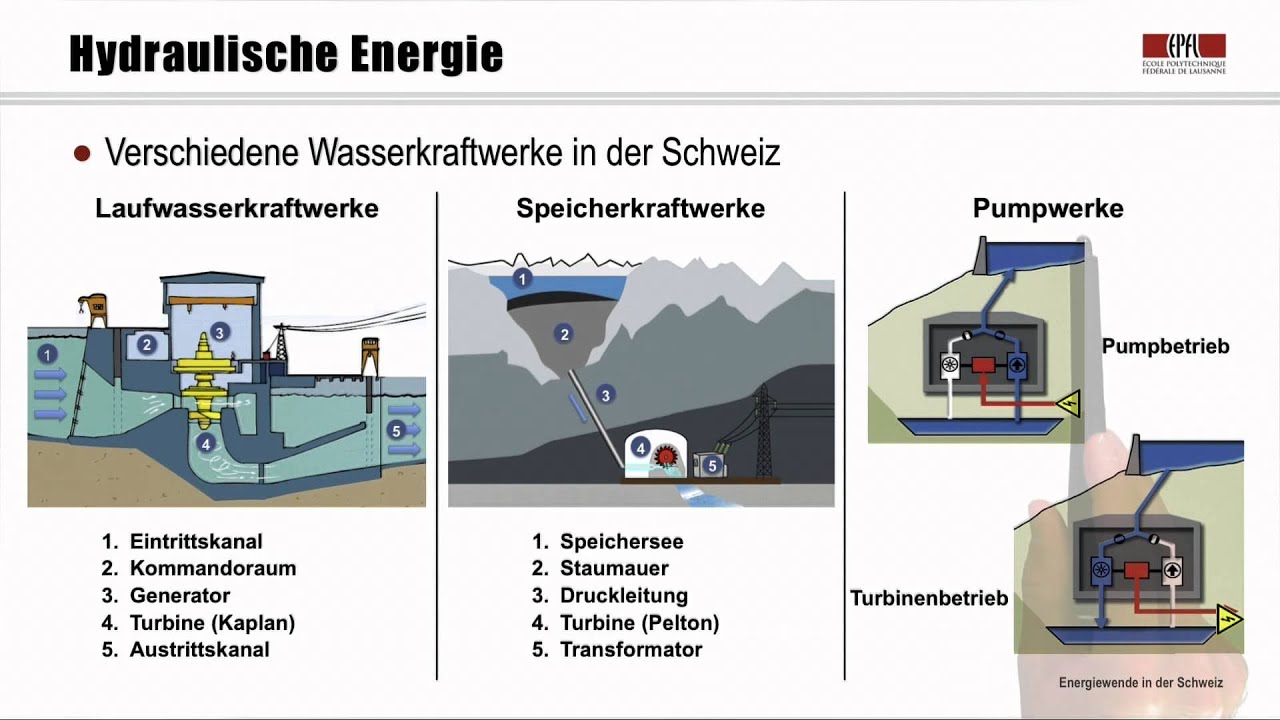
- Hydropower: water cycle and Swiss hydropower potential.
- Wind energy: origin, scaling, and Swiss wind map.
- Biomass energy: closed carbon cycle and biogas production.
- Geothermal energy: sources and applications.
- Comparative table of renewable energies in Switzerland.
Contribution & Novelties
The video provides a clear and concise introduction to renewable energy sources, specifically tailored to Switzerland. It effectively explains the concept of renewability based on time scales and offers a comparative analysis of different renewables. The video is valuable for educational purposes, providing a solid foundation for further study.
Pour aller plus loin :
- Renewable energy on Wikipedia — Provides a comprehensive overview of renewable energy sources and their global context.
- Solar constant on Wikipedia — Explains the solar constant and its significance in solar energy calculations.
- Pumped-storage hydroelectricity on Wikipedia — Details the technology used for energy storage in hydropower systems.
- Geothermal energy on Wikipedia — Offers an in-depth look at geothermal energy sources and applications.
117 words
Radar Profile
The radar profile shows high scores in quality and reliability, with moderate scores in quantity and technical level. This indicates a well-produced educational video that is accurate and reliable, but may not delve deeply into technical details or provide extensive information.