Lektion 14: Der Energieeinsatz in der Industrie
Keywords
Summary
168 words
Critical Evaluation
Value of the Information & Strength of the Argument
The video provides a comprehensive and systematic overview of industrial energy efficiency, covering both theoretical principles and practical applications. It effectively argues that energy savings can be achieved through a combination of process optimization, heat recovery, and integration of renewable energy. The argumentation is logical and well-structured, moving from problem identification to solution strategies. The use of real-world examples, such as the European chemical industry’s 60% production increase with a 50% reduction in energy intensity, strengthens the credibility of the claims. However, the video lacks depth in quantitative analysis and does not provide specific data or case studies beyond general trends.
Scientific Rigor, Source Quality, Title Accuracy
The scientific rigor is moderate: the lecturer is a professor at EPFL, lending authority, but no specific sources are cited within the video. The content aligns with established engineering knowledge and Swiss energy statistics, but the lack of references makes it difficult to verify specific claims. The title accurately reflects the content, which is a tutorial on industrial energy use. The video does not include any advertising or sponsored content.
186 words
Title / Content Match
The title accurately reflects the content, which focuses on energy use in industry and strategies for efficiency.
Quality & Reliability
8/10
The video is an educational lecture by a professor at EPFL, providing a structured overview of industrial energy use, efficiency measures, and technologies. It is based on established engineering principles and statistics, but lacks explicit citations or references to specific studies, which slightly reduces its verifiability.
Key Moments
Markers derived by PSI from the transcript: the creator did not define chapters.
- Introduction and overview of industrial energy consumption in Switzerland.
- Breakdown of energy use by sector and heat-to-electricity ratios.
- Discussion of energy reduction targets and challenges.
- Explanation of energy audits and material/energy flows.
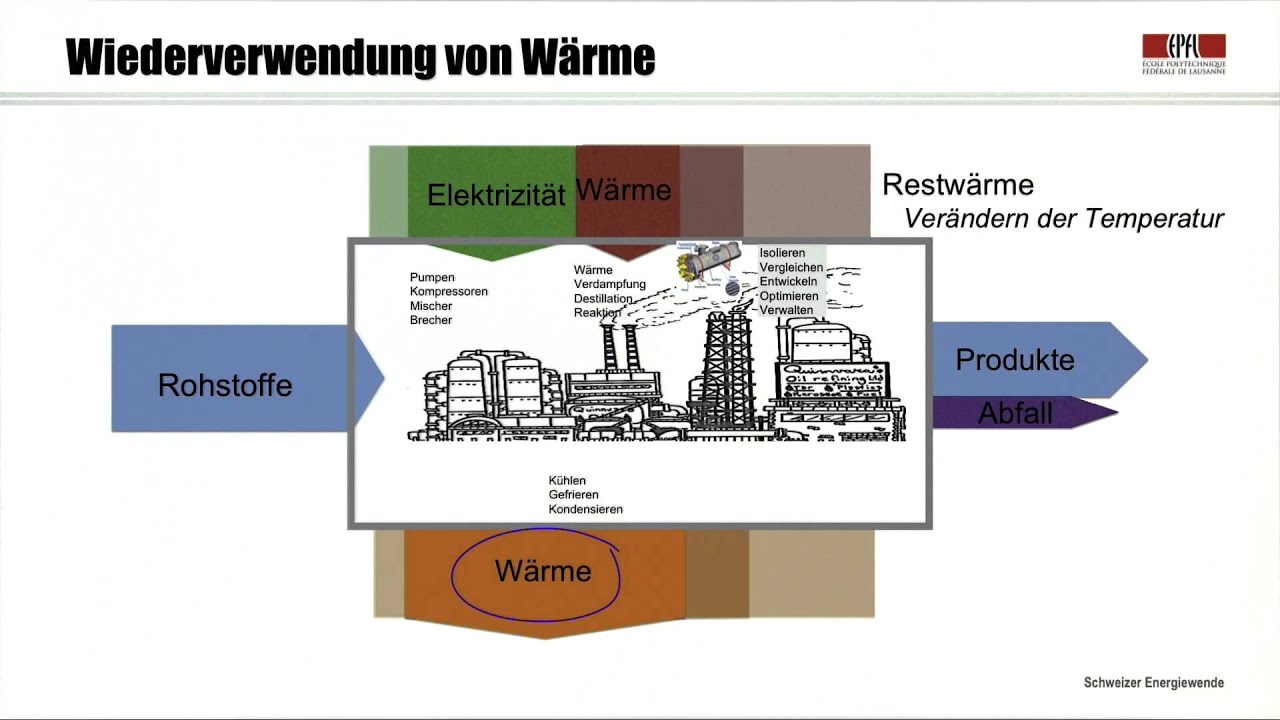
- Introduction to heat recovery using heat exchangers.
- Use of heat pumps to upgrade residual heat.
- Combined heat and power (CHP) and industrial ecology.
- Conclusion on balancing investments and energy savings.
Concurring Sources
- Swiss Federal Office of Energy - Energy consumption statistics — Provides official data on Switzerland's energy consumption, supporting the video's statistics.
Contribution & Novelties
The video offers a clear educational framework for understanding industrial energy efficiency, emphasizing a systematic approach from energy auditing to heat recovery and cogeneration. It introduces the concept of industrial ecology as a way to maximize resource efficiency. The content is not novel but serves as a good primer for students and professionals.
Pour aller plus loin :
- Pinch analysis — A methodology for heat integration in industrial processes.
- Heat pump — Technology used to upgrade waste heat to useful levels.
- Cogeneration — Combined production of heat and power.
- Industrial ecology — Framework for optimizing resource flows in industrial systems.
100 words
Radar Profile
The radar profile shows high scores in quality of information and reliability, with moderate scores in quantity and technical level. This indicates a well-structured and credible educational video, but with limited depth and breadth of content.