Leçon 9: Les scénarios et les coûts
Keywords
Summary
157 words
Critical Evaluation
Value of the Information & Strength of the Argument
The video provides valuable insights into the cost structure of Swiss energy scenarios, offering a transparent and systematic approach. It clearly explains the assumptions and parameters used, such as interest rates, fuel costs, and investment costs, which enhances the credibility of the analysis. The argumentation is solid, as it compares different scenarios and highlights the trade-offs between investment and operational costs. However, the video does not delve into the sensitivity of results to key parameters, and the presenter’s authority is not explicitly stated, though the institutional affiliation suggests expertise.
Scientific Rigor, Source Quality, Title Accuracy
The video demonstrates scientific rigor by clearly stating the methodology and assumptions, and by providing a wiki for detailed data. However, it does not cite external sources, relying instead on the calculator’s built-in data. The title accurately reflects the content, which is focused on scenarios and costs. The video is part of a series, and the presentation is clear and logical. The lack of explicit citations to peer-reviewed literature is a minor weakness, but the transparency of the model partially compensates.
185 words
Title / Content Match
The title accurately reflects the content, which focuses on scenarios and costs in the Swiss energy context.
Quality & Reliability
7/10
The video is an educational tutorial from an academic institution (EPFL) presenting a transparent cost model for Swiss energy scenarios. It clearly states assumptions and limitations, and provides a wiki for detailed data. However, it lacks explicit citations to peer-reviewed sources and the presenter's authority is not detailed.
Key Moments
Markers derived by PSI from the transcript: the creator did not define chapters.
- Introduction to the lesson and illustration of a kWh cost.
- Explanation of the cost indicator in the calculator.
- Assumptions for cost estimation: construction, annualized investment, maintenance, interest rates.
- Comparison of Swiss Federal Council scenarios for 2050, highlighting cost differences.
- Breakdown of costs for gas power plants: fuel, investment, maintenance.
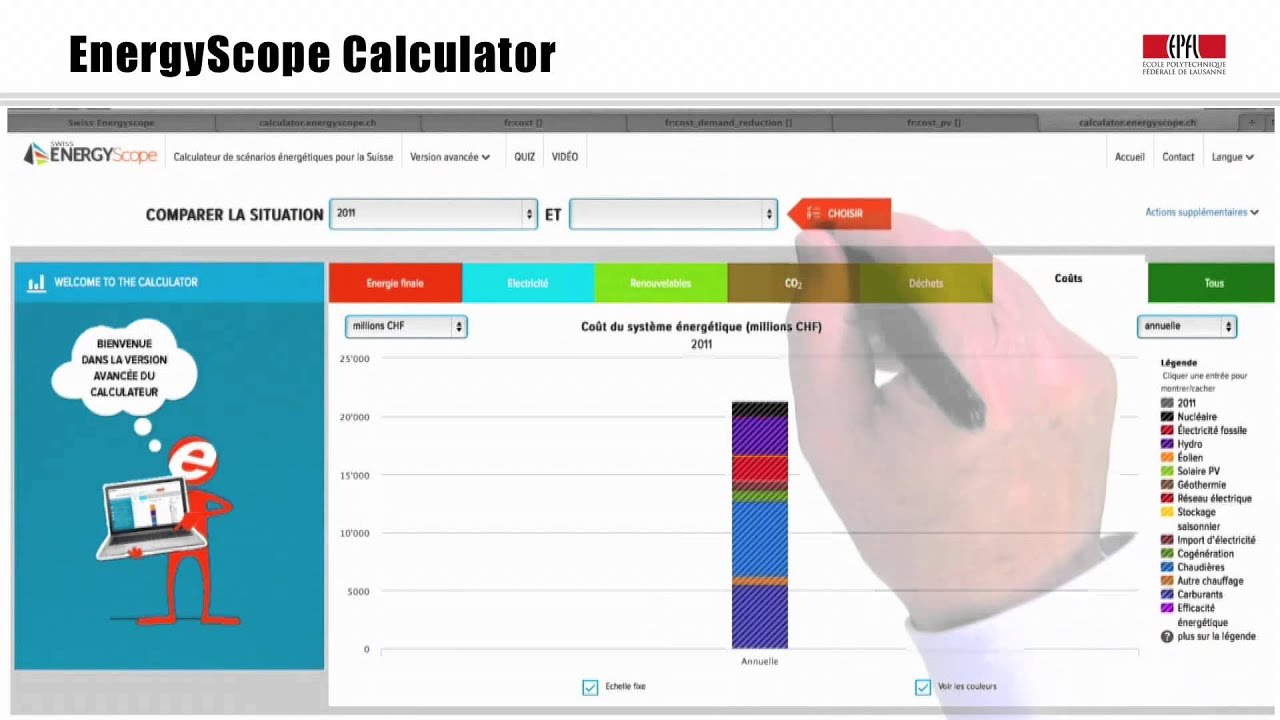
- Demonstration of the calculator: selecting language, year, and viewing cost indices.
- Analysis of fuel costs and energy efficiency investments.
- Examination of solar PV and wind costs, including assumptions and calculated costs per kWh.
Cited Sources
- Swiss-Energyscope Wiki — The video references the wiki for detailed cost data and assumptions.
Concurring Sources
- Swiss Federal Office of Energy - Energy Scenarios — The video discusses scenarios from the Swiss Federal Council, which are documented by the Swiss Federal Office of Energy.
Contribution & Novelties
The video provides a practical tutorial on using the Swiss-Energyscope calculator to estimate energy scenario costs, emphasizing transparency and assumptions. It offers a clear methodology for cost breakdown, which is valuable for educational purposes.
Pour aller plus loin :
- Swiss Energy Strategy 2050 — Official Swiss government page on the Energy Strategy 2050, providing context for the scenarios.
- Levelized cost of electricity — Wikipedia article explaining LCOE, a key concept in cost analysis.
- Swiss-Energyscope — The platform’s website, offering the calculator and wiki.
83 words
Radar Profile
The radar profile shows balanced scores across all dimensions, with slightly higher quality of information and reliability, indicating a well-structured and credible educational content, though with moderate technical depth.
💬 No comments were provided for analysis.