Leçon 20: Electricité et chaleur à partir de combustible/carburant
Keywords
Summary
130 words
Critical Evaluation
Value of the Information & Strength of the Argument
The video provides valuable information on energy conversion technologies, clearly explaining the principles and comparing different approaches. The argumentation is solid, grounded in thermodynamic laws and technical details. The presentation is logical, moving from basic concepts to specific technologies and their trade-offs. The comparison of combustion and fuel cell pathways is well-structured, and the discussion of efficiency limits and future prospects is insightful. The content is accurate and up-to-date, though it does not delve into recent developments or provide quantitative data beyond typical ranges.
Scientific Rigor, Source Quality, Title Accuracy
The scientific rigor is high, with accurate explanations of thermodynamic principles and technical details. However, the video does not cite specific sources, relying on general knowledge. The title accurately reflects the content, which is a tutorial on electricity and heat generation from fuels. The content is well-organized and presented in a clear, educational manner.
153 words
Title / Content Match
The title accurately reflects the content, which covers electricity and heat generation from fuels.
Quality & Reliability
8/10
The video provides a structured and technically accurate overview of energy conversion technologies, with clear explanations of thermodynamic principles and fuel cell operation. The content is consistent with established scientific knowledge, though it lacks citations to specific sources.
Key Moments
Markers derived by PSI from the transcript: the creator did not define chapters.
- Introduction to the lesson on converting fuels to electricity and heat.
- Definition of fuels and carburants, and overview of conversion pathways.
- Explanation of Carnot efficiency and temperature constraints.
- Discussion of combustion technologies and combined cycle power plants.
- Introduction to fuel cells and their operating principles.
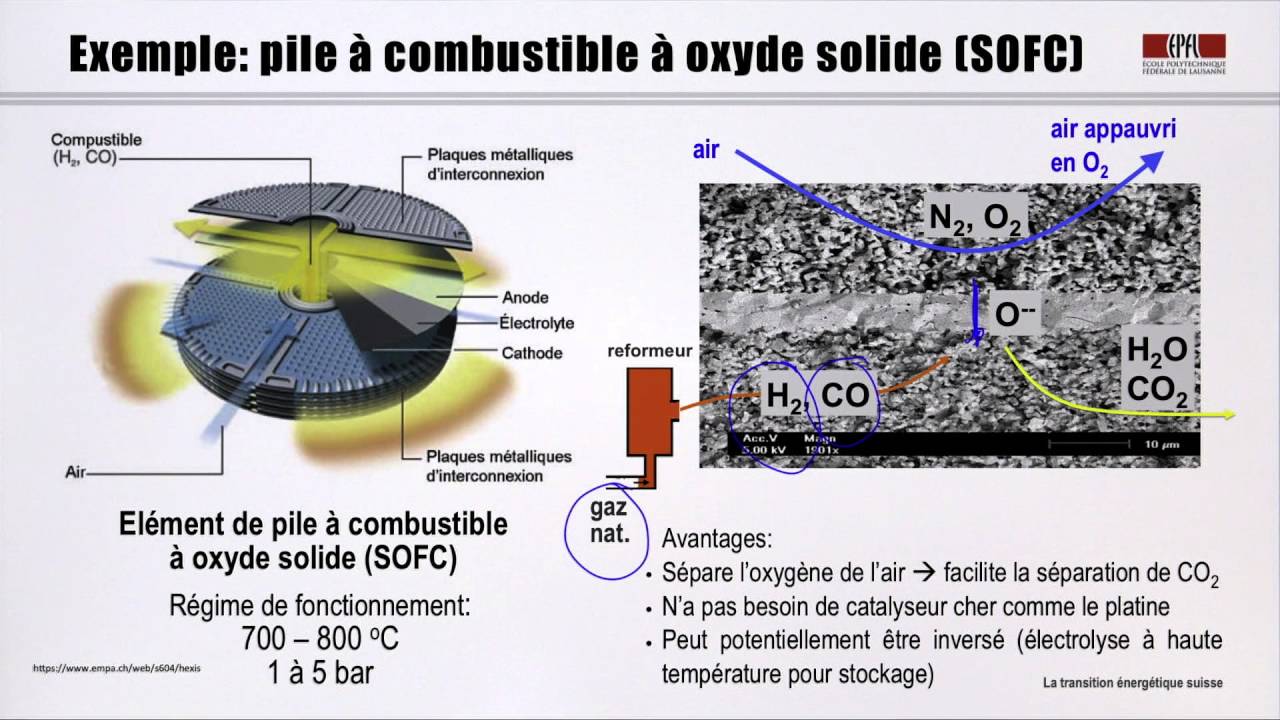
- Detailed look at SOFC fuel cells and their advantages.
- Comparison of electrical efficiencies of various technologies.
- Discussion of cogeneration and combined heat and power.
- Summary of combustion vs. fuel cell technologies.
- Conclusion and outlook on future developments.
Contribution & Novelties
The video provides a clear and structured overview of fuel-to-electricity conversion, emphasizing the trade-offs between combustion and fuel cell technologies. It highlights the potential of SOFCs for high efficiency and cogeneration, and discusses the future possibility of reversible operation for hydrogen production.
Pour aller plus loin :
- Carnot cycle — Fundamental thermodynamic cycle explaining efficiency limits.
- Solid oxide fuel cell — Detailed information on SOFC technology.
- Cogeneration — Overview of combined heat and power systems.
75 words
Radar Profile
The radar profile shows high scores in information quantity, quality, and reliability, with a slightly lower technical level. This indicates a well-balanced educational video that is both informative and accurate, suitable for a general audience interested in energy technologies.