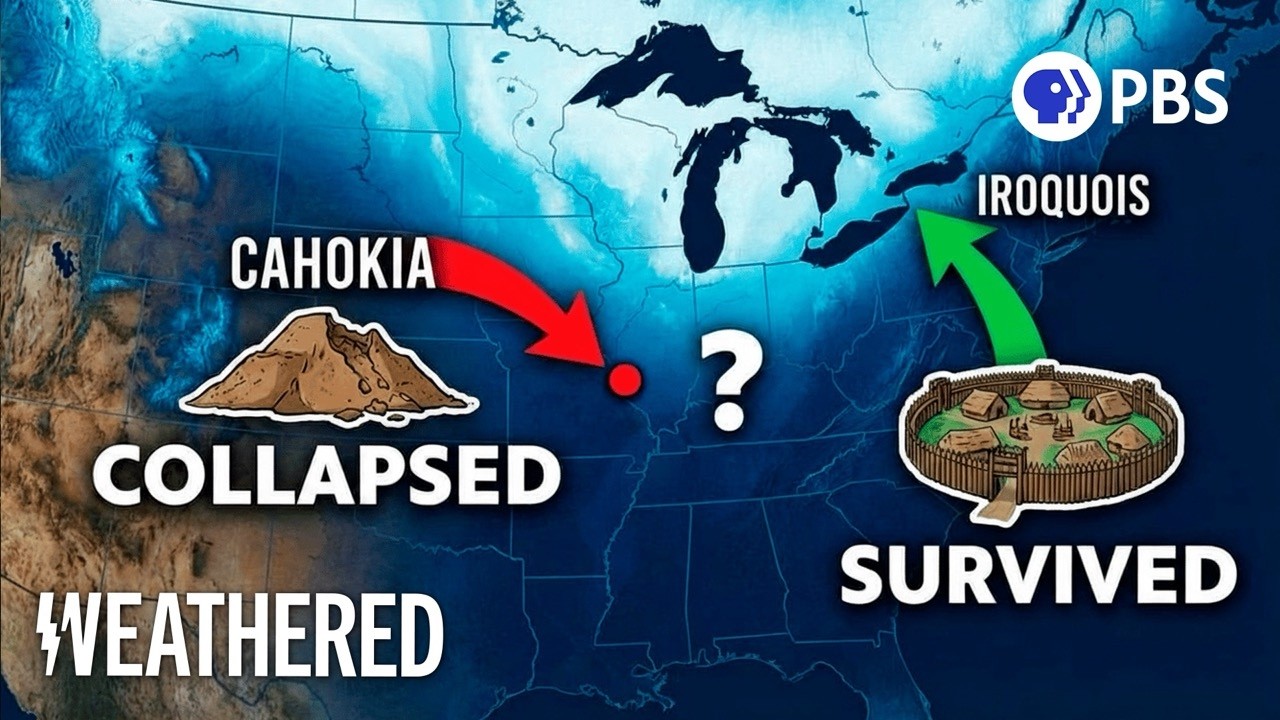
Climate Change Won't End the World. This Could.
Keywords
Summary
137 words
Critical Evaluation
Value of the Information & Strength of the Argument
The video provides valuable information by synthesizing historical patterns and expert opinions into a coherent framework for understanding societal resilience. It effectively argues that collapse is not predetermined but depends on societal organization, particularly inequality and democratic processes. The argumentation is solid, using historical examples and expert testimony to support claims, though some assertions lack direct citations within the video. The inclusion of specific data (e.g., wealth distribution) adds credibility, but the video could benefit from more explicit sourcing.
Scientific Rigor, Source Quality, Title Accuracy
The video maintains a high level of scientific rigor by featuring experts like Luke Kemp and Laurie Laybourn, and referencing historical events and climate models. However, the lack of on-screen citations for specific statistics weakens the overall sourcing. The title is somewhat sensationalized, as the video actually argues that climate change could end the world, but focuses on societal collapse as the more likely mechanism. This slight mismatch does not significantly detract from the content’s quality.
170 words
Title / Content Match
The title is somewhat misleading: the video argues that climate change could indeed end the world, but focuses on societal collapse as the more immediate threat. The title's contrast is attention-grabbing but not fully accurate.
Quality & Reliability
8/10
The video presents a well-structured argument supported by references to academic research (Luke Kemp) and expert opinion (Laurie Laybourn), with clear explanations of concepts like learning rates and historical examples. However, some claims (e.g., specific percentages of wealth distribution) are not sourced in the video itself, and the framing is somewhat advocacy-oriented.
Key Moments
Markers derived by PSI from the transcript: the creator did not define chapters.
- Introduction to the possibility of climate change ending the world, referencing the Permian-Triassic extinction.
- Laurie Laybourn introduces the 'storm' analogy and the need for new capabilities.
- Discussion on situational awareness and the inadequacy of current climate risk assessments.
- Emphasis on adaptation as a crucial complement to mitigation.
- Luke Kemp explains the role of inequality in societal collapse, citing historical examples.
- The importance of democracy and inclusive decision-making for resilience.
- Conclusion summarizing the five capabilities and a call to action.
Cited Sources
- PBS Terra Patreon — Support the show and access extended interviews.
- PBS Terra Merch — Purchase merchandise to support the show.
- Support PBS — Donate to PBS member stations.
Concurring Sources
- IPCC Sixth Assessment Report — Provides scientific consensus on climate impacts, supporting the video's claims about risks.
Dissenting Sources
- Climate change is not a 'civilizational collapse' risk — Some researchers argue that framing climate change as an existential threat may be overstated, potentially leading to fatalism rather than action.
Contribution & Novelties
The video offers a novel synthesis of historical collapse patterns and modern climate risk, presenting a practical framework of five capabilities for societal resilience. It challenges the binary narrative of climate targets and emphasizes the role of inequality and democracy in determining outcomes.
Pour aller plus loin :
- Collapse: How Societies Choose to Fail or Succeed — Jared Diamond’s seminal work on societal collapses, relevant to the historical analysis.
- Climate change adaptation — Overview of adaptation strategies, directly related to the video’s second capability.
- Learning curve (machine learning) — Explains the concept of learning rates, which the video uses to discuss solar energy scaling.
104 words
Radar Profile
The radar profile shows high scores in information quantity and quality, indicating a well-researched and informative video. The technical level is moderate, making it accessible to a general audience. The overall reliability is high, though the lack of on-screen citations slightly reduces the score.
💬 Sur les 30 commentaires analysés, l'orientation est très négative, avec une majorité exprimant un sentiment d'urgence et de frustration face à l'inaction politique et la concentration des richesses. Les commentaires reflètent un désespoir mêlé d'appels à l'action, certains saluant la franchise de la vidéo.