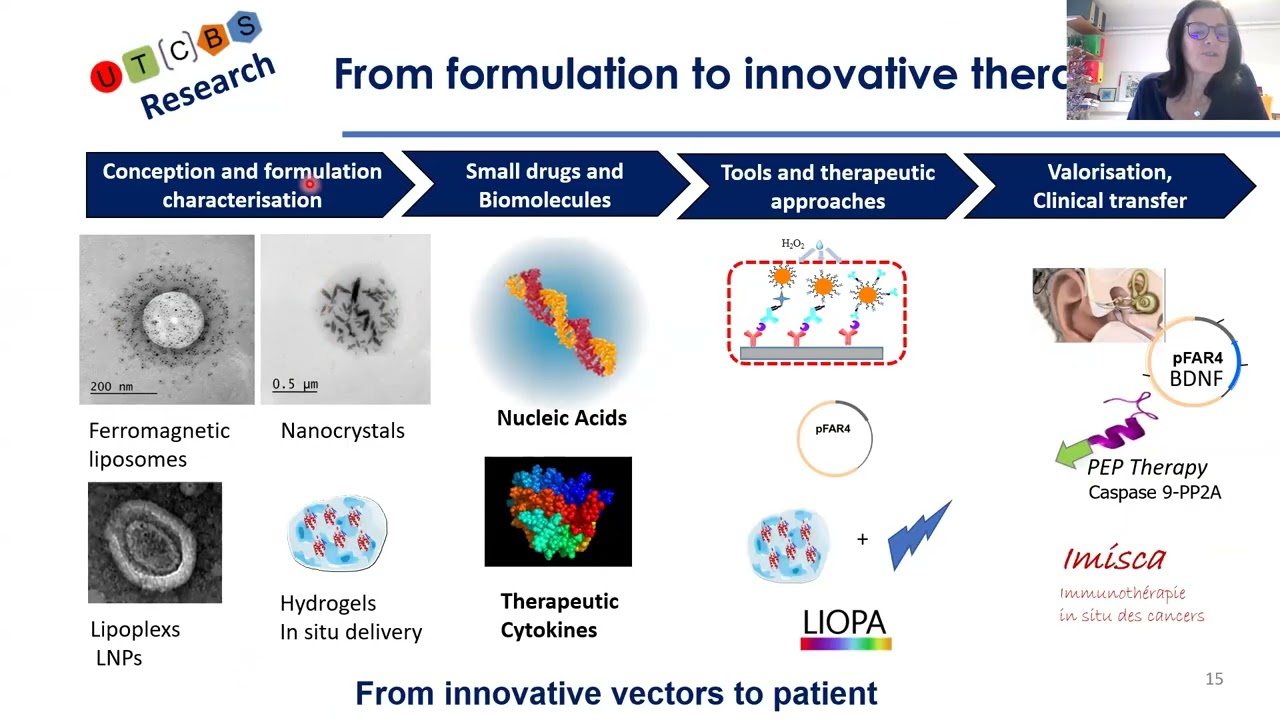
Nathalie Mignet - Nanomédicaments et nanoparticules lipidiques pour la délivrance d'acide nucléique
Keywords
Summary
177 words
Critical Evaluation
Value of the Information & Strength of the Argument
The talk provides valuable insights into the field of nanomedicine, particularly the design and application of lipid nanoparticles for nucleic acid delivery. The speaker effectively argues for the importance of ionizable lipids in achieving endosomal escape and presents compelling examples from her own research, such as the post-encapsulation method and the use of LNPs for immunotherapy. The argumentation is solid, supported by references to published studies and her laboratory’s data. However, some claims could benefit from more detailed evidence, and the presentation is more of an overview than a deep dive into specific mechanisms.
Scientific Rigor, Source Quality, Title Accuracy
The speaker demonstrates scientific rigor by referencing approved nanomedicines and recent publications. She mentions specific studies, such as those on the EPR effect and the use of LNPs for mRNA delivery, but does not always provide explicit citations. The title accurately reflects the content, and the talk is well-structured. The speaker’s expertise is evident, and she appropriately distinguishes between established knowledge and her own research findings.
175 words
Title / Content Match
The title accurately reflects the content, which focuses on nanomedicines and lipid nanoparticles for nucleic acid delivery.
Quality & Reliability
8/10
The speaker is a recognized expert in nanomedicine, with a strong academic and research background. The talk is well-structured, presenting both established knowledge and recent research from her laboratory. However, it is a conference presentation, not a peer-reviewed publication, and some claims lack specific citations.
Key Moments
Markers derived by PSI from the transcript: the creator did not define chapters.
- Introduction of Nathalie Mignet and her background.
- Definition of nanoparticles and their approved applications.
- Explanation of the EPR effect and its limitations.
- Discussion on nanocrystals and hydrogels for improved drug delivery.
- Transition to nucleic acid delivery and the need for vectors.
- Evolution from cationic to ionizable lipids for endosomal escape.
- Composition and production of modern LNPs via microfluidics.
- Post-encapsulation method for mRNA and its advantages.
- Applications in immunotherapy, including IL-12 mRNA delivery.
- Ongoing work on mucosal delivery and future perspectives.
Cited Sources
- FDA-approved nanomedicines — Mentioned as a general context for approved nanoparticles.
- Study on EPR effect — Referenced when discussing tumor accumulation.
- Publication on post-encapsulation of mRNA — Her lab's recent work on post-encapsulation.
- Science Hematology study on IL-12 mRNA — Referenced for immunotherapy applications.
Concurring Sources
- Nature Reviews Materials review on LNPs — Supports the general principles of LNP design and applications.
- Article on ionizable lipids — Confirms the role of ionizable lipids in endosomal escape.
Dissenting Sources
- Study questioning EPR effect — Some studies have questioned the universality of the EPR effect, suggesting it may not apply to all tumor types.
Contribution & Novelties
The talk provides an expert overview of lipid nanoparticles for nucleic acid delivery, with a focus on recent developments and the speaker’s own research contributions. It highlights the importance of ionizable lipids and microfluidic production methods. The post-encapsulation approach is a novel contribution from her lab.
Pour aller plus loin :
- Lipid nanoparticles for mRNA delivery — Comprehensive review on LNP technology.
- Ionizable lipids — Overview of ionizable lipids and their role in endosomal escape.
- Microfluidic production of LNPs — Study on microfluidic mixing for LNP synthesis.
87 words
Radar Profile
The radar profile shows high scores in information quantity, quality, and reliability, with a slightly lower technical level, indicating a comprehensive and trustworthy presentation that is accessible to a broad audience.
💬 Sur les 0 commentaires analysés, aucune tendance n'a pu être dégagée.